

Open the claim
Report the crash, obtain the claim number, identify the adjuster, and confirm whether the insurer is investigating liability, coverage, or both.
Florida vehicle damage guide
After a Florida crash, the vehicle claim can move on a different track from the injury claim. Document the damage, control towing and storage costs, review repair estimates, and examine any total-loss valuation before accepting payment or signing a release.
Updated September 17, 2026
A vehicle-damage claim may be handled through the at-fault driver's property damage liability coverage, or through your own collision coverage if you purchased it. Keep photos, estimates, valuation documents, rental and towing receipts, vehicle records, and insurer communications. If the car is declared a total loss, check the comparable vehicles and every adjustment used to calculate actual cash value.
Document the vehicle before repairs, salvage transfer, or disposal. Preserve the post-crash condition and enough pre-crash information to evaluate repair cost, total-loss value, and any later diminished-value dispute.
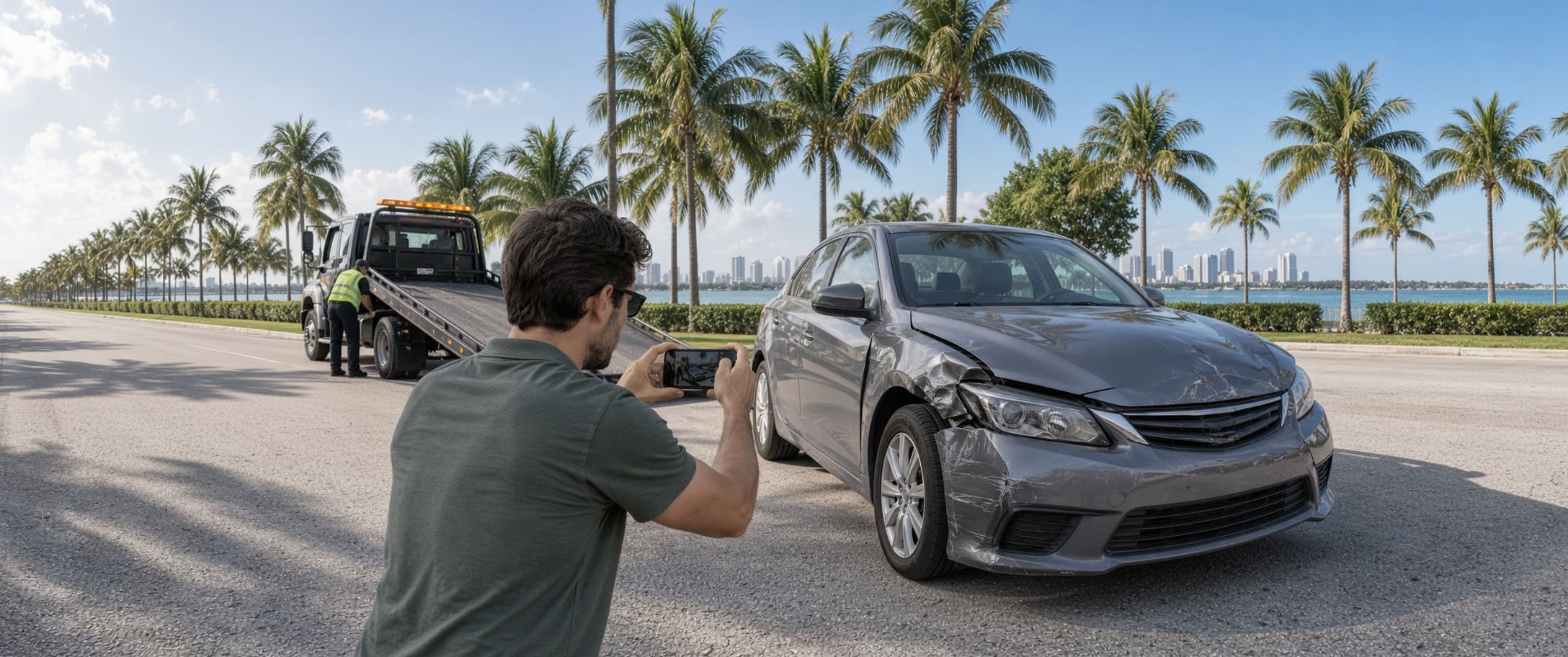
Photograph all four sides of the vehicle, wheel positions, airbags, dashboard warnings, glass, interior damage, cargo damage, and the odometer. If the vehicle may be moved to salvage, make sure the images are complete before possession changes. For a broader evidence checklist, see the Florida car accident photo evidence guide.
The path depends on whose policy is paying. A third-party claim is made against the other driver's property damage liability coverage. A first-party claim is made under your own collision coverage, if you purchased it, and usually remains subject to your deductible and policy terms.
Report the crash, obtain the claim number, identify the adjuster, and confirm whether the insurer is investigating liability, coverage, or both.
Document the vehicle before repair or salvage transfer. Confirm where the car is stored and when an insurer or repair facility will inspect it.
Review labor operations, parts, paint, calibration, structural work, and whether the repair shop expects a supplement after disassembly.
If repair is feasible, track supplements and completion. If the car is totaled, request the valuation report and check every comparable and adjustment.
Florida generally requires at least $10,000 in property damage liability coverage. A severe crash can involve repair costs, a total-loss payment, towing, storage, and loss-of-use expenses that exceed that limit. Your own collision coverage may provide another route for vehicle damage if it applies to the loss. For the broader coverage issue, see policy limits after a Florida car accident.
If your own collision insurer pays when another driver is at fault, the insurer may later pursue the at-fault party or that party's insurer through subrogation. That recovery can include your deductible, but reimbursement of the deductible should not be treated as guaranteed; it depends on what is actually recovered and the circumstances of the claim.
An insurance estimate is often a starting point, not the final repair bill. Hidden damage can appear after teardown, and a repair shop may submit a supplement for additional labor, parts, calibration, structural work, or other crash-related repairs.
Florida Department of Financial Services guidance states that you have the right to select the repair shop after an accident. An insurer may offer preferred shops or explain network benefits, but you should still confirm inspection requirements, repair authorization, rental consequences, and any policy terms before work begins.
Florida's Motor Vehicle Repair Act generally requires a written estimate for customer-authorized repair work expected to exceed $150 unless the customer waives that right. The estimate should identify the vehicle, describe the work, state the estimated cost, and include required disclosures.
Compare body labor, mechanical labor, paint materials, replacement parts, scanning, calibration, alignment, structural measurements, and sublet work. Ask the shop which items cannot be confirmed until the vehicle is disassembled.
Collision damage behind a bumper, quarter panel, wheel assembly, suspension component, or structural section may not be visible during the first inspection. What matters is whether the added work is crash-related, documented, and reasonably necessary.
Florida law restricts repair shops from charging for unauthorized repairs beyond specified statutory tolerances. Keep the original estimate, every authorization, supplement, parts notice, completion notice, and final invoice in the claim file.
Florida law provides that when an insurer elects to repair a vehicle and specifically requires a particular repair shop, the insurer must cause the vehicle to be restored to its pre-loss physical condition as to performance and appearance, subject to the policy. Ask in writing whether a shop is required or merely recommended.
When a first-party auto policy settles a total loss on actual cash value, Florida law sets out methods an insurer may use to determine a comparable vehicle value. The number should be supported by market information and documented adjustments, not presented as an unexplained lump sum.
Florida law allows a cash settlement based on the cost of comparable vehicles in the local market, certain recognized used-vehicle valuation sources, or dealer quotations. The exact method used should be identifiable from the valuation materials.
Check make, model year, body type, trim, drivetrain, mileage, options, condition, and other features that materially affect value. A lower trim or materially different mileage can distort the comparison.
If the insurer reduces value for condition, prior damage, betterment, depreciation, or another factor, ask for the dollar amount and basis for each adjustment. Florida's motor-vehicle claim statute requires itemized support for certain deductions.
Florida's settlement statute addresses sales tax when it will necessarily be incurred to repair or replace the vehicle and allows payment to be deferred until the obligation is actually incurred. Review the valuation and policy rather than assuming every total-loss check is calculated the same way.
The amount owed to a lender can be higher or lower than the vehicle's market value. A total-loss settlement typically addresses the vehicle value under the applicable coverage, while any remaining loan balance depends on the finance agreement and whether separate GAP coverage applies.
Florida's salvage-title statute uses percentage thresholds in specific situations, but that does not create a universal rule that every insured vehicle must automatically be declared a total loss the moment an estimate reaches 80% of value.
For first-party total-loss settlements, Florida Statutes section 626.9743 focuses on actual cash value, comparable vehicles, documented valuation methods, and itemized deductions. The insurer's total-loss decision also involves the policy, repair economics, and the vehicle's condition.
Florida Statutes section 319.30 separately defines total loss and governs salvage or destruction title consequences. It includes an 80% test for certain uninsured vehicles and additional rules for insured vehicles, repair agreements, and severely damaged late-model vehicles.
If an adjuster says the car is or is not a total loss, ask for the valuation report, the repair estimate, the applicable policy language, and the explanation for the decision. Do not rely on an isolated percentage without knowing which rule is being applied.
Rental-car payment depends on the coverage being used and the facts of the claim. Your own rental reimbursement coverage is optional and usually has a daily or total limit. A third-party property damage claim can also involve reasonable loss-of-use damages when the other driver is legally responsible.
Rental reimbursement is separate optional coverage. Check the daily limit, maximum number of days or total dollar cap, approved rental class, and whether the insurer pays the rental company directly or reimburses you after you submit receipts.
Property damage liability coverage can include loss of use when liability is established, but payment may be affected by liability investigation, available policy limits, the repair period, and whether the vehicle is repairable or a total loss.
Keep shop updates showing parts delays, supplement approval dates, and revised completion dates. If the insurer says rental authorization will end, request the cutoff date and reason in writing before continuing to incur charges.
Rental authorization may end soon after the total-loss settlement reaches a stage where replacement is reasonably possible. Ask the adjuster for the exact end date rather than assuming rental continues until you buy another vehicle.
A damaged vehicle left in a tow yard can generate daily storage charges while liability or total-loss issues are still being investigated. Florida law gives towing and storage operators lien rights in specified circumstances, so notices about storage, release, or sale should not be ignored.
Get the tow company's name, physical address, phone number, tow date, daily storage rate, administrative charges, and the documents required for release or insurer inspection.
Ask the insurer whether towing and storage are authorized, the amount approved, and whether the vehicle should be moved to a repair facility, salvage yard, or other location after inspection.
If the car may be moved or released to salvage, finish your photographs and retrieve personal property. For a serious crash, consider whether additional inspection or evidence preservation is needed before the vehicle leaves your control.
Florida's motor-vehicle claim statute requires an insurer to give notice before terminating payment of previously authorized storage charges and provides a 72-hour period for the insured to remove the vehicle before payment ends.
Diminished value is the claimed market-value loss that remains after a damaged vehicle has been repaired. In Florida, a third-party property damage claim against an at-fault party may include proven diminished value. A first-party collision claim against your own insurer is different: a properly repaired vehicle does not automatically create a separate payment for inherent diminished value, and the policy language and controlling case law matter.
Florida Department of Financial Services guidance notes that Florida courts have recognized diminished value as a potential loss in a third-party property damage claim. The claimant must prove that the vehicle remained worth less after repair because of the crash.
The same DFS guidance distinguishes first-party physical damage coverage. A properly repaired vehicle does not automatically create a separate diminished-value payment from your own insurer; the policy language and Florida case law matter.
A percentage or online calculator does not prove diminished value by itself. The useful question is whether credible market evidence shows a measurable post-repair loss in value and whether the applicable claim permits recovery of that loss.
The damaged car and the injured person create different categories of loss. They may involve different adjusters, coverages, documents, valuation methods, and settlement timing. Keeping them separate reduces the risk of overlooking an injury issue while trying to get the vehicle repaired or replaced quickly.
Property damage and bodily injury can be adjusted on different tracks, but Florida courts generally treat personal injury and property damage caused by the same tort as one cause of action against the same tortfeasor. If litigation is contemplated, do not assume the claims can be split into separate lawsuits; exceptions can depend on the parties, subrogation rights, consent, and procedural history.
A property-damage payment does not necessarily resolve a bodily injury claim, but release language can be broader than the check or email that came with it. Before signing any release, settlement, waiver, or full and final settlement, confirm exactly which claims and parties it covers. See Florida car accident settlement release for a detailed checklist.
A useful dispute identifies specific errors. Instead of saying only that the offer is too low, show where the estimate, comparable vehicles, mileage, equipment, condition rating, or repair scope fails to match the actual vehicle and loss.
Ask for the insurer's written estimate, valuation report, comparable vehicles, condition adjustments, deductions, and any written explanation available under Florida's motor-vehicle claim settlement rules.
Start with VIN-decoded trim, mileage, drivetrain, factory options, wheel package, condition, prior damage, and major equipment. A valuation cannot be reliable if the vehicle configuration is wrong.
If the dispute concerns repair scope rather than value, ask the shop to document hidden damage, measurements, scans, calibration requirements, photographs, and the reason each supplement item is related to the crash.
If the adjuster will not address supported errors, request a supervisor review and keep the communication in writing. Florida Department of Financial Services offers voluntary automobile mediation for property-damage claim disputes in any amount, including eligible first-party and third-party disputes, before litigation. See the Florida automobile mediation program.
Many vehicle-damage claims can be handled directly with the insurer and repair facility. Legal review becomes more useful when the property dispute overlaps with a serious injury claim, contested liability, limited insurance, a broad release, or evidence that could disappear with the vehicle.
Vehicle repair or total-loss issues should not distract from medical documentation, injury coverage, liability evidence, and settlement decisions that may carry much larger consequences.
If the other insurer denies liability or assigns fault to you, photographs, vehicle damage patterns, witness information, video, and the crash report may become important beyond the vehicle claim.
A serious vehicle loss can exceed the available property damage liability limit once repair or total-loss value, towing, storage, and loss-of-use expenses are combined. The coverage picture should be reviewed before assuming one insurer will pay every property-related expense.
In a serious crash, the vehicle can contain physical evidence relevant to impact forces, seat belts, airbags, component failure, or other disputed facts. Consider preservation before salvage or destruction.
For a broader review of liability, insurance, injuries, and settlement issues, visit the Florida car accident lawyer page. You can also use the Florida car accident claim checker to identify common claim problems.
If another driver is legally responsible, a property damage claim may be made against that driver's liability coverage. If you carry collision coverage, you may also be able to use your own policy, usually subject to the deductible and policy terms. Which route is more practical can depend on fault, coverage limits, repair timing, and whether the other insurer has accepted liability.
For first-party total-loss settlements based on actual cash value, Florida law permits specified valuation methods involving comparable vehicles, recognized used-vehicle valuation sources, dealer quotations, or another documented method agreed to or supported under the statute. Review the comparable vehicles and every adjustment rather than focusing only on the final number.
Your own rental reimbursement coverage is optional and subject to policy limits. A third-party property damage claim may also include reasonable loss-of-use expenses when another driver is liable. Confirm the approved rental period, daily limit, vehicle class, and end date in writing.
Find out where the vehicle is located, the daily storage rate, who authorized payment, and whether the insurer wants the vehicle moved after inspection. Keep every tow and storage notice. If an insurer previously authorized storage for an insured and plans to terminate that payment, Florida Statutes section 626.9743 requires notice that gives the insured 72 hours to remove the vehicle before payment ends. Do not assume that rule applies identically to every third-party claimant.
Potentially. A third-party claim may include proven diminished value. A first-party collision claim against your own insurer is different and does not automatically include inherent diminished value after a complete repair.
A total-loss payment based on vehicle value does not automatically equal the loan payoff. If the settlement is lower than the balance owed, review the finance agreement and any GAP coverage to determine whether some or all of the remaining balance may be addressed separately.
Property damage and bodily injury are often adjusted separately, and the vehicle issue may sometimes be resolved while medical treatment is still ongoing. Read the release carefully so a property settlement does not unintentionally release injury claims. Separate insurance handling also does not automatically mean separate lawsuits are permitted for damages arising from the same tort.
Free consultation
If the vehicle dispute overlaps with injuries, contested fault, limited coverage, or a settlement release, our team can review the claim and explain the next steps.
No fee unless we win. Available 24/7 for new clients in Orlando, Fort Myers, and across Florida.
(407) 203-2769