

Florida car accident insurance guide
Policy limits after a Florida car accident: what they mean for a claim
Policy limits usually cap what a specific insurance coverage can pay on a covered Florida crash claim. They do not set the full value of the case, and serious injuries may require review of liability, UM/UIM, commercial, and umbrella coverage.

Quick answer
A Florida car accident policy limit is the maximum amount a specific coverage generally makes available for a covered claim, subject to the policy and applicable law. If proven damages exceed one liability limit, the next step is not simply to accept that number. Check for other liability policies, vehicle owners, employers or commercial coverage, excess or umbrella insurance, and applicable UM/UIM coverage before evaluating a policy-limits settlement.
What policy limits mean in a Florida car accident claim
Policy limits answer a coverage question: how much a particular insurance contract may pay. They do not, by themselves, determine fault, injury severity, or the total value of the damages caused by the collision.
The limit belongs to a specific coverage
A declarations page may show separate limits, deductibles, or other coverage terms for bodily injury liability, property damage liability, PIP, UM/UIM, MedPay, collision, and related protections. A $100,000 bodily injury limit does not mean every part of the policy carries the same amount.
The limit is not the same as the claim's value
A crash can cause damages that are lower than, equal to, or far above the available insurance. Medical evidence, lost income, future care, permanent limitations, fault, comparative fault, and legally recoverable damages still have to be evaluated independently.
The stated limit may not equal the amount still available
Coverage defenses, exclusions, prior payments, multiple injured claimants, and disputes about who qualifies as an insured can affect what remains available. This is why a policy-limit number should be checked against the actual policy and claim record.
More than one policy can apply to one crash
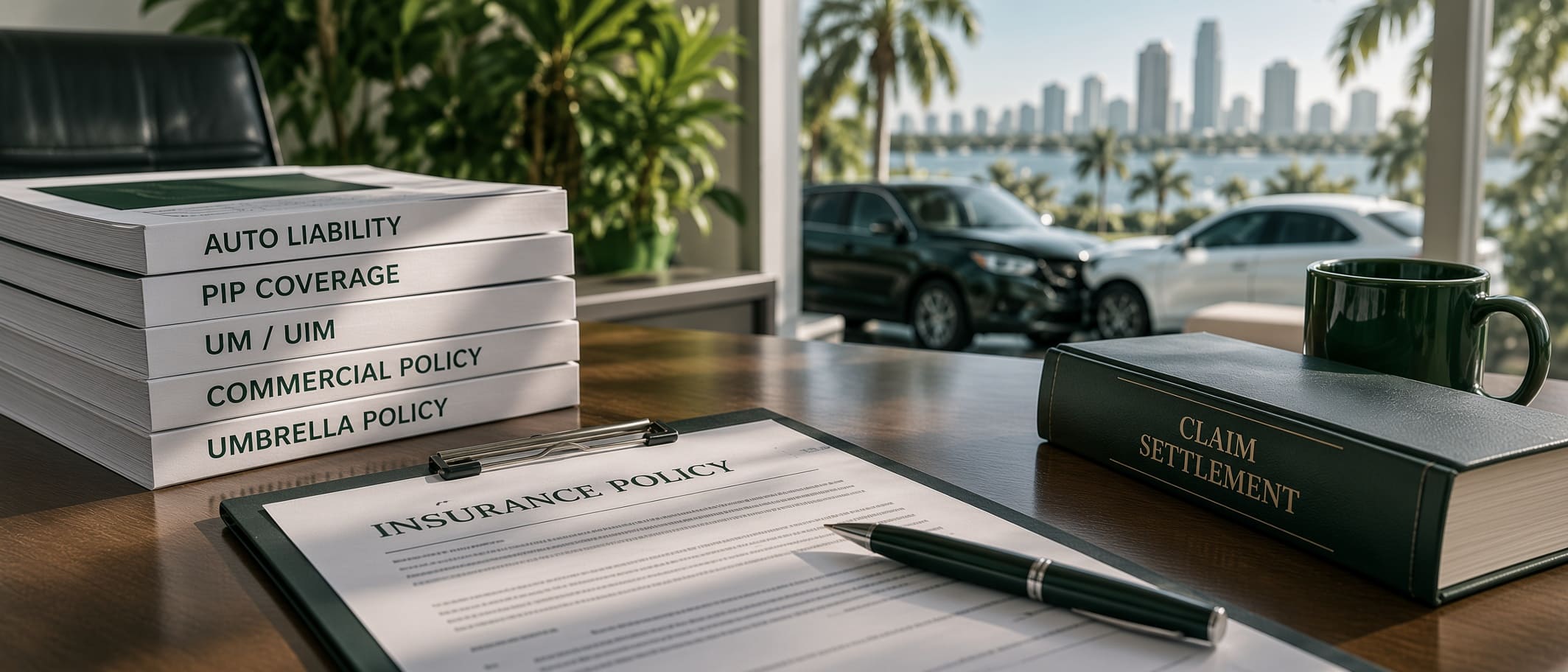
A serious collision may involve the at-fault driver's BI policy, a vehicle owner's policy, an employer or commercial policy, excess or umbrella insurance, and UM/UIM coverage available to the injured person. Each layer must be analyzed separately.
Important distinction
Florida's basic registration requirement for most private passenger vehicles is generally at least $10,000 in PIP and $10,000 in Property Damage Liability. Bodily Injury Liability is not part of the ordinary minimum registration requirement for every private-passenger driver, although financial-responsibility rules can require BI in specific circumstances. Do not assume the other driver has BI coverage just because the vehicle was insured.
Which insurance limits can matter after a Florida crash
Different coverages have separate limits. Identify which policy applies to the loss before treating any one number as the available insurance.
Liability and first-party coverage
- Bodily Injury Liability (BI): may pay damages for injuries caused by an insured who is legally responsible.
- Personal Injury Protection (PIP): Florida no-fault benefits with statutory limits and eligibility rules.
- Property Damage Liability (PDL): addresses damage an insured causes to other people's property.
Additional coverage layers
- UM/UIM: can apply when the responsible driver has no BI coverage or insufficient limits.
- Commercial coverage: may apply when a company vehicle, truck, delivery vehicle, or other commercial risk is involved.
- Umbrella or excess coverage: may add liability limits above an underlying policy when its terms are satisfied.
For a broader coverage overview
For a coverage-by-coverage explanation of BI, PIP, PDL, and UM/UIM, see the Florida car accident insurance guide.
Per-person, per-accident, and combined single limits
The format of the limit matters. A policy can use split limits or a combined single limit, and multiple injured people can make the per-accident cap more important than the per-person number.
| Limit format | What it means | Why it matters to the claim |
|---|---|---|
| $100,000 / $300,000 BI | Up to $100,000 for bodily injury to one person, subject to a $300,000 bodily injury cap for the accident. | One severely injured claimant may face the $100,000 per-person ceiling even when the per-accident total is higher. |
| $300,000 per accident | The total BI amount available for all covered injury claims arising from the same crash. | Several injured people may be competing for the same aggregate limit. |
| Combined single limit (CSL) | One liability limit may apply across bodily injury and property damage rather than separate split limits. | A serious property-loss component can matter because it may draw from the same pool, depending on the policy. |
| Umbrella or excess layer | Additional liability insurance may sit above an underlying auto or commercial policy. | The excess layer usually does not respond until its attachment requirements and policy terms are satisfied. |
Multiple claimants change the analysis
If several people are injured in the same crash, a per-accident limit may have to be divided among competing claims. Florida law also contains procedures addressing competing third-party claims that, in the aggregate, may exceed available policy limits.
How to find the available policy limits
A reliable limits review uses more than an adjuster's informal statement. Confirm the insurer, insureds, liability limits, policy defenses, and the actual policy documents, then check whether another policy or excess layer exists.
Florida's liability insurance disclosure statute
Florida Statutes §627.4137 gives a claimant a direct way to request liability insurance information in writing. The insurer must provide the required disclosure within 30 days.
- The name of the insurer and each insured
- The liability limits available under the policy
- Policy or coverage defenses the insurer reasonably believes may apply
- A copy of the policy and disclosure of known excess or umbrella insurance
Do not stop at one declarations page
If a crash involves a company vehicle, a vehicle owned by someone other than the driver, a rideshare or delivery platform, a rental vehicle, or more than one responsible driver, the first policy you identify may not be the only liability coverage that matters.
What happens when damages exceed the at-fault driver's liability limits
A low BI limit does not reduce the injuries or automatically erase damages above the limit. It does, however, change the recovery analysis because the insurer's contractual obligation is ordinarily tied to the available policy and its terms.
Check other insureds and responsible parties
The vehicle owner, employer, business, another negligent driver, or another legally responsible entity may have separate coverage. Liability must be supported by the facts; a larger policy alone does not create responsibility.
Look for commercial or umbrella coverage
A company vehicle can carry commercial limits that differ from an ordinary personal auto policy. An excess or umbrella policy may provide another layer after the underlying liability coverage is exhausted or otherwise meets the excess policy's conditions.
Review UM/UIM coverage
Underinsured motorist coverage can become important when the responsible driver's BI limits are lower than the injured person's proven damages. The declarations page, UM forms, stacking status, insured status, and policy terms all matter.
Evaluate personal assets realistically
A judgment can exceed insurance limits, but collecting from an individual is a separate legal and practical question. Asset analysis should be case-specific and should not replace a complete search for available insurance.
What a low limit does not mean
It does not automatically make the insurer liable above the policy limits. Claims for extra-contractual or bad-faith damages involve separate legal standards. Under Florida §624.155, liability-claim bad-faith exposure is affected by the statute's 90-day tender framework and by separate rules for competing third-party claims, so bad faith should not be treated as an automatic extension of coverage.
PIP and UM/UIM limits are separate from the at-fault driver's BI limit
Florida claims often involve first-party coverage in addition to the liability claim. PIP and UM/UIM are separate coverages with their own limits, conditions, exclusions, and claim procedures.
PIP
Florida PIP policies subject to §627.736 provide up to $10,000 in combined medical and disability benefits, plus a $5,000 death benefit, subject to statutory rules. Medical benefits generally reimburse 80% of covered expenses, disability benefits generally reimburse 60% of covered loss, and qualifying initial care must be received within 14 days. If there is no determination of an emergency medical condition, medical benefits are generally limited to $2,500.
UM/UIM
When a Florida motor vehicle liability policy provides BI coverage, §627.727 generally requires UM coverage unless the named insured validly rejects it or selects lower limits in writing. UIM can apply when the at-fault driver's BI coverage is lower than the injured person's legally recoverable damages. The signed UM form, endorsements, insured status, vehicle information, and policy terms can affect the amount actually available.
Notice before finalizing an underinsured-driver settlement
If a proposed settlement with the liability insurer and insured will not fully satisfy the injury or wrongful-death claim and would create a UIM claim, §627.727(6) requires notice of the proposed settlement to applicable UIM insurers by certified or registered mail. The statute then gives the UIM insurer 30 days after receipt to authorize the settlement or preserve subrogation rights as provided by law.
Practical point before signing a release
A policy-limits offer from the at-fault insurer can be important, but it should not be accepted in isolation when UM/UIM coverage may exist. Review the release language and the applicable statutory or policy notice requirements first. For more detail, see the Florida UM/UIM coverage guide.
Commercial vehicle and umbrella limits can change the available insurance
Commercial crashes require a separate coverage review because Florida and federal financial-responsibility rules can produce limits very different from an ordinary personal auto policy. In 2026, Florida §627.7415 applies to specified commercial motor vehicles and qualified motor vehicles.
| Vehicle or coverage | Example limit framework | Claim issue |
|---|---|---|
| Florida commercial motor vehicle, 26,000 to under 35,000 lbs. | §627.7415 lists $50,000 per occurrence in combined BI/PD liability, in addition to other insurance requirements. | Confirm the vehicle's legal classification and gross vehicle weight. |
| Florida commercial motor vehicle, 35,000 to under 44,000 lbs. | §627.7415 lists $100,000 per occurrence in combined BI/PD liability. | Do not assume a truck carries the same limits as a private passenger car. |
| Florida commercial motor vehicle, 44,000 lbs. or more | §627.7415 lists $300,000 per occurrence in combined BI/PD liability. | Federal rules may require more if the motor carrier is subject to 49 C.F.R. Part 387. |
| For-hire interstate property carrier with a GVWR of 10,001 lbs. or more | 49 C.F.R. §387.9 lists $750,000 for nonhazardous property; specified hazardous materials can require $1 million or $5 million. | Carrier status, commodity, GVWR, and federal applicability must be verified. |
| Umbrella or excess policy | No single universal amount. The declarations and excess policy control the additional layer. | Florida §627.4137 expressly includes known excess or umbrella insurance in liability disclosure. |
Verify the vehicle classification and actual policy
The numbers above are examples from current Florida and federal law, not a substitute for identifying the actual carrier, vehicle classification, policy, endorsements, filings, and any excess insurance in the specific crash.
How policy limits affect settlement strategy
A policy-limits offer should be compared with proven damages, other available coverage, competing claims, and the release that would close the claim.
Build the damages record before deciding whether the limit is enough
Medical records, bills, future care recommendations, wage documentation, permanent restrictions, and the effect on daily life help show whether the proven damages approach or exceed the available coverage.
Confirm every policy before treating the first limit as the ceiling
A $50,000 BI limit can look like the end of the insurance analysis until an employer policy, vehicle-owner policy, umbrella layer, additional responsible driver, or applicable UM/UIM coverage is identified.
Account for multiple claimants and reduced availability
The per-accident limit can become more important when several people are injured. A settlement strategy should consider whether the same pool is being claimed by passengers, occupants of other vehicles, pedestrians, or other injured people.
Read the release before accepting a limits offer
A policy-limits payment can still be a poor result if the release closes claims against parties or coverage sources that should remain open. Review who is released, which claims are closed, and whether UM/UIM rights, property claims, liens, or reimbursement obligations are affected.

Before accepting a policy-limits settlement
Confirm the written liability limits, the actual policy, any known umbrella or excess layer, the amount still available under a per-accident cap, UM/UIM notice issues, PIP and provider balances, and the release language. For a broader review of a low settlement offer, see what to check before accepting a low Florida car accident settlement offer.
When legal review becomes especially useful
Legal review is especially useful when serious injuries, multiple claimants, disputed coverage, commercial insurance, UM/UIM, or an umbrella policy may affect the available recovery. The Florida Car Accident Claim Checker can help organize the claim, and broader legal help is available on the Florida car accident lawyer page.
Florida car accident policy limits FAQ
What are policy limits after a Florida car accident?
Policy limits are the maximum amounts a specific insurance coverage generally makes available for a covered loss. They are not the same as the total damages caused by the crash.
How can I find the at-fault driver's liability limits in Florida?
The limits may be shown on insurance documents or confirmed through the insurer. Florida Statutes §627.4137 also requires specified liability insurance information within 30 days of a claimant's written request, including liability limits, known excess or umbrella insurance, policy defenses, and a copy of the policy.
What if my damages are higher than the driver's BI limits?
Check whether another policy or party may be responsible. Depending on the facts, the claim may involve a vehicle owner, employer or commercial policy, umbrella or excess coverage, another negligent party, or applicable UM/UIM coverage. Damages above one policy's limit do not automatically make that insurer responsible for the excess.
Is bodily injury liability insurance required for every Florida driver?
No. For most ordinary Florida-registered private passenger vehicles, the basic registration requirement is generally at least $10,000 in PIP and $10,000 in Property Damage Liability. BI can be required in certain financial-responsibility situations and is commonly purchased voluntarily, but it is not part of the ordinary minimum requirement for every driver.
Should I accept the at-fault insurer's policy-limits offer if I also have UIM coverage?
Not before checking the UM/UIM policy and settlement-notice requirements. Florida §627.727(6) addresses notice to applicable UIM insurers when a proposed liability settlement will not fully satisfy the injury or wrongful-death claim and would create a UIM claim, and the statute requires that notice by certified or registered mail. Release language should also be reviewed before the liability settlement is finalized.

Free consultation
Talk to an attorney about the insurance available after your crash
If the at-fault driver's limits appear too low or you are unsure whether another policy may apply, The Nunez Law Firm can review liability coverage, UM/UIM, commercial or umbrella insurance, medical documentation, and settlement issues.
No attorney's fee unless there is a recovery. Responsibility for case costs is governed by the written fee agreement. Available for new clients in Orlando, Fort Myers, and across Florida.
(407) 203-2769Official sources
- Florida Statutes §324.022 Primary source for Florida's $10,000 property-damage financial-responsibility requirement.
- Florida Statutes §627.733 Primary source for required motor-vehicle security tied to Florida's no-fault/PIP framework.
- Florida Statutes §324.021 Primary source for Florida financial-responsibility definitions and liability-limit framework.
- Florida Statutes §627.736 Primary source for PIP medical, disability, death-benefit, and treatment-timing rules.
- Florida Statutes §627.727 Primary source for UM/UIM coverage, lower-limit selection or rejection, stacking-related provisions, and settlement notice rules.
- Florida Statutes §627.4137 Primary source for liability insurance disclosure, including known excess or umbrella insurance and the 30-day response requirement.
- Florida Statutes §627.7415 Primary source for additional liability insurance requirements for specified commercial motor vehicles and qualified motor vehicles.
- 49 C.F.R. §387.9 Current federal schedule of minimum public-liability financial responsibility for covered motor carriers.
- Florida Statutes §624.155 Primary source for Florida insurer bad-faith standards, the liability-claim 90-day tender framework, and competing third-party claim procedures.
Legal information
This page provides general information about Florida car accident insurance and policy limits as of September 2026. It is not legal advice, and the result in a specific claim depends on the policy language, facts, evidence, parties, and applicable law.