

Capture the whole scene
Take wide photographs from safe positions showing the roadway, intersection, shoulders, vehicles, traffic controls, and surrounding landmarks.
Florida car accident evidence guide
If it is safe, photograph vehicle positions, damage, road conditions, traffic controls, injuries, and details that may disappear after the scene is cleared. Keep the original files.
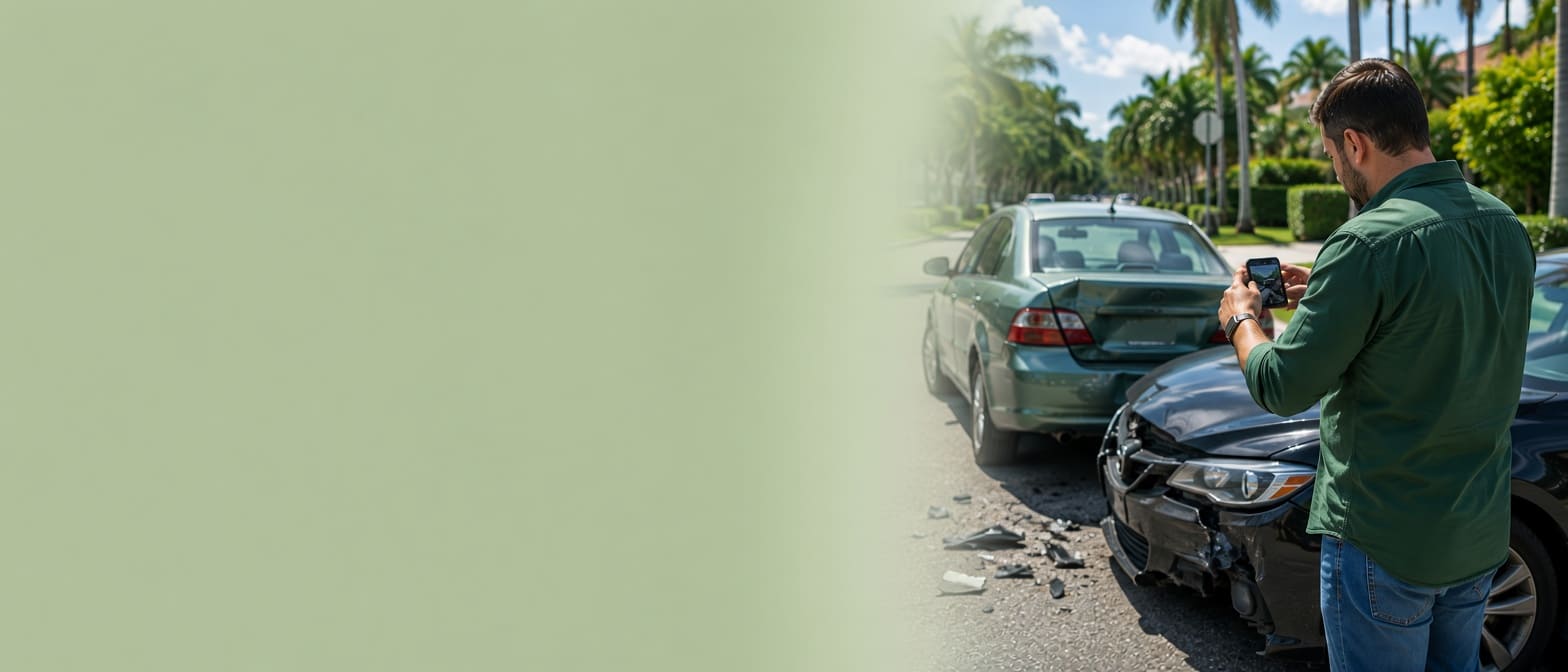
Start with wide views of the crash scene and vehicle positions, then photograph each vehicle's damage, license plates, traffic controls, lane markings, debris or tire marks, weather, lighting, nearby cameras, and visible injuries. Do not enter traffic or delay medical care for a picture. Keep the original image files unchanged.
The most useful photographs are often the ones that show conditions before vehicles are moved, debris is swept away, tow trucks arrive, traffic resumes, or weather changes. Safety comes first, so use the order below only when you can do it without entering a travel lane or interfering with emergency responders.
Take wide photographs from safe positions showing the roadway, intersection, shoulders, vehicles, traffic controls, and surrounding landmarks.
If the vehicles have not yet been moved, photograph where each one stopped and how they relate to lanes, crosswalks, medians, and curbs.
Photograph every damaged side of every involved vehicle, then move closer for impact points, broken lights, glass, wheels, tires, and deployed airbags.
Photograph debris, fluid, tire marks, temporary construction, standing water, blocked signs, lighting, and anything likely to change within minutes or hours.
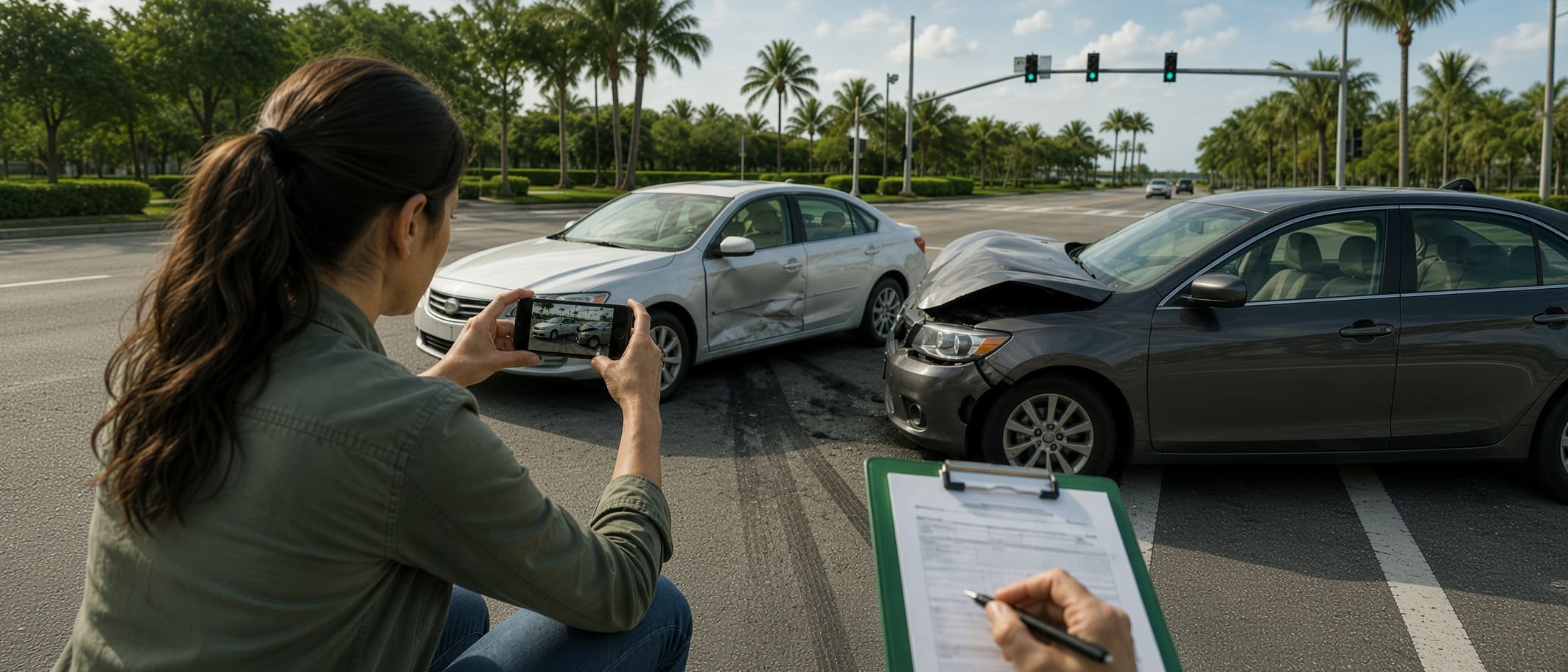
Florida law requires reasonable efforts to move a damaged vehicle that is obstructing traffic when the crash involves property damage only. Do not leave a vehicle in a dangerous position merely to take more photographs. If you can safely take a few orientation shots first, do so quickly; otherwise, move to safety and document the scene from a protected location.
Close-ups alone can be misleading because they do not show where damage sits on the vehicle or how the vehicles were positioned. A stronger photo set moves from context to detail.
Photograph each vehicle from several angles, including undamaged areas. Full-vehicle views help establish scale, orientation, preexisting damage, and the location of the main impact relative to the rest of the body.
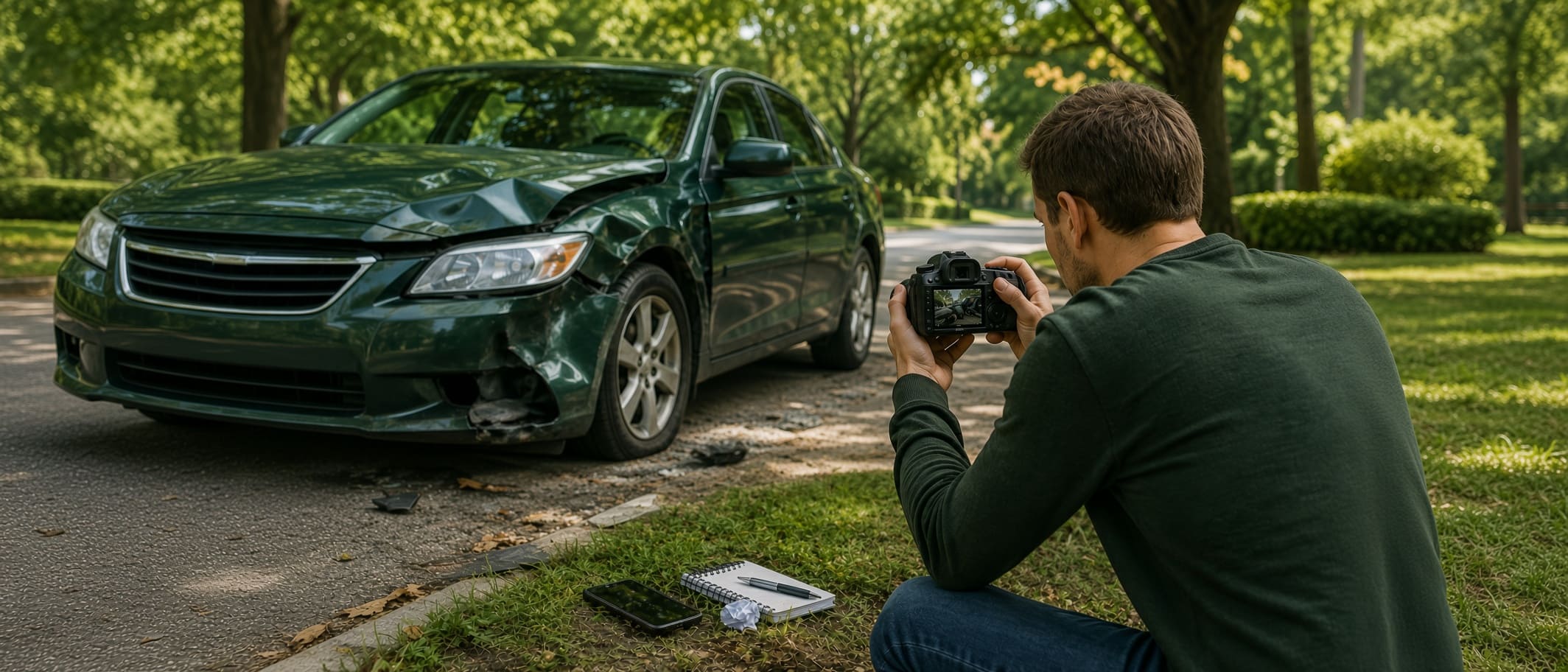
Take medium and close images of crushed panels, bumper intrusion, broken lamps, paint transfer, scratches, dents, wheel damage, tire damage, shattered glass, and any contact marks that may show how the vehicles came together.
Document deployed airbags, broken seats, damaged head restraints, cracked interior components, loose cargo, child-restraint damage, blood or other visible injury-related evidence, but do not disturb the vehicle merely to create a better photograph.
Take a clear image of each involved vehicle's license plate and, when practical, the make and model. If a commercial vehicle is involved, also capture company markings and vehicle numbers visible from a lawful, safe position.
If a vehicle is towed, photograph its condition before it leaves and save the tow company's information. Serious-injury cases may require inspection of the vehicle before repairs, salvage, or destruction changes important physical evidence.
Pair close details with full-vehicle views so a later reviewer can see where the damage is located and how it relates to the rest of the vehicle.
A vehicle can be repaired, but scene conditions may disappear quickly. Roadway photographs can be especially important when fault turns on a red light, failure to yield, lane position, turning movement, limited sight distance, construction, or wet pavement.
When it can be done safely, photograph the intersection or hazard from the direction each vehicle approached. A view from the driver's perspective can clarify whether a signal, sign, stopped vehicle, curve, landscaping, or construction limited what could be seen.
A photograph of a nearby camera does not preserve its recording, but it can identify a source that should be contacted quickly. Retention periods vary, and some systems overwrite recordings quickly.
Photograph visible camera equipment and the intersection or road segment it appears to cover. Do not assume every traffic camera records or stores video; the image simply helps identify what should be checked.
Photograph the names and addresses of gas stations, stores, offices, apartment buildings, homes, parking facilities, or other properties with cameras facing the road. Keep the address so a preservation request can be directed to the right location.
If a truck, bus, rideshare vehicle, or fleet vehicle is involved, photograph visible company names, unit numbers, DOT numbers, and camera hardware. Electronic and video records may require prompt preservation.
If a witness says a dashcam or phone captured the crash, record the person's contact information and, with permission, photograph the vehicle or device context so you can later identify the recording source.
Injury photographs can show visible changes over time, but they do not diagnose an injury and they should never delay treatment. Florida PIP medical benefits generally require initial services and care within 14 days after the motor vehicle accident, subject to the statute's provider and coverage rules.
Photograph visible bruising, cuts, burns, swelling, abrasions, seat-belt marks, airbag injuries, casts, braces, or stitches. If emergency care is underway, let medical treatment take priority and document later.
Some bruising and swelling become more visible after the first day. If symptoms remain visible, take follow-up images from similar angles and distances so changes can be understood over time.
Store injury images securely. Do not post them publicly or send them through unnecessary channels. Public social-media posts can create privacy problems and may be reviewed in a disputed claim.
Photographs are most useful when they fit a documented medical timeline. Save discharge instructions, appointment dates, diagnostic records, prescriptions, therapy notes, and bills separately from the image files.
Florida drivers involved in a crash have statutory duties to exchange identifying and vehicle information in covered circumstances. A phone camera can help preserve what was exchanged, but do not publish sensitive information and do not insist on photographing a private document if the other person does not consent.
Focus on accurate witness contact information. Record the person's name, phone number, email address, and a brief note about what the person says they saw. A witness photograph is usually less useful than reliable contact details.
Original files are easier to verify when they have not been overwritten, filtered, or replaced by compressed copies. Florida evidence rules require authentication or identification, so keep the source files and enough context to identify what each image depicts.
Do not crop, filter, annotate, recolor, or overwrite the originals. If you need an edited copy for explanation, make a duplicate and leave the source file unchanged.
Save the original images to at least one additional secure location. Avoid relying only on a text-message thread or social-media upload because those services may compress or alter files.
Do not rename everything immediately unless you preserve a copy with the original filenames. The sequence can help show when and in what order the images were taken.
After you are safe, record the date, approximate time, location, direction of travel, weather, and what each important photo shows. A contemporaneous note can make the photo set easier to understand months later.
If the crash caused major injury or raises a vehicle-defect, commercial-vehicle, or disputed-fault issue, consider legal review before a vehicle, dashcam, phone, or other evidence source is repaired, reset, sold, salvaged, or destroyed.
Photographs do not decide fault by themselves. They can, however, preserve facts that later become relevant to liability, comparative fault, injury causation, property damage, or the credibility of competing accounts.
Florida uses a modified comparative-fault rule for negligence actions covered by section 768.81. Damages can be reduced by a claimant's percentage of fault, and a party found greater than 50 percent at fault for his or her own harm may not recover damages under subsection (6), subject to statutory exceptions. Images of lanes, signals, vehicle positions, visibility, and impact points can therefore become significant when fault is disputed.
Florida law requires law enforcement crash reports in specified situations. Section 316.066(4) generally prevents a crash report made by a person involved in the crash, and statements that person makes to an officer for completing the required crash report, from being used as evidence in a civil or criminal trial, subject to statutory exceptions. Independently created photographs are separate evidence and still must satisfy applicable rules, including authentication.
Florida law currently provides a two-year limitations period for actions founded on negligence, but the applicable deadline can depend on when a claim accrued and the type of claim. Older crashes and non-negligence claims may require a different analysis. In every case, useful evidence can disappear long before a filing deadline: video may be overwritten, vehicles repaired, roadway conditions changed, and witnesses harder to locate.
Photographing bruising or vehicle damage does not satisfy PIP medical requirements. Section 627.736 generally requires initial services and care within 14 days after a motor vehicle accident for PIP medical benefits, subject to the statute's coverage and provider provisions.
Under section 316.065, a driver must immediately notify the appropriate law enforcement agency when a crash results in injury or death or apparent damage to a vehicle or other property of at least $500.
Use this as a practical priority list. You do not need every picture in every crash, and you should skip any shot that requires unsafe movement or interferes with medical or police work.
| Photo subject | What to include | Why it may matter |
|---|---|---|
| Whole scene | Vehicles, road, intersection, lane layout, shoulders, medians, and landmarks. | Provides context for vehicle movement, direction of travel, and where the collision occurred. |
| Vehicle positions | Where each vehicle stopped, wheels, lanes, crosswalks, curbs, and relative distance. | Can help evaluate turning, lane-change, rear-end, intersection, and right-of-way disputes. |
| Damage | All sides, primary impact area, paint transfer, glass, wheels, tires, and interior damage. | Shows location and extent of physical damage and may help compare competing crash accounts. |
| Road and controls | Signals, signs, lane arrows, markings, construction, surface defects, debris, and tire marks. | Can preserve conditions relevant to visibility, right of way, braking, and driver choices. |
| Weather and lighting | Rain, standing water, glare, fog, darkness, streetlights, and shadows. | Records conditions that can change quickly and affect visibility or vehicle control. |
| Visible injuries | Bruising, cuts, burns, swelling, seat-belt marks, braces, casts, and follow-up progression. | Adds visual context to the medical timeline but does not replace diagnosis or treatment records. |
| Evidence sources | Nearby cameras, business names, truck unit numbers, witness vehicles, and tow information. | Helps identify records or witnesses that may need prompt follow-up before evidence is lost. |
Not having scene photographs does not automatically end a claim. Serious injuries, emergency transport, shock, weather, traffic, or police instructions may make photography impossible. Build the record from the sources that still exist.
Find out whether anyone else took photographs or video. Ask for the original files rather than screenshots when possible.
FLHSMV is Florida's official repository for crash reports. The report can identify parties, vehicles, insurers, witnesses, the investigating agency, and other leads for follow-up.
If your vehicle is still at a tow yard, repair facility, or home, take a complete photo set before repairs begin. For a serious case, ask whether an inspection should occur before alteration or disposal.
Later scene photographs cannot recreate the original vehicle positions, weather, debris, or signal phase, but they can document roadway geometry, signs, lane markings, sight lines, and nearby camera locations.
For additional post-crash guidance, browse the Florida auto accident resources. If an injury claim involves disputed fault or evidence that may disappear, you can also contact The Nunez Law Firm.
Prompt review can matter when a recording, vehicle, or other evidence source may be lost, altered, repaired, or overwritten before a liability dispute is resolved.
Start with wide scene photographs, vehicle positions, all visible vehicle damage, license plates, road and lane markings, traffic signs and signals, debris or tire marks, weather and lighting, nearby cameras, and visible injuries. Then photograph identifying or insurance information when it can be done safely and appropriately.
If it is safe and lawful to do so, a few quick orientation photographs before movement can be useful. However, Florida law requires reasonable efforts to move a damaged vehicle that is obstructing traffic in a property-damage-only crash. Do not create a roadway hazard or delay emergency response merely to take photos.
Preserve the identifying and insurance information that must be exchanged or provided, but respect privacy and consent. Writing down the information or securely photographing documents when the other driver allows it can reduce transcription errors. Do not publish images containing personal information.
No single photograph automatically proves legal fault. A photo set can preserve vehicle positions, signals, road geometry, visibility, damage, and other facts that may support or challenge a version of events. Fault still depends on the full evidence and applicable Florida law.
Copies may be cropped or annotated for explanation, but keep the original files unchanged. Original images make it easier to establish what the photograph depicts and to answer questions about authenticity, timing, sequence, or image alteration.
Potentially. Compare the report with the original photographs, physical damage, roadway layout, witnesses, video, and other records. Section 316.066(4) generally protects a crash report made by a person involved in the crash and that person's statements made to an officer for completing the required report from use as trial evidence, subject to statutory exceptions. The crash record should not be treated as the only evidence in a disputed claim.
Keep relevant original files while a claim, coverage issue, injury, repair dispute, or possible lawsuit remains unresolved. Florida currently provides a two-year limitations period for actions founded on negligence, but different claims and older crashes can involve different deadline rules.
Focus first on medical care. Later, ask passengers or witnesses for original files, obtain the crash report, photograph the vehicle before repair when possible, identify nearby cameras, and document the roadway from a safe location. Missing scene photos do not automatically prevent a claim.
Free consultation
If fault is disputed, important footage may disappear, or the insurance company is using incomplete evidence against you, The Nunez Law Firm can review the crash record and explain the next steps.
Free case assessment for new clients in Orlando, Fort Myers, and across Florida.
(407) 203-2769