

Truck Tire Maintenance Records After a Florida Blowout Accident
Inspection reports, tire-service records and pressure alerts may help explain a truck tire blowout. Learn which records may exist, what they show and who may control them.

Which truck tire maintenance records matter after a crash?
Inspection, service and pressure history
Start with the carrier's vehicle maintenance file, any driver-reported tire defects, periodic inspection documents, tire-service invoices, replacement history and any recorded inflation-pressure data. Together, they may show when a problem was noticed, what work was performed and who handled the tire.
A record is one piece of evidence, not a diagnosis. The failed tire and other physical evidence often need separate examination.
Why Tire Maintenance Records Matter After a Truck Crash
What the records may establish
When a commercial truck loses a tire or a section of tread, an important question is whether that tire had an earlier problem. Maintenance documents can help reconstruct its condition before the crash, especially when several entries identify the same axle or wheel position.
Low inflation pressure, excess loading, road impact, improper repair or mounting, and tire defects can have different causes. Records may narrow the possibilities, but may not distinguish among them without a physical examination.
What a maintenance timeline might reveal
- Pressure warnings: an alert followed by continued operation.
- Repeat repairs: repeated work at the same tire location.
- Replacement dates: a tire changed shortly before the failure.
- Unresolved defects: a report without a matching repair entry.
These patterns help frame the questions for a tire examination; none alone proves the cause.
Limits of the evidence: A tire blowout does not, by itself, establish negligent maintenance. A missing entry also does not automatically prove that an inspection never occurred.
Which Inspection Records May Be Available?
These records serve different purposes. Whether one exists depends on the vehicle, operator, reported defects and applicable regulations.
For operations subject to 49 CFR § 396.11, drivers generally report safety-related defects they discover or that are reported to them, including tire defects. A report is not required when no such defect is discovered or reported, and regulatory exceptions apply.
Covered commercial vehicles generally undergo an inspection at least once every 12 months under 49 CFR § 396.17. The inspection record may identify the vehicle, inspector, inspected components and results. It is not necessarily a tire-pressure history.
Under 49 CFR § 396.3, covered motor carriers must maintain specified vehicle identification, maintenance scheduling and dated inspection/repair records. An entry may help connect a tire concern to a later repair or replacement.
If a roadside inspection occurred, its report may show tire or wheel defects. Under 49 CFR § 396.9(d)(3), covered carriers or intermodal equipment providers must certify correction of noted violations within 15 days and retain a copy for 12 months after inspection. Not every truck will have a recent roadside report.
Important: No single inspection form automatically provides the tire's full history. The tractor and trailer may have separate records, owners and maintenance providers.
Repair History, Tire Replacement and Pressure Records
The most revealing details are often in ordinary work orders and fleet records, rather than in a single document labeled “tire inspection.”
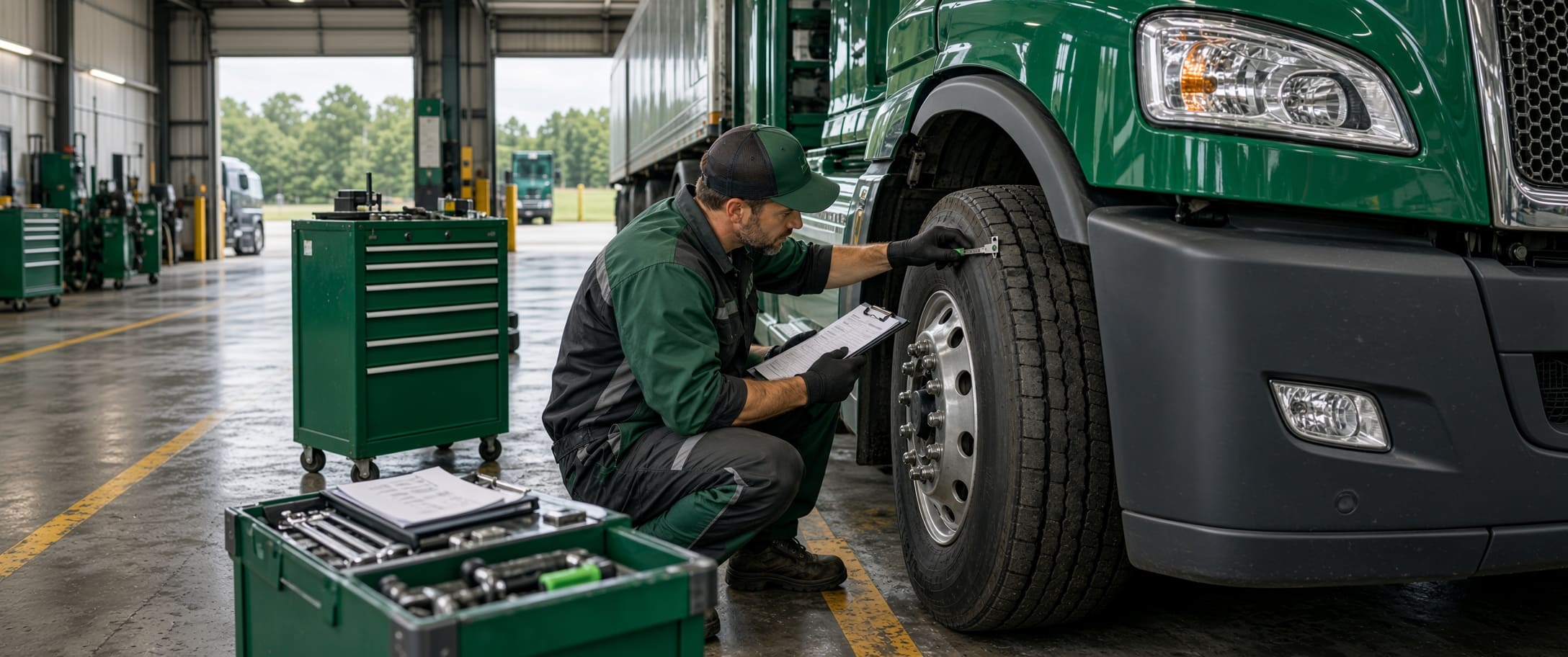
Four parts of the tire's history
Replacement and installation
Invoices or fleet logs may identify the service date, tire model, vehicle, wheel position, mileage and reason for replacement.
Repairs and repeat complaints
Work orders may describe punctures, air leaks, tread damage, wheel or valve problems and whether repairs were completed.
Inflation-pressure information
Manual checks, tire-pressure monitoring alerts or telematics may exist. Federal rules do not require a universal per-trip tire-pressure log for every truck.
Operating conditions
Load information and vehicle configuration may help an expert evaluate whether the tire was appropriate for its axle and load.
Match the correct tire: A generic fleet maintenance summary does not establish what happened to the tire involved in the crash. Records should identify the relevant vehicle or trailer and wheel position whenever possible.
Federal Truck Tire Requirements
The FMCSA rules establish tire-condition, inspection and recordkeeping duties for covered operations. The precise application depends on the vehicle and carrier.
Tire condition — 49 CFR § 393.75
The rule prohibits operating on certain damaged, separated, flat or audibly leaking tires. For covered trucks, it generally requires at least 4/32 inch tread depth on front tires and 2/32 inch on other tires, measured as specified in the regulation.
Read § 393.75Maintenance records — 49 CFR § 396.3
Covered carriers must systematically maintain vehicles and keep specified inspection and repair records. For covered motor vehicles controlled for 30 consecutive days, the rule requires specified maintenance-file records. Under § 396.3(c), required records must be kept where the vehicle is housed or maintained for one year and for six months after the vehicle leaves the carrier’s control.
Read § 396.3Driver reports — §§ 396.11 and 396.13
For applicable operations, DVIRs document reported defects; covered reports and repair certifications are generally retained for three months. Before driving, the driver must be satisfied that the vehicle is in safe operating condition and review the prior DVIR when required.
Read § 396.11 · § 396.13Annual inspection — §§ 396.17 and 396.21
Covered commercial vehicles generally must pass a periodic inspection within the preceding 12 months. The inspection report is generally retained for 14 months and may be demanded by authorized government officials under § 396.21.
Read § 396.17 · § 396.21What Physical Evidence Should Be Preserved?
Documents can describe earlier work, but the tire itself may contain evidence of the failure mechanism. When possible, preservation should be arranged before the truck, wheel or tire is repaired, salvaged or discarded.
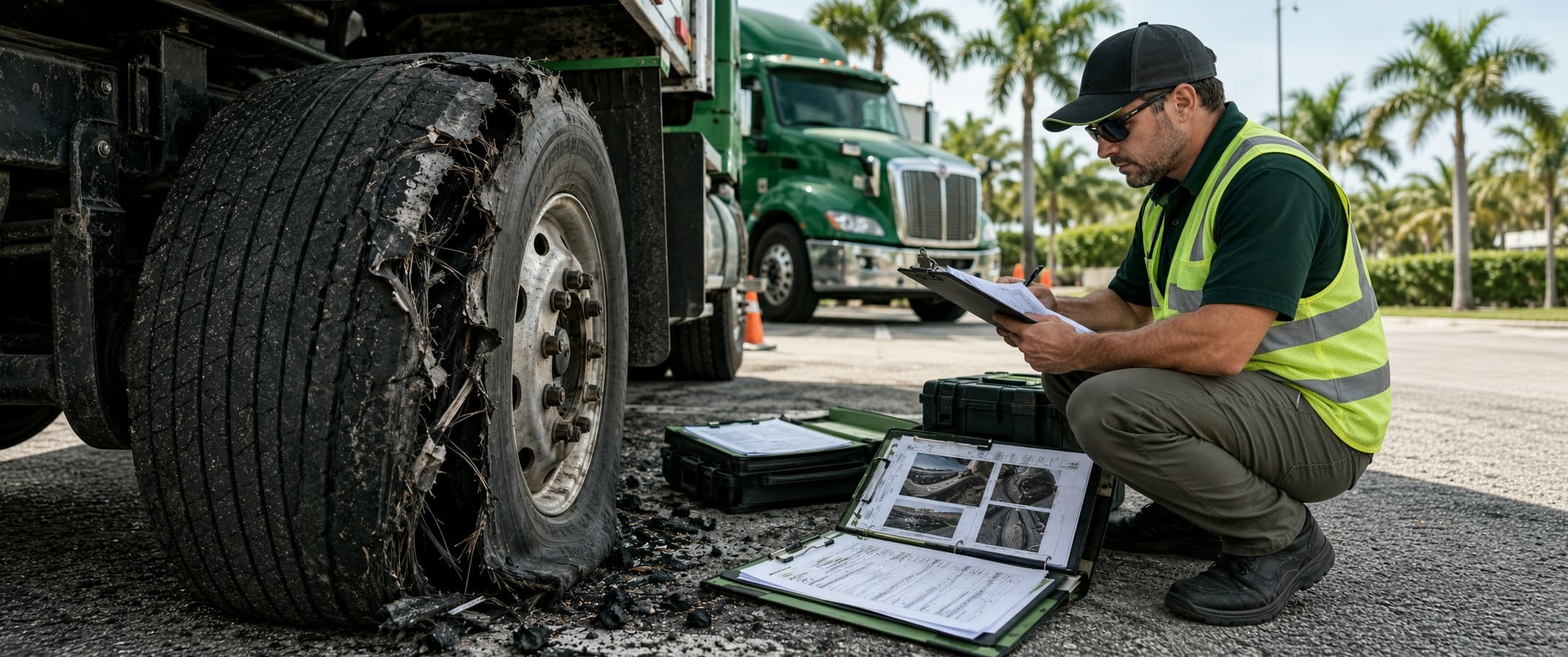
Items that may matter in an expert review
Failed tire and fragments
Casing, tread pieces, belts and sidewall material recovered from the scene.
Wheel and associated parts
Rim, valve components and nearby wheel-end parts when relevant to the suspected failure.
Identification details
Tire markings, available tire identification number, wheel position, vehicle and trailer identifiers.
Contemporaneous documentation
Crash-scene photos, recovery and storage notes, video and any relevant electronic tire alerts.
Handling history
Records of who collected, moved, examined or stored the physical items help establish their history.
Access is not automatic
If another party controls the truck or tire, an injured person cannot assume the right to take it. A documented preservation request may identify what should be kept; inspection may require agreement or court process.
Who May Control the Maintenance Documents?
A truck's operational history may be divided among several businesses. Identifying the tractor, trailer, carrier and service provider helps narrow a request to the right records.
Motor carrier or fleet operator
May maintain the regulated vehicle file, repair schedule, driver defect reports and internal fleet maintenance data.
Vehicle or trailer owner
May have ownership, leasing or service records, particularly when the tractor and trailer are owned by different parties.
Repair shop, tire dealer or contractor
May hold invoices, tire replacement details, service photographs, repair notes or retreading information if the services occurred.
Driver, technology provider or agency
May have relevant defect messages, electronic alerts or roadside inspection information, subject to actual retention and access rules.
Are Trucking Companies Required to Give These Records to an Injured Person?
Not automatically. An obligation to create or retain a document is different from a duty to disclose it to a private person. The route to the information depends on the circumstances.
Required recordkeeping
Federal rules require covered carriers to retain specified records for limited periods. They do not require every pressure check, digital alert or workshop note to exist. Retention duties do not give an injured person automatic access to those records.
Requests before a lawsuit
Before litigation, someone may ask a carrier or service provider to preserve or voluntarily share identified records. A targeted request can identify the crash, vehicle or trailer and record categories. Such requests do not themselves compel disclosure.
Discovery in a case
In a filed case, Florida Rule 1.350 can support document requests to parties; Rule 1.351 addresses records from nonparties, such as tire shops, without a deposition. Relevance, notice, objections and procedural protections may limit production.
Truck Tire Maintenance Records FAQ
Are trucking companies required to keep tire-pressure logs?
Must a truck driver complete a DVIR after every trip?
How long must truck maintenance records be kept?
Can I request truck tire maintenance records without filing a lawsuit?
Does an absence of tire defects in a report prove the tire was safe?
Does a passing annual inspection rule out poor maintenance?
Who should preserve the blown tire?
Find out which evidence may need attention after a tire blowout
If you were injured in a Florida truck accident, The Nunez Law Firm can review the circumstances and discuss which evidence may need attention. An initial case assessment is free, with no obligation to proceed.