

Florida school bus safety
Florida school bus stop‑arm accidents: who may be liable?
When a driver passes a school bus with its stop arm extended, the first question is whether that driver had to stop on this road. The next is whether passing the bus caused the injury. Both questions matter when a child or another road user is hurt.
Quick answer
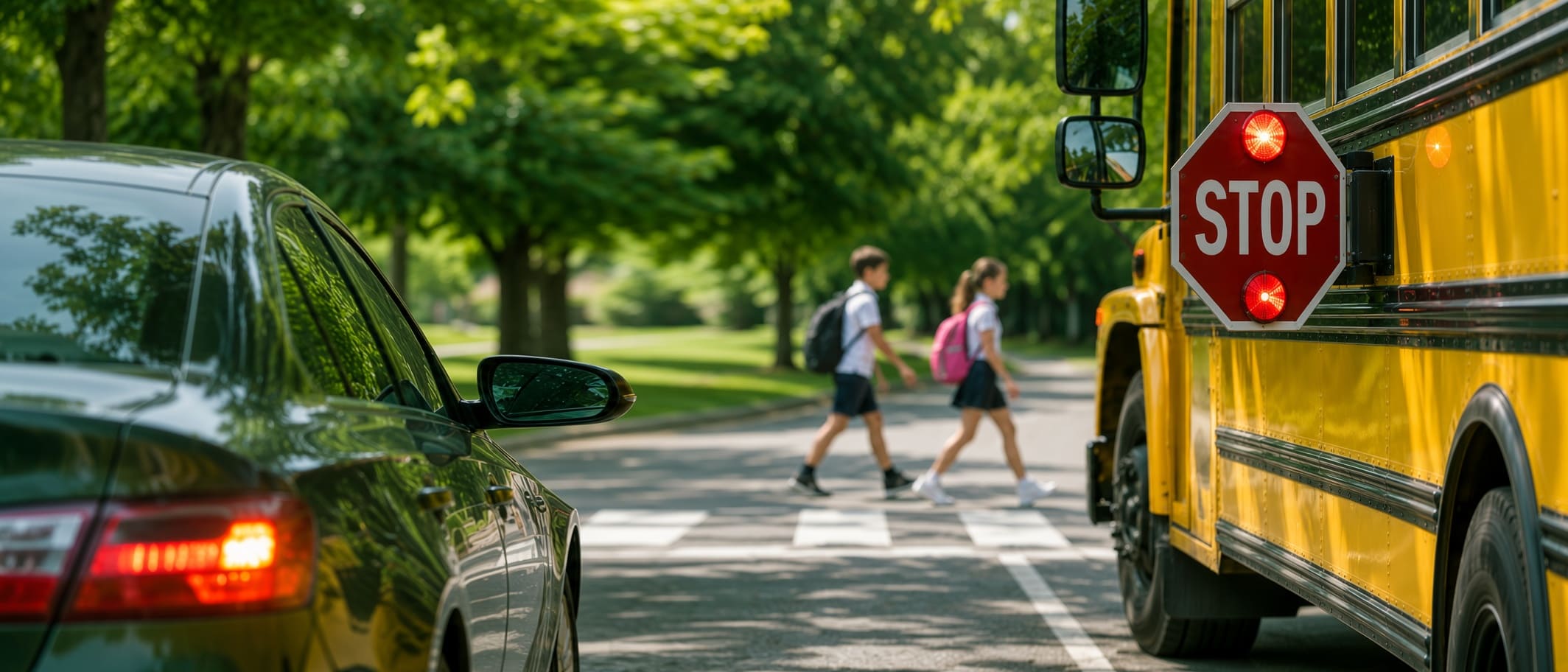
Florida Statutes §316.172 generally requires drivers to stop for a stopped school bus displaying its stop signal. Only drivers approaching from the opposite direction on a qualifying divided highway are excepted. If someone is injured, proving a traffic violation is an important step—but the claim also needs evidence that the violation caused the harm.
When must drivers stop for a school bus in Florida?
Under §316.172(1)(a), a driver approaching a school bus that is stopped with its stop signal displayed must come to a complete stop and may not pass until the signal is withdrawn. The rule applies to vehicles approaching from behind and, unless the divided-highway exception applies, from the opposite direction.
A driver cannot pass simply because the bus door is closed or no child is visible. Passing on the side where children board and exit is separately addressed in §316.172(1)(b), which requires a traffic hearing for that violation. In a disputed case, establish when the bus stopped, when its arm was extended, and when the car passed. Those seconds may decide whether the rule was broken.
| Road situation | Required response |
|---|---|
| Two-lane road without a divider | Traffic in both directions must stop. |
| Multilane road with painted markings or a center turn lane, but no qualifying divider | Traffic in both directions must stop. |
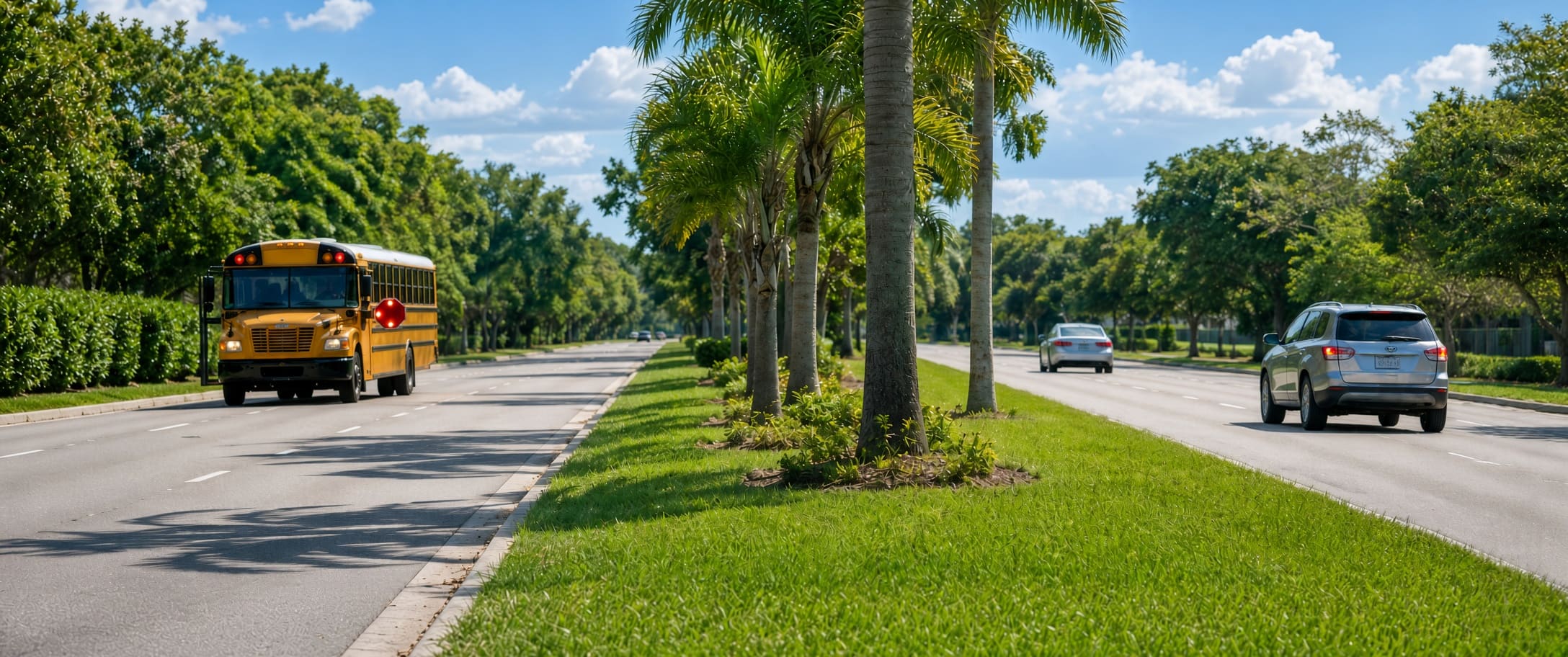
| Road with a raised median, physical barrier, or unpaved median at least 5 feet wide | Opposite-direction traffic falls within the statutory exception; same-direction traffic must stop. |
| Vehicle behind the bus traveling in the same direction | A full stop is required while the stop signal remains displayed. |
What if the school bus is on the opposite side of the road?
A road does not qualify as divided just because it has four or more lanes. Under §316.172(2), a driver traveling in the opposite direction need not stop only if the road has a raised median, a physical barrier, or an unpaved dividing space at least five feet wide.
Double-yellow lines, painted center areas, and a paved center turn lane are not enough. Drivers in both directions must stop on an undivided multilane road. If there is a qualifying divider, the exception applies to traffic approaching from across it—not to cars traveling behind the bus in the same direction.
If the roadway layout is disputed, photograph it from each driver’s approach. Record the type and width of the median, lane markings, the bus stop location, and where each vehicle traveled. Even a driver who qualifies for the stop-law exception must still exercise reasonable care around pedestrians.
Who may be liable for a stop‑arm accident?
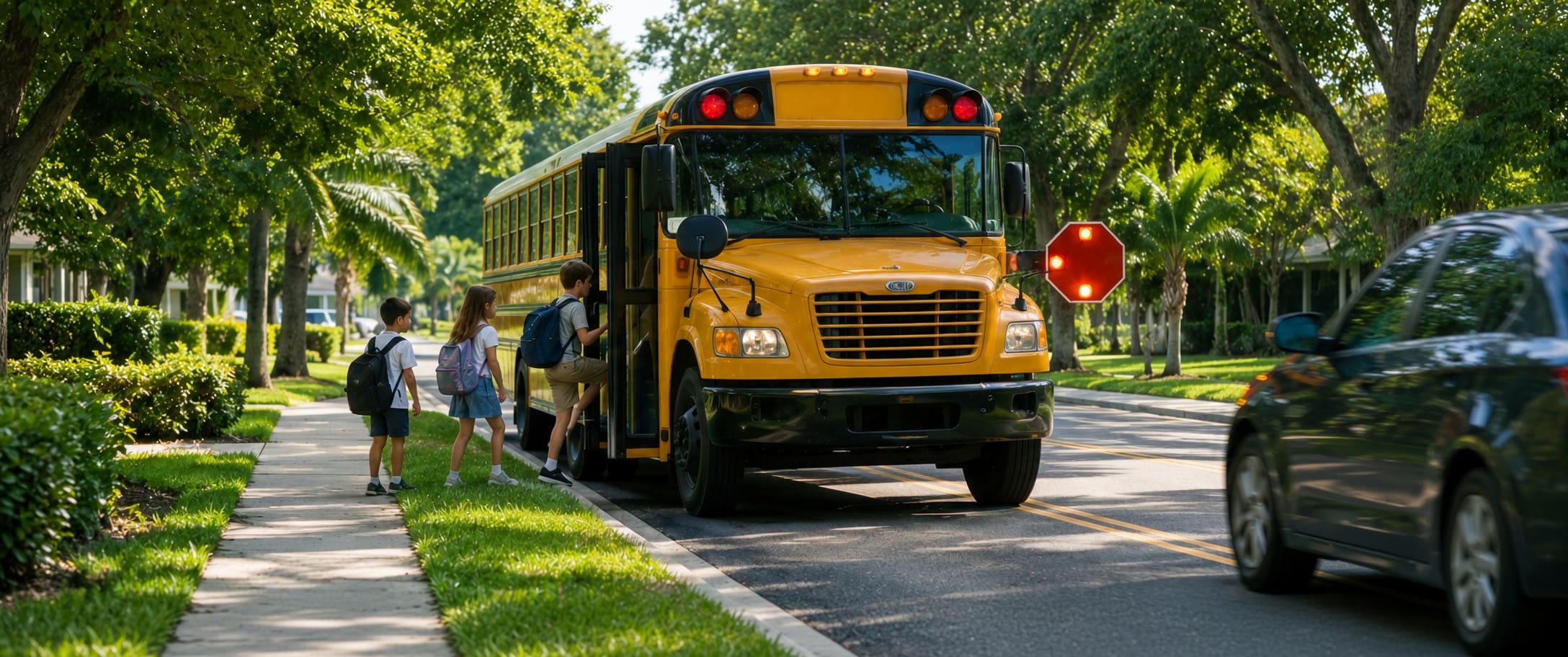
A stop-arm violation may explain how a crash began, but it does not answer every question about liability. The evidence still has to show who acted negligently and how that conduct caused or contributed to a particular injury. Responsibility should be assessed separately for each potentially involved person.
The driver who passed the bus
A motorist who drove past a required stop may be liable when that movement struck a child, forced another vehicle to react, or otherwise caused the injury.
Another involved motorist
A second driver may share responsibility if a separate unsafe action—such as changing lanes or failing to brake—contributed to the collision.
A bus operator or other responsible party
An unsafe stop, missing warning signal, or negligent boarding procedure can matter, but only if a duty was breached and that failure contributed to the harm.
How fault may be divided
Florida Statutes §768.81 governs comparative fault in applicable negligence actions. Fault is not divided simply because several people or vehicles were present.
Registered vehicle owners
Stop-arm cameras commonly identify a license plate, not the driver. That distinction matters when evaluating who actually passed the bus. Separately, under Florida’s dangerous instrumentality doctrine, an owner who allowed someone else to use the vehicle may also face liability for that driver’s negligence, subject to legal limitations. See Aurbach v. Gallina.
Does a traffic citation automatically prove negligence?
No. A traffic citation concerns enforcement of the school bus stopping rule. A civil injury claim also requires proof of duty, breach, causation, and damages. A stop-arm camera might show a car passing the bus without capturing the moment someone was struck. The footage can establish an important fact, but not necessarily the whole claim.
The opposite is true as well: a claim does not fail merely because police issued no ticket. The officer may have arrived after the incident or lacked enough information to identify the vehicle at the scene. Witness accounts, braking evidence, road layout, video, and medical records may establish what happened even without a citation.
What if a child is injured while boarding or leaving the bus?
Children may cross directly in front of the school bus, walk around its far side, or step into traffic after getting off. The size of the bus can hide both the child and an approaching car. That is why the order of events—not a single photograph of the scene—usually matters most.
Establish the bus signals
Check when the bus came to a stop, when its warning lights were operating, and when the stop arm was extended and withdrawn.
Reconstruct the child’s route
Identify where the child boarded or exited, which way the child moved, and where the child could first be seen by the approaching motorist.
Match the vehicle movement to the injury
Compare the lane and speed of the car, any braking, sight distance, the impact point, and available medical and scene evidence.
Age and comparative fault
Age also changes the fault analysis. In Swindell v. Hellkamp, the Florida Supreme Court held that children under six cannot be found contributorily negligent. For older children, conduct must be assessed in light of their age and circumstances. A child entering the road is not, by itself, proof that the child was legally at fault.
What video and witness evidence may be available?
Different recordings answer different questions. A bus-mounted camera may show the passing car and the stop arm, while a nearby storefront camera may show where the child was standing. The strongest evidence places the active stop signal, the vehicle’s movement, and the injury on one timeline. Useful sources include:
Florida Statutes §316.173 permits school districts to operate special stop-arm enforcement systems, but not every bus has one. Section 316.173(17)(a)2 allows recordings from such a system to help determine civil or criminal liability for incidents captured incidental to its lawful operation. A presumption used in a camera-citation proceeding does not automatically prove that the violation caused an injury.
Preserve footage promptly
Section 316.173(17)(b) requires recordings from the special enforcement system to be destroyed within 90 days after final disposition of the recorded event—not automatically 90 days after the collision. Other cameras may overwrite material sooner. Send a written preservation request as early as possible with the date, approximate time, location, travel direction, and bus number or route if known. A preservation request is important, but it does not guarantee disclosure or override statutory requirements.
Contact the school district or bus operator promptly and, when appropriate, the investigating agency. Ask who controls each recording and request the original file, its timestamps, and footage from before and after the incident. Footage may exist but still be subject to student privacy protections, agency procedures, or legal process before it can be released.
Can school district or bus operator conduct affect liability?
It can, if the operator’s own actions contributed to the injury. Section 316.172(3) requires school buses to stop as far to the right as possible and use the required lights and signals for loading and unloading. When possible, a bus should not stop where the view is obstructed within 200 feet in either direction.
A disputed stop location, a missing signal, or unsafe boarding procedures call for a closer look at bus video, stop-selection records, policies, and sightlines. The key question is whether a specific breach helped cause the injury. A public school district is not liable merely because it operated the bus, and claims against public entities can involve special notice, immunity, and procedural rules.
Florida school bus stop‑arm accident FAQ
Do I have to stop on a four-lane road?
Yes, when there is no qualifying divider. Cars traveling in both directions must stop on an undivided four-lane road, even if it has painted markings or a center turn lane. The exception concerns opposite-direction traffic across a raised median, physical barrier, or unpaved separation at least five feet wide.
Can an injury claim proceed if police issued no ticket?
Yes. A ticket is not a prerequisite for a civil injury claim. Video, witnesses, roadway evidence, and medical records can establish what happened even when no citation was issued.
Can I obtain school bus stop-arm camera video?
Possibly. First find out whether that particular bus had a camera system and who holds the recording. Ask for preservation promptly; obtaining a copy may require a records request or legal process and may be affected by privacy rules.
Who is responsible if a child is struck near the bus?
The driver who passed illegally may be responsible if the violation caused the injury. Another driver, vehicle owner, or bus operator may also be implicated when a separate legal basis for liability is supported by evidence.
Can a family bring a claim against a school district?
Potentially. A claim depends on proof that an act or omission attributable to the district breached an applicable duty and caused harm. Claims against a public school district may also involve special procedural requirements.
Free consultation
Talk to an attorney about a school bus stop‑arm injury
A child injured near a stopped school bus may need medical care while critical recordings are still at risk of being overwritten. The Nunez Law Firm can review the roadway layout, stop-arm signals, and available evidence to explain possible legal options.
Serving clients in Orlando, Fort Myers, and throughout Florida.
(407) 203‑2769Official legal sources
- Florida Statutes §316.172Stopping duties, divided-highway exception, and school bus signal obligations.
- Florida Statutes §316.173Stop-arm camera authorization, evidence uses, and destruction after final disposition.
- Florida Statutes §768.81Comparative fault and apportionment in applicable negligence actions.