

Who is at fault in a Florida parking lot car accident?
In a Florida parking lot car accident, fault depends on what each driver did and whether those actions caused the crash. The driver backing out must watch for traffic, but a passing driver who is traveling too fast for conditions or fails to react may also be responsible. Two reversing cars do not automatically split fault 50/50, and a crash on private property can still give rise to a negligence claim.
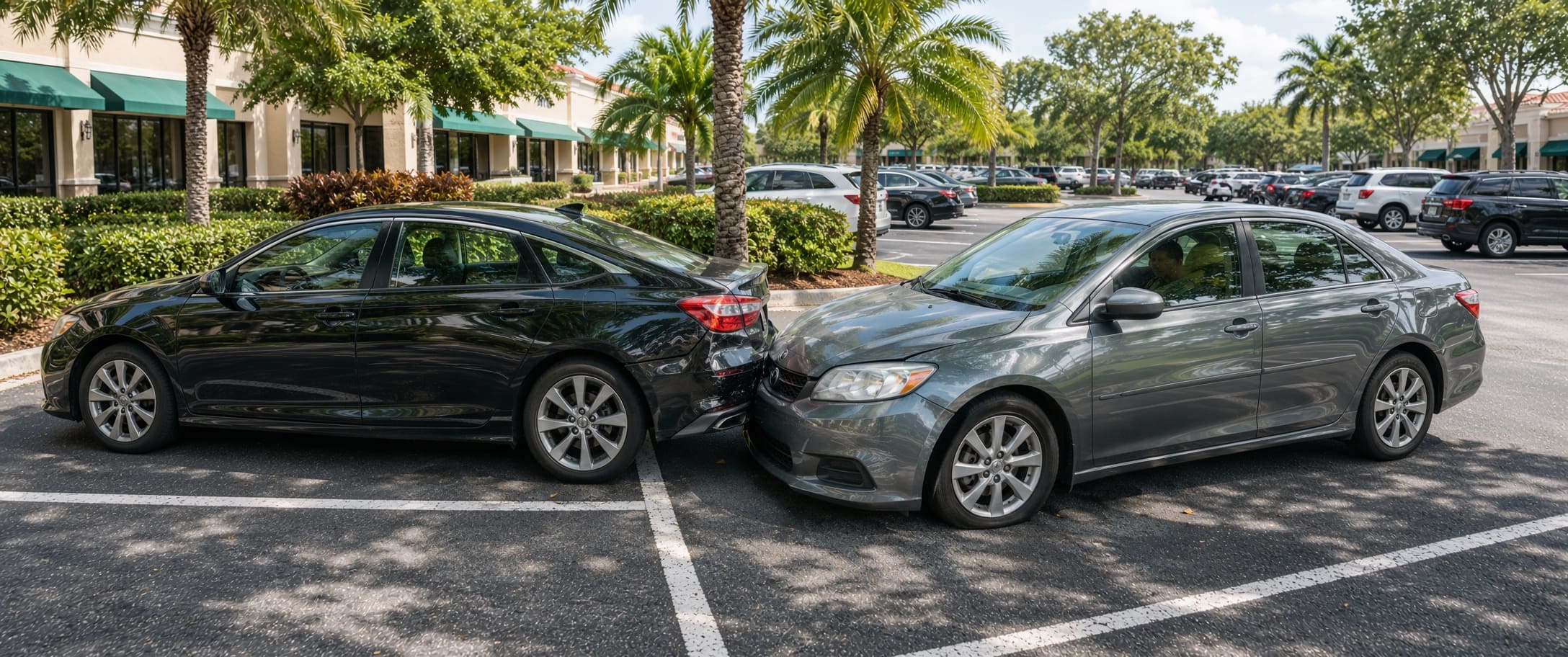
Who is responsible in common parking lot collisions?
| Collision scenario | Potential responsibility | Evidence to look for |
|---|---|---|
| A car reverses into a passing vehicle | The reversing driver may have failed to check the aisle; the passing driver’s speed or conduct may also matter. | Camera footage, direction of damage, sight lines. |
| Two cars reverse from opposite spaces | Either or both drivers may have failed to stop or check behind them. | Timing, vehicle positions, whether one car had stopped. |
| Two cars meet where parking aisles intersect | The driver who disregarded a sign or entered without adequate clearance may be negligent. | Signs, arrows, markings, approach speeds. |
| A moving car strikes a legally parked car | The moving driver may be responsible; unusual parking or a separate hazard may change the analysis. | Photographs, parking position, vehicle damage. |
| A driver turns into an occupied aisle | The turning driver may have failed to observe traffic; the other driver’s ability to avoid impact is relevant. | Video, witness statements, visibility. |
Accidents when backing out of a parking space
Under Florida Statutes, section 316.1985, drivers must not back up unless they can do so safely and without interfering with other traffic. If that statute does not govern a particular private lot, a driver can still be negligent for reversing without taking reasonable precautions.
Consider the view from a small car parked between two SUVs. The driver may have to move slowly to see down the aisle. A backup camera and sensors can help, but they do not replace checking mirrors, looking around the car or stopping when the view is blocked.
What if both drivers were backing up?
Find out which car began moving first, whether either driver stopped and how much time the other had to react. Dents in both rear bumpers cannot, by themselves, establish that both cars were moving at impact.
In a hypothetical example, one car stops halfway out of a space while the other continues reversing and hits it. Footage may show that only one car was moving at impact, although the driver who stopped may still have contributed by backing into an unsafe position.
Who has the right of way in a parking lot?
Leaving a parking space is different from crossing another aisle or entering a public road. Under the definitions in section 316.003, not every parking aisle qualifies as a highway. The statutory intersection rules in the table apply only where the crossing and its traffic controls fall within the law.
| Situation | What the drivers should do |
|---|---|
| Leaving a parking space | Wait until the aisle is clear enough to enter safely, whether reversing or pulling forward. A passing driver must also watch for emerging vehicles. |
| Two unmarked aisles meet | Section 316.121 requires drivers to yield to traffic already in a qualifying intersection from another highway. Elsewhere, a wider aisle does not automatically have priority; consider visibility and each driver’s chance to stop. |
| Two drivers enter at the same time | Section 316.121(2) gives the vehicle on the right priority when vehicles enter from different highways at the same time. At other internal crossings, slow down and let the other car clear if priority is uncertain. |
| STOP or YIELD signs | At an authorized stop sign, stop and yield to traffic in the intersection or approaching closely enough to be an immediate hazard. At a yield sign, slow down, stop if safety requires it and yield to that traffic. Posted signs also matter when assessing reasonable care. |
| Four-way stop | At a four-way stop covered by section 316.123(2)(b), the first vehicle to stop proceeds first. If vehicles arrive together, the one on the left yields to the one on the right. |
These intersection rules are set out in section 316.121 and section 316.123. Photograph the signs and both approaches, including any markings or obstructions, if the drivers disagree about who had priority.
Even a driver with the right of way must take reasonable steps to avoid a visible hazard. A speed that would be safe on an open street may be too fast in a crowded lot.
Leaving the parking lot for a public road
When entering or crossing a highway from a private road or driveway, section 316.125(1) requires drivers to yield to vehicles approaching close enough to create an immediate hazard. In a business or residential district, subsection (2) also requires stopping before crossing the sidewalk or its extended area. If there is no sidewalk area, stop at the nearest point to the street with a view of approaching traffic. Yield to vehicles and pedestrians close enough to pose an immediate hazard. These exit rules do not automatically govern crossings between parking aisles.
Do Florida traffic laws apply on private parking lots?
Section 316.072(1) describes the places where Chapter 316 applies, including locations where vehicles have a right to travel, unless a particular provision specifies otherwise. Under section 316.006(2) and (3), local authorities may also obtain traffic-control jurisdiction over certain private roads through approved written agreements; the statute separately addresses enforcement on HOA-controlled roads.
If fault is disputed at a shopping center or gated community, check whether the aisle was open to public vehicular travel and ask the property manager or local traffic authority whether an enforcement agreement covers it. Private ownership alone does not exempt a lot from Chapter 316. The wording of the particular rule still matters.
How Florida divides fault between drivers
Under Florida’s modified comparative negligence rule, section 768.81, your share of fault generally reduces the damages you can recover. In a covered negligence action, being more than 50% at fault for your own harm bars recovery; being exactly 50% at fault does not.
| Claimant’s fault | Potential tort recovery before other adjustments |
|---|---|
| 0% | $20,000 |
| 25% | $15,000 |
| 50% | $10,000 |
| 51% | $0 |
The example assumes a covered negligence action, one other responsible party and $20,000 in proven, legally recoverable damages. Actual payment may be affected by insurance limits and other rules. Florida changed its comparative-fault law on March 24, 2023. For older crashes or lawsuits, check the transition rules in sections 30 and 31 of Chapter 2023‑15 before estimating recovery.
What if you hit an unattended parked car?
If you damage an unattended car in a crash covered by section 316.063, stop immediately. Find the owner or operator and give your name, address and vehicle registration number. If you cannot find them, leave a written notice with those details securely attached in a conspicuous place on the damaged property. You must also notify the nearest authorized police agency without unnecessary delay. A note alone is not enough.
For ordinary drivers, section 316.065(1) separately requires immediate notice to law enforcement after a crash involving injury, death or apparent property damage of at least $2,000. The property-damage threshold increased from $500 on October 1, 2026, under Chapter 2026‑39 (SB 488). That threshold does not eliminate the separate duty to report damage to unattended property under section 316.063. Other reporting duties may apply even when the immediate-notification threshold is not met. Call 911 if someone needs emergency assistance.
If you discover that someone damaged your parked car, photograph the damage, keep any note left by the driver and ask the parking operator to preserve footage from before you returned to the vehicle.
What evidence can establish parking lot accident fault?
A photo taken after both cars have been moved may not establish who was reversing or whether one driver had stopped. Prioritize recordings that show both vehicles before impact.
Security cameras and dashcams
Contact the store, property manager or parking operator promptly. Identify the location, date and approximate time and ask that relevant footage be preserved, including footage from before the collision. A camera covering the entrance may show the approach even if it does not show the impact.
Businesses may decline to release recordings directly, and retention periods vary. Keep a copy of the request, the contact person’s name and any response. Preserve dashcam files in their original format rather than relying on a short edited clip.
Physical evidence and witnesses
- Photograph the vehicles before moving them if it is safe, including the exact point of contact and the surrounding parking spaces.
- Record signs, painted arrows, obstructions and any damaged or missing markings.
- Collect names and contact details of independent witnesses, including employees who observed the vehicles.
- Keep repair estimates, tow records and any police or incident report. Compare the damage locations with the accounts of both drivers.
- Preserve medical records if you developed pain or other symptoms after the collision.
Which insurance pays after a parking lot collision?
Florida personal injury protection (PIP) can pay eligible injury-related expenses regardless of who caused the crash. Under section 627.736(1), you must receive qualifying initial care within 14 days of the motor vehicle accident to qualify for medical benefits. PIP pays 80% of eligible medical expenses and 60% of qualifying income loss, subject to coverage and limits. Medical and disability benefits share a $10,000 statutory limit.
The medical portion is capped at $2,500 if a qualifying provider finds no emergency medical condition (EMC), or if no authorized provider has affirmatively determined that you had one. The latter rule was explained by the Florida Fourth District Court of Appeal in Medical Center of the Palm Beaches v. USAA Casualty Insurance Co. (2016). An affirmative determination by a provider authorized under section 627.736(1)(a)3 is needed for medical reimbursement above $2,500, but does not guarantee payment of the full limit.
PIP does not repair a car. The responsible driver’s property damage liability coverage may pay for vehicle damage, subject to fault and policy limits. Your own collision coverage, if purchased, may offer another route to repair, typically subject to a deductible. An insurer that pays under collision coverage may seek reimbursement from another responsible party.
You may also have a bodily injury claim against a driver who caused the crash. The motor vehicle tort exemption in section 627.737(1)–(2) can restrict recovery for losses payable by PIP and for pain and suffering. When the injury threshold applies, it requires permanent injury within a reasonable degree of medical probability (other than scarring or disfigurement), significant permanent loss of an important bodily function, significant permanent scarring or disfigurement, or death. Whether a policy covers the incident cannot be decided simply from the parking lot location.
Frequently asked questions
Can a parking lot driver be at fault if the police did not issue a ticket?
Yes. A citation and civil fault involve different determinations. Photos, statements and video can support a negligence claim even when no ticket was issued. See how fault can be established without a traffic ticket.
What if a driver says my parked vehicle was illegally positioned?
The parking position may be relevant if it contributed to the crash. A parking violation does not automatically excuse another driver from avoiding a visible stationary vehicle.
Can the parking lot owner be responsible?
Possibly. If you believe the parking layout or a visibility obstruction contributed to the crash, preserve photos and identify who controlled that part of the property. Ownership alone does not establish liability; the applicable duty, breach and causal connection must be evaluated.
Does a low-speed collision rule out an injury claim?
No. The nature and severity of an injury must be assessed using medical evidence and the facts of the crash. The amount of visible vehicle damage alone does not determine whether an injury occurred.
What if the other driver leaves before we exchange information?
Notify law enforcement as appropriate, document the vehicle description and location, and request preservation of available recordings. Tell your insurer promptly; applicable coverage depends on the policy and circumstances.
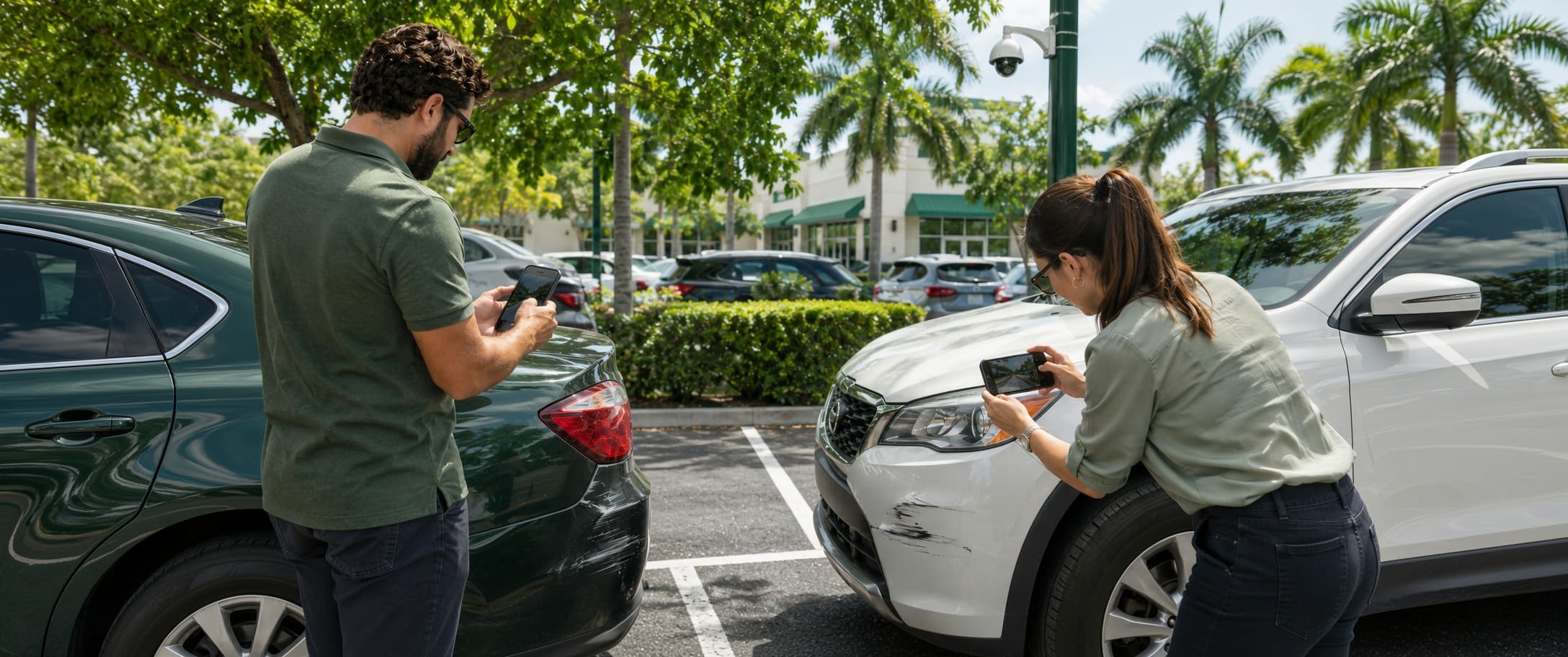
What to do when the insurers disagree about fault
If an insurer assigns you a share of fault, ask for the evidence supporting its decision. Save the written explanation, the video and repair or medical records. A Florida car accident lawyer can assess a disputed injury claim. This article is general information, not a determination of fault in a particular collision.
Official sources
- Florida Statutes, section 316.1985: backing a vehicle
- Florida Statutes, section 316.003: definitions
- Florida Statutes, section 316.121: intersection priority
- Florida Statutes, section 316.123: stop and yield signs
- Florida Statutes, section 316.125: entering a highway
- Florida Statutes, section 316.063: damage to unattended property
- Florida Statutes, section 316.065: immediate crash notification
- Florida Senate: SB 488, Chapter 2026‑39, effective October 1, 2026
- Florida Statutes, section 316.006: traffic jurisdiction
- Florida Statutes, section 316.072: application of traffic laws
- Florida Statutes, section 768.81: comparative fault
- Chapter 2023‑15, Laws of Florida: civil remedies and effective date
- Florida Statutes, section 627.736: PIP benefits
- Medical Center of the Palm Beaches v. USAA Casualty Insurance Co., No. 4D14‑3580 (Fla. 4th DCA, August 31, 2016): PIP medical benefit limits
- Florida Statutes, section 627.737: limitations on tort damages