

Get medical attention and describe all symptoms
Urgent symptoms require prompt care. Explain that you were a motorcycle passenger and report head, neck, back, or joint symptoms even if the full injury picture is not yet clear.
Florida motorcycle passenger injury guide
A passenger may have a claim against the motorcycle operator, another driver, or both. The motorcycle owner may also be responsible in some cases. Which insurer pays depends on fault, permission to use the bike, and the actual policies.
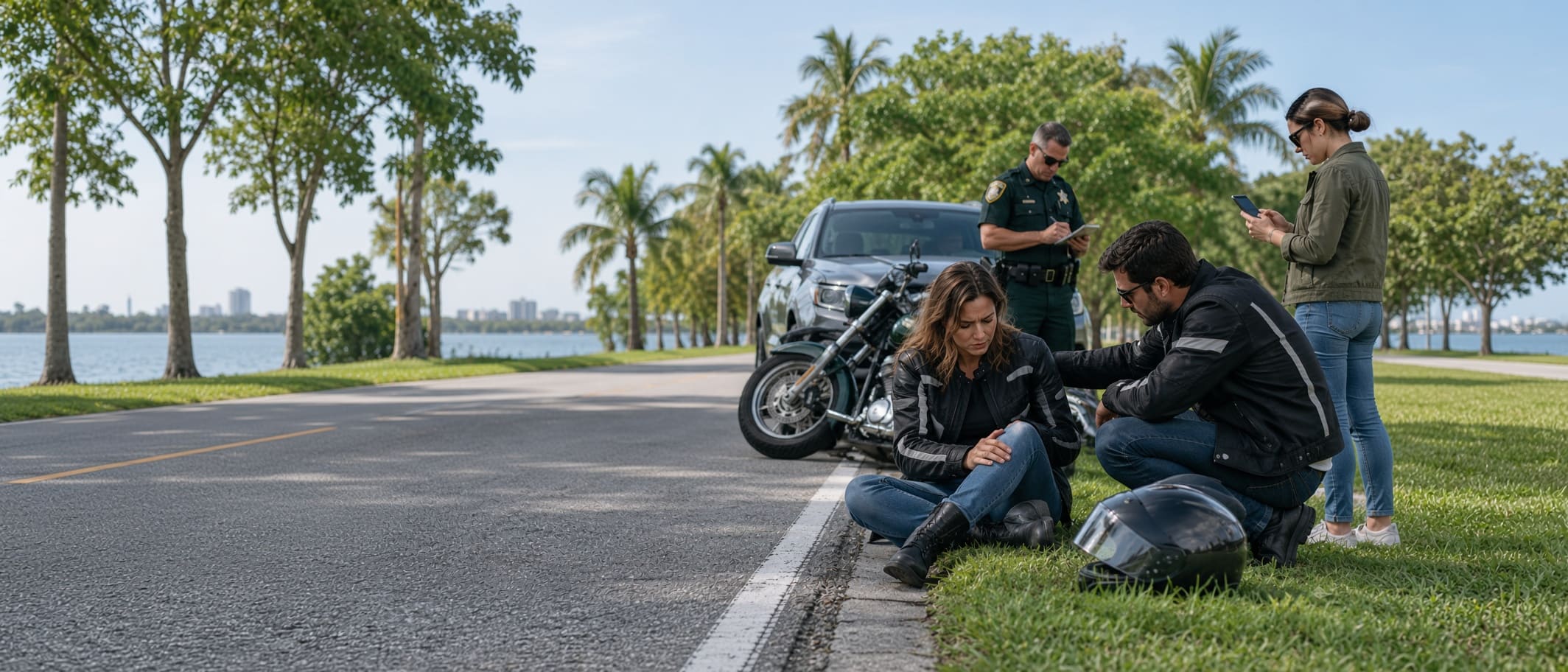
In Florida, an injured motorcycle passenger may have a claim against a negligent rider, another driver, and sometimes the bike's owner if it was entrusted to someone else. Payment may come from applicable bodily injury liability insurance, qualifying UM/UIM, motorcycle medical payments coverage, or health insurance. Standard auto PIP ordinarily does not cover a passenger injured on the motorcycle. Identify each potentially responsible person and policy before accepting a settlement.
Legal authorities checked: October 21, 2026. The outcome of an individual claim depends on the facts and policy terms.
A passenger usually does not control the motorcycle or decide when to brake, turn, or change lanes. That distinction matters: the injured passenger's claim is not automatically defeated because the rider made a mistake.
Suppose a car turns left across the motorcycle's path or changes lanes without checking for it. The passenger may pursue a negligence claim against that motorist, supported by the crash evidence. The driver's bodily injury liability coverage, if available, may respond to the claim.
Excessive speed, an unsafe turn, loss of control, or impaired riding can create liability even when no other vehicle was involved. The passenger may have a claim against the operator. Whether the operator's motorcycle policy pays depends on its liability terms, insured-person definitions, limits, and exclusions.
Suppose the motorcycle's owner let a friend ride it and that friend negligently crashed while carrying a passenger. Under Florida's dangerous-instrumentality doctrine, a person who voluntarily entrusts a motorcycle to another driver may face vicarious liability for its negligent operation even if the owner was not at the scene. The permission, ownership, and actual cause of the crash must be established; individual owners who loan vehicles may be subject to statutory liability limits and exceptions under Florida Statutes § 324.021(9). Florida courts have discussed this doctrine in motorcycle-entrustment cases, including Woodson v. Ivey. An owner's possible legal liability does not guarantee that their insurance covers the loss.
A turning driver and a speeding motorcyclist may both have played a part. Florida's comparative fault rules allow responsibility to be evaluated among those whose conduct caused the injury. A passenger may have claims involving more than one responsible party, but cannot collect twice for the same loss.
If a tire failure, defective component, negligent repair, or dangerous road condition caused the crash, a different party might be involved. Those claims need evidence tying the defect or condition to the collision; a breakdown or pothole alone does not establish legal responsibility.
A passenger is not barred from pursuing a claim simply because the rider is a friend or relative. However, the liability policy may define insured persons and may contain household, family-member, or other exclusions. If the rider borrowed the motorcycle, identify the owner and obtain the actual policy rather than assuming only the rider's insurance matters.
The immediate medical bill and the eventual injury settlement are not necessarily paid by the same insurer. First identify every potentially applicable policy; then separate first-party benefits from claims against the person who caused the crash.
| Coverage | When it may matter |
|---|---|
| Other driver's bodily injury liability | May respond when the driver of a car, truck, or another vehicle is legally responsible and has applicable coverage. It is not the same as property damage liability coverage. |
| Motorcycle liability policy (owner or operator) | May respond when the operator negligently injures a passenger, including in a one-bike crash, or when the owner has covered liability from permissive use. Check who owns the bike, whether the operator had permission, insured-person definitions, exclusions, and limits. |
| Uninsured/underinsured motorist (UM/UIM) | Can matter if a legally responsible motorist has no coverage or insufficient limits. The passenger's own policies, qualifying resident-family policies, and a policy covering the motorcycle may need review. Availability is not automatic. |
| Motorcycle medical payments or accident medical benefits | Optional coverage may help pay eligible treatment expenses without waiting for the liability dispute to end. Passenger eligibility and medical limits depend on the contract. |
| Health insurance | May help with treatment subject to network rules, deductibles, and copays. A health plan may later assert reimbursement rights, depending on the plan and law. |
Motorcycles generally do not require proof of PIP and property damage liability insurance as a condition of Florida registration. That does not eliminate possible financial-responsibility obligations or mean the rider actually has bodily injury coverage.
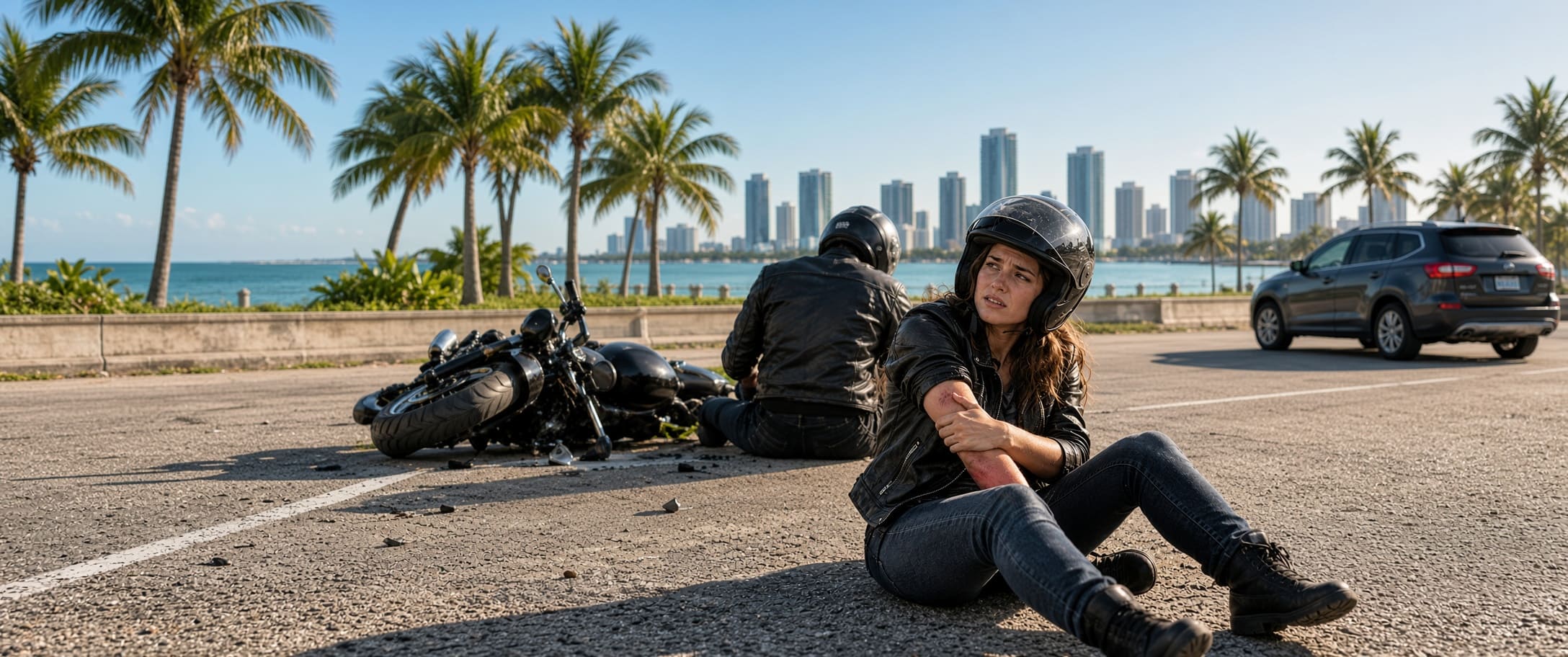
Declarations pages show limits, not all the conditions for payment. Obtain the motorcycle owner's policy, identify the actual operator, and review endorsements, passenger exclusions, UM selection or rejection forms, and any relevant resident-family policies. For UM/UIM basics, see the Florida UM/UIM coverage guide; motorcycle occupancy and exclusions still require their own analysis.
Usually not for injuries sustained while riding on a motorcycle. Florida's no-fault PIP definition of a motor vehicle generally concerns vehicles with four or more wheels. The PIP payment rules also distinguish a person in a covered motor vehicle from someone occupying another self-propelled vehicle. A motorcycle passenger should not assume that their own auto PIP policy or the other driver's PIP provides an automatic $10,000 medical benefit.
This is why the familiar 14-day PIP treatment rule from ordinary Florida auto accident claims should not be treated as a universal deadline for motorcycle passengers. Prompt medical care is still important for health and evidence, and other policies may impose their own notice conditions. See Florida Statutes § 627.732 and § 627.736.
A motorcycle policy may carry separate medical payments benefits. Those benefits are contractual and should be checked even though statutory auto PIP does not ordinarily apply to a passenger on the bike.
Florida's exception allowing certain riders over 21 to ride without a helmet requires at least $10,000 of qualifying medical benefits coverage. It does not convert motorcycle injuries into ordinary PIP claims or guarantee payment to every passenger.
Responsibility is assessed according to the passenger's own conduct, not simply the motorcycle rider's conduct. An insurer may try to argue that the passenger interfered with control of the bike, occupied an unsafe seat, or contributed to the severity of an injury. Such arguments need facts and a causal connection; being on the motorcycle is not itself proof of negligence.
For example, an unexpected unsafe lane change by the operator does not become the passenger's decision just because the passenger accepted the ride. Evidence should distinguish what each person could control.
Florida law regulates motorcycle helmets, including a limited medical-coverage exception for riders over 21. A helmet defense concerns how the passenger's conduct may have contributed to particular injuries, not who caused the impact. In Lenhart v. Basora (Fla. 4th DCA 2012), a scooter passenger's lack of a helmet was considered as part of comparative negligence; the court required the jury to consider the full comparative-fault picture, not the helmet issue alone.
Under Florida Statutes § 768.81, fault attributable to the injured claimant can reduce recoverable damages, and a claimant found more than 50% at fault is generally barred from recovery in covered negligence actions. The outcome depends on the evidence and the law applicable to that claim. Motorcycle passenger seating is addressed separately in § 316.2085.
There are two questions to prove: how the crash happened and how it injured the passenger. Insurance documents answer a third question—who may be able to pay.
An officer may not have seen the collision, interviewed every person, or documented symptoms that appeared later. Compare the report with the physical evidence, medical history, and the passenger's account before accepting an insurer's fault determination.
The categories of recoverable damages are not the same as the amounts an insurer will pay. Recovery depends on proof, applicable law, the responsible parties, and the insurance limits or other available assets.
Ambulance transport, emergency treatment, surgery, follow-up visits, prescriptions, physical therapy, and reasonably supported future treatment needs.
Documented wages missed during recovery and, in appropriate cases, future loss of earning capacity supported by medical and employment evidence.
Physical pain, mental suffering, and loss of normal activities where legally recoverable. The medical record and specific daily limitations matter more than broad descriptions.
Reasonable out-of-pocket costs and damaged personal property, such as a helmet or protective gear, where supported by records and applicable coverage.
In an ordinary negligence claim against an at-fault driver, generally no. Florida's Fifth District Court of Appeal held that a motorcyclist outside the PIP system did not have to satisfy the usual no-fault permanent-injury threshold before seeking pain-and-suffering damages (Scherzer v. Beron, 455 So. 2d 441 (Fla. 5th DCA 1984)). That does not eliminate the need to prove the defendant's negligence, medical causation, and actual damages.
An UM/UIM claim is different. Florida Statutes § 627.727(7) expressly restricts an uninsured-motorist insurer's liability for pain and suffering unless the injury falls within the categories in § 627.737(2), including qualifying permanent injury, significant permanent impairment or scarring, or death. The source of recovery matters: do not apply the third-party liability rule automatically to UM/UIM benefits.
A serious injury can exceed available liability limits. If a passenger plans to settle with an underinsured driver while preserving a potential UIM claim, § 627.727(6) contains a written-notice process and a 30-day period for the UIM insurer to respond. Do not sign a broad release before determining which insurer must receive notice and whether other claims could be affected.
Urgent symptoms require prompt care. Explain that you were a motorcycle passenger and report head, neck, back, or joint symptoms even if the full injury picture is not yet clear.
Keep the crash number, vehicle details, insurance information, and contact information. In a single-bike crash, the motorcycle operator's and owner's identities still matter.
Photograph visible damage and keep damaged helmets or clothing. If vehicle condition is disputed, avoid repairs or disposal that could destroy evidence until preservation needs are assessed.
Provide accurate basic facts, keep claim numbers and letters, and identify potential medical coverage. Do not assume the other driver's insurer will immediately pay every medical invoice.
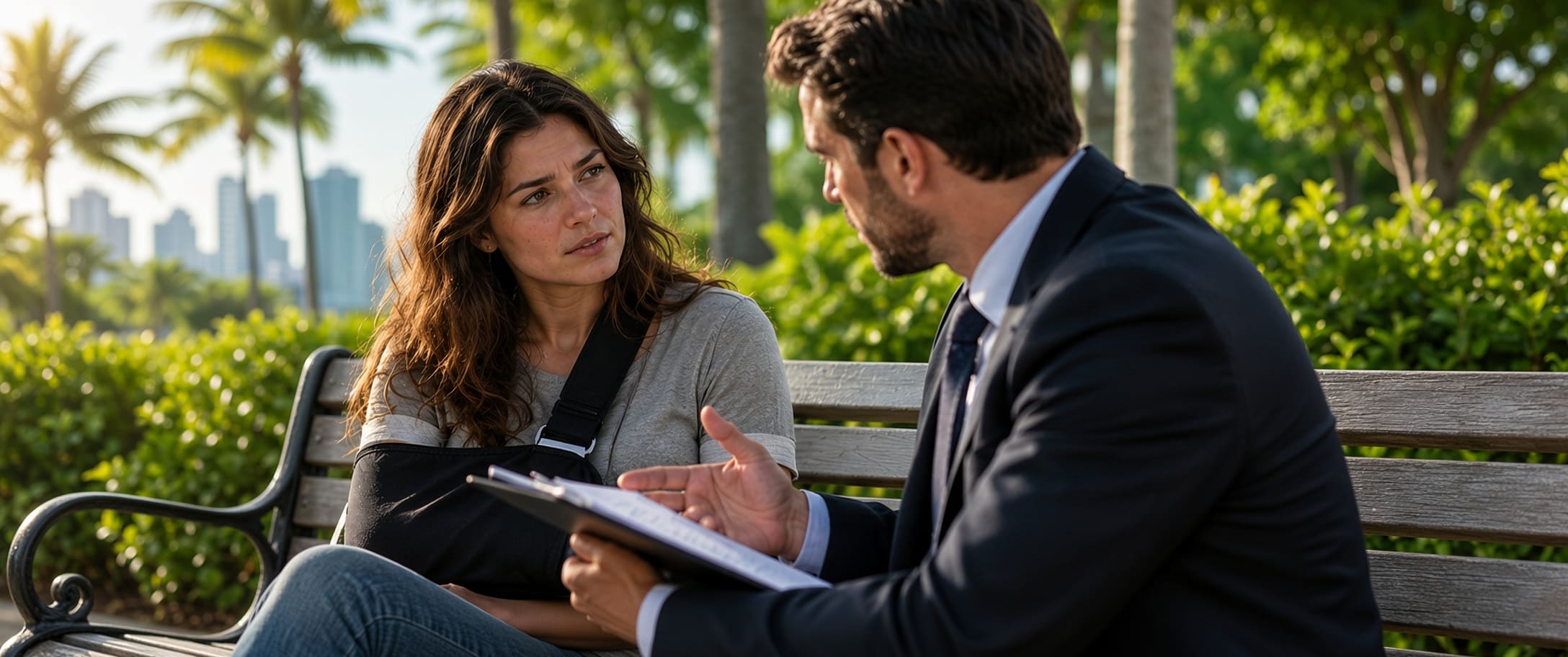
If the rider and another driver blame each other, or insurers dispute passenger eligibility, the full policies and supporting records should be reviewed before any broad release is signed.
For most Florida negligence injury lawsuits arising from accidents on or after March 24, 2023, the limitations period is two years. Florida Statutes § 95.11 governs the ordinary negligence deadline. Different dates or rules may apply to older accidents, certain other claims, minors, or defendants such as government entities.
An insurance claim is not the same thing as filing a lawsuit before the statute of limitations expires. Insurers may also have separate notice and cooperation provisions. The safest practical approach is to identify the coverage and preserve evidence promptly rather than treating the two-year period as a reason to wait.
Potentially, yes. A passenger may have a negligence claim against the operator, including after a single-motorcycle crash. Payment through insurance depends on whether a relevant liability policy covers the passenger and the incident.
Sometimes. If the owner voluntarily permitted another person to operate the motorcycle, Florida's dangerous-instrumentality doctrine may make the owner vicariously liable for negligent operation, subject to statutory limits and exceptions. Ownership by itself does not establish coverage; permission and the full insurance contract matter.
Yes, the relationship does not by itself prevent a claim. The relevant questions are fault, damages, available insurance, and any policy exclusion that affects coverage. An insurance claim and a lawsuit are not necessarily the same step.
Do not assume it does. Florida statutory auto PIP ordinarily does not extend to an injury sustained while occupying a motorcycle. Your other coverages, including UM/UIM and medical benefits where applicable, should be examined independently.
Check all potentially applicable UM/UIM policies, optional motorcycle medical coverage, and health insurance. An uninsured driver can still be legally liable, but obtaining payment may be difficult if no insurance or collectible assets are available.
Not automatically. The operator's actions and the passenger's own conduct must be considered separately. Fault assigned to the passenger requires evidence of conduct that contributed to the harm.
Possibly. The helmet rules and the factual link between helmet use and a particular injury can matter, but not wearing a helmet does not by itself establish who caused the crash. Florida law allows a limited helmet exception for certain people over 21 with qualifying medical benefits coverage.
Not ordinarily in a direct negligence claim by a motorcycle occupant against an at-fault driver, under the rule explained in Scherzer v. Beron. But an UM/UIM insurer has a separate statutory threshold for paying pain-and-suffering damages under Florida Statutes § 627.727(7). The type of claim makes a difference.
A report records information available around the crash and may not include later diagnoses. Keep medical records, appointment dates, symptoms, and treatment notes to show the injury timeline. A missing injury entry is not automatically the end of the claim.
Most negligence injury actions arising from accidents on or after March 24, 2023, have a two-year limitations period. Other claims or circumstances can involve different rules, so deadlines should be assessed for the specific accident.
Questions about coverage?
Passenger claims can involve several insurers and conflicting accounts of who caused the crash. If coverage has been denied, ownership or permission to use the motorcycle is disputed, the rider and another driver blame each other, or a potential UIM settlement is approaching, reviewing the actual policy language and evidence can help clarify the available options.
(407) 203-2769This article provides general legal information, not advice about a particular claim. Coverage, deadlines, and liability depend on the accident and the policies involved.