

Florida hit-and-run evidence guide
Florida Hit-and-Run Without a License Plate: What Evidence Can Help?
Did the other driver leave before you saw the plate? You may still have useful evidence. Vehicle details, nearby footage, witnesses and collision debris can help police narrow the search, even when no license plate number was recorded.
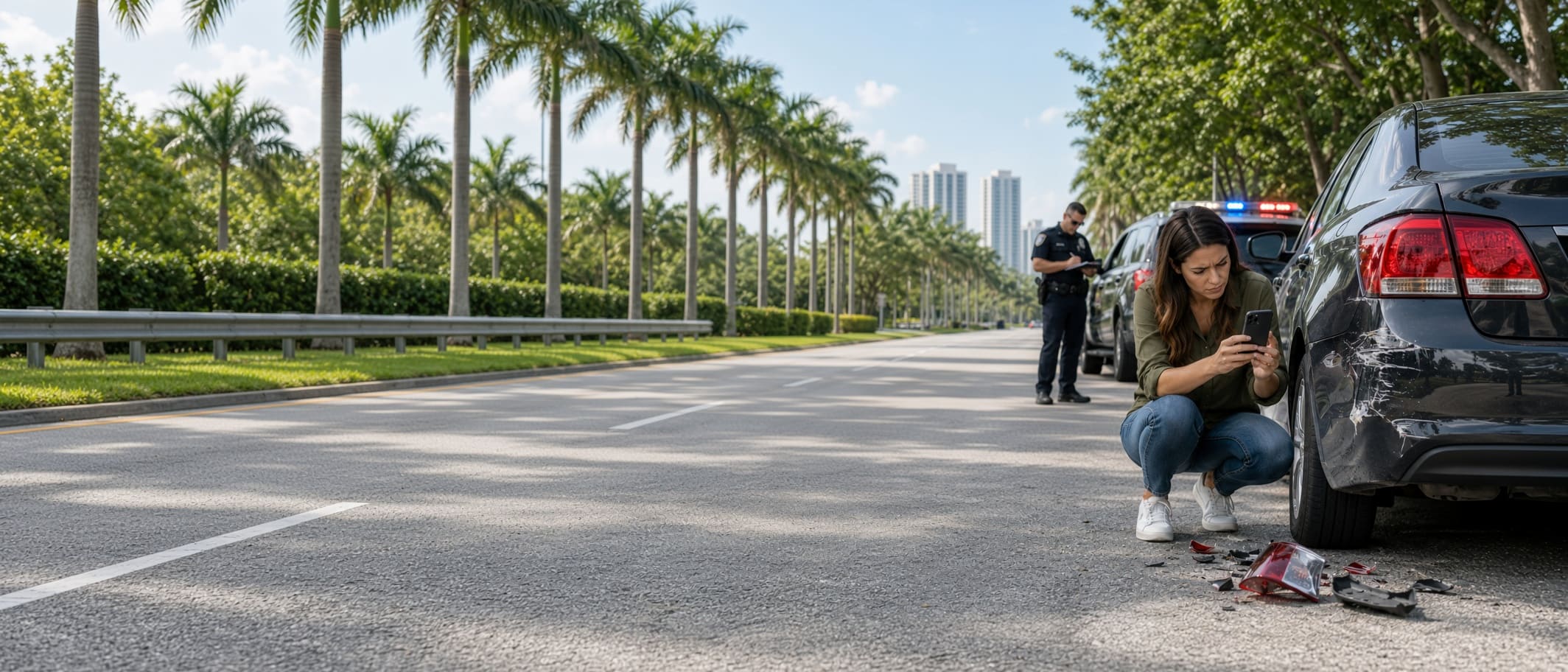
Yes. A hit-and-run can still be investigated when you did not see or remember the license plate. A witness may have noticed part of it. A camera may show the car leaving. Damage, paint transfer or a broken vehicle part may help narrow the make or model. None of these clues guarantees an identification, but reporting accurate details quickly gives investigators more to work with.
Can a hit-and-run driver be identified without a plate?
Not seeing the plate is different from having no evidence. You might remember the type of vehicle, a damaged headlight, the road it turned onto or the exact time it passed a nearby store. Investigators may be able to compare those details with witness accounts, recordings and vehicles that have matching damage.
It is important to separate three questions. Proof that a collision occurred is not necessarily proof of which vehicle caused it. And identifying a particular vehicle does not automatically establish who was driving at the time. Stronger cases connect several independent clues instead of relying on one broad description.
Scene photos, impact damage and witness accounts can establish the sequence of the crash.
Vehicle features, travel direction, recordings and matching damage may narrow the possibilities.
A vehicle lead is not the same as proof of the driver's identity or legal responsibility.
What details about the vehicle matter?
Write down what you actually saw while the memory is fresh. If you are unsure whether a vehicle was a particular brand or model, say so. An accurate partial description is more useful than a confident guess.
| Clue | What to record | Why it may help |
|---|---|---|
| Color and body style | Dark blue sedan, silver pickup, white compact SUV, or another description you are sure of. | Narrows the appearance of vehicles seen in the area. |
| Make or model | Manufacturer badge, distinctive grille, taillight shape or approximate model, if recognizable. | Helps compare witness observations with video. |
| Distinctive features | Roof rack, decals, unusual wheels, tinted windows or damage visible before the collision. | May distinguish a car from others of the same color and type. |
| New damage | Where the fleeing vehicle was struck, and any light, mirror or bumper piece that appeared to break off. | Can support later comparisons with a damaged vehicle. |
| Route and time | Lane, direction of travel, turn taken, road name and best estimate of the time. | Makes nearby camera searches more focused. |
| Partial plate | Any confidently remembered letter, number, state design or plate position. | Even incomplete information may provide an investigative lead. |
What if your description changes? Give police the additional detail and explain when you remembered it. Do not quietly replace your earlier account or assume that a photo of a similar-looking car proves it is the same vehicle.
Witnesses, photos and nearby cameras
One person may have noticed the impact; another may have watched the vehicle drive away. A camera that did not record a readable plate can still show its body style, a missing bumper piece or the direction it traveled.
What witnesses may remember
Ask for names and contact details. Note which direction each person was facing and whether they saw the crash or only the departure. Let witnesses describe their own observations without suggesting answers.
Where footage may exist
Check for dashcams and cameras on nearby businesses, parking areas and homes. A view farther down the road may show the vehicle after it leaves the immediate crash scene.
How to preserve recordings
Contact potential camera owners promptly and ask them to retain footage from a specific time window. Keep original files and the date, time and source of each recording. Access may require consent or legal process.
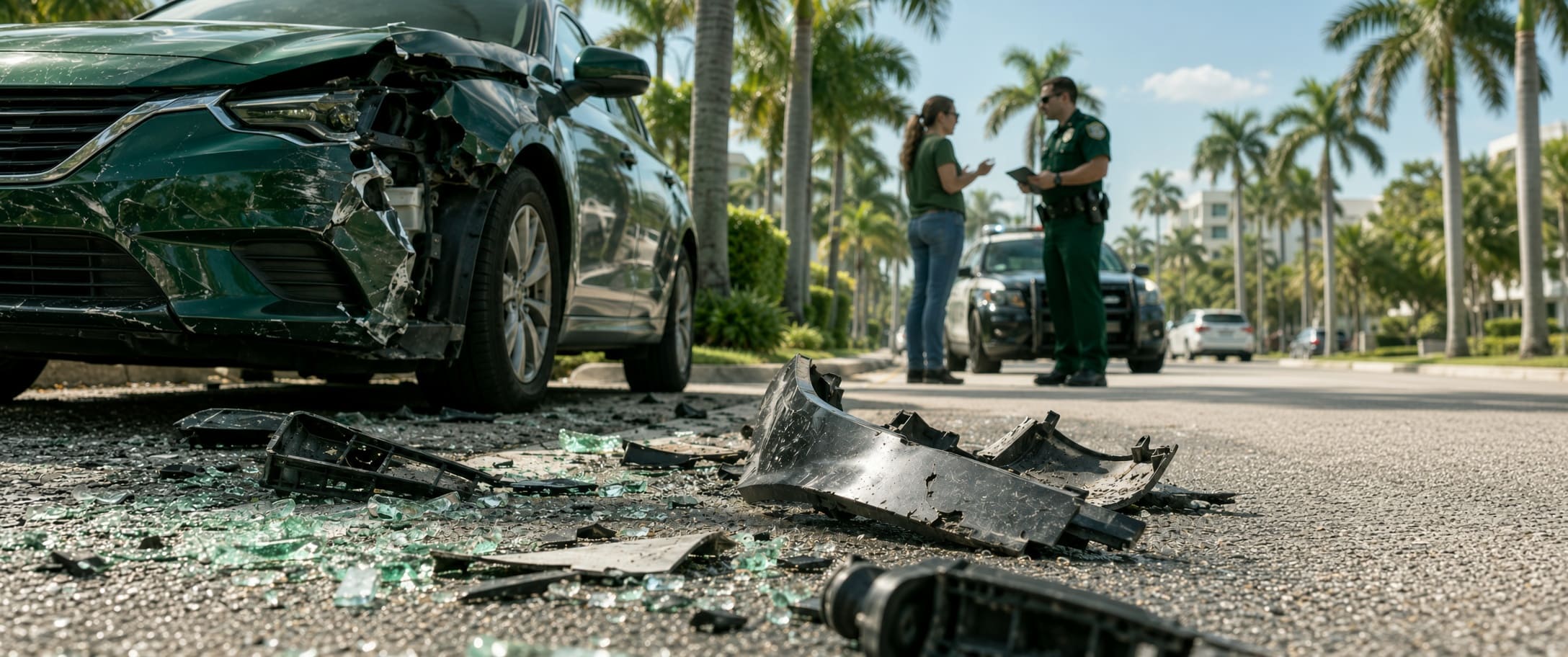
Keep the originals. Save unedited photos and videos before cropping or sharing shorter clips. Original files may contain useful timing and file information; a social-media copy may not preserve it. For detailed steps on requesting footage and preventing its loss, see how to preserve car accident video evidence in Florida.
Paint transfer, broken parts and other physical evidence
A missing plate does not erase contact evidence. The location of a scrape, a broken lamp housing or a piece of plastic near the impact point may help investigators assess which vehicles were involved. These clues still need careful interpretation.
Paint transfer and contact marks
Photograph transferred paint and the surrounding damage before washing or repairing your car. A color match by itself cannot uniquely identify the other vehicle, but the location and pattern of contact may matter.
Broken lights, mirrors and bumper fragments
Fragments may carry part numbers or design features associated with certain vehicle models. That can help narrow a search, although a common part usually does not identify one specific car.
Document the scene without disturbing it
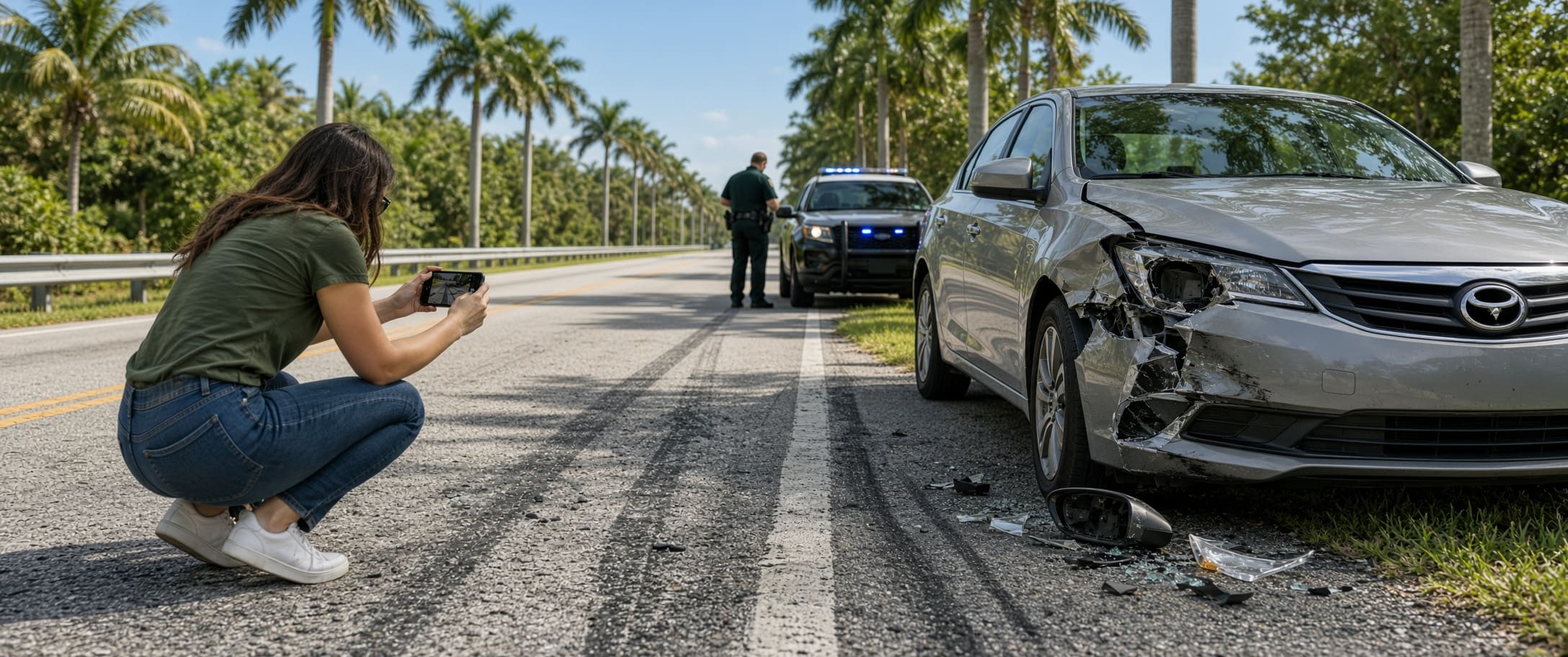
Take wide photos first, then close-ups showing where debris or marks were found. Tell responding officers about fragments or sharp objects. Do not enter traffic, handle hazardous debris or interfere with the scene to collect evidence.
What should you tell the police?
If anyone is injured or there is an immediate safety concern, call 911. Otherwise, contact the local law enforcement agency to report that the other driver left. Florida law addresses drivers' duties after crashes in section 316.027 for crashes involving injuries and section 316.061 for certain property-damage crashes. You do not need to invent a license plate number to make a report.
- Start with the location and time.
Give the road, intersection or nearest address, your direction of travel, the approximate time and a description of the collision.
- Describe the fleeing vehicle accurately.
Share its color, body type, distinctive features, visible damage, direction of travel and any partial plate information. Say clearly which details are uncertain.
- Identify witnesses and possible cameras.
Provide contact information and camera locations. Explain whether anyone may have seen the vehicle before or after the impact.
- Point out physical evidence and injuries.
Show officers available photos, paint transfer or debris locations. Report injuries or pain and seek appropriate medical care.
- Keep the report and follow up with new information.
Ask for the incident or report number and investigating agency's contact information, if available. Submit later photos or witness details through the agency's process.
Example of a factual report“A dark SUV struck the left rear of my car near the intersection at about 6:20 p.m. It continued east and turned right. I did not see its license plate. A person outside the store may have witnessed it.”
Florida section 316.065 also addresses prompt crash notification, while section 316.066 governs crash reports. A police report documents information available to investigators; it does not, by itself, prove every disputed fact or establish civil liability.
What if the driver remains unknown?
An investigation may not identify the vehicle or driver. That does not make your documentation pointless. Keep the incident number, witness details, original images, medical records, photographs of damage, repair estimates and communications with insurers. If a new lead appears, share it with the investigating agency rather than approaching a suspected vehicle owner yourself.
Notify your auto insurer in accordance with your policy's requirements. Depending on the policy and circumstances, Personal Injury Protection (PIP), collision coverage or uninsured motorist (UM) coverage may be relevant—but they cover different losses and none is automatic. For the insurance details, see the firm's Florida uninsured and underinsured motorist coverage guide.
If you were injured and evidence is disappearing, legal advice can help determine whether preservation requests, further records or a claim review are appropriate. The firm's Orlando hit-and-run lawyer page explains how to seek case-specific assistance.
Frequently asked questions
Can police investigate a hit-and-run without a license plate?
Yes. A plate number is helpful, but it is not the only possible lead. Police can consider the crash location, vehicle description, witness statements, recordings and physical evidence. Whether those leads identify a particular car or driver depends on what the investigation establishes.
What if I only remember the color of the vehicle?
Report the color and any other detail you remember, including body style, approximate size, direction of travel and time. Color alone rarely identifies one vehicle. Avoid choosing a make or model simply because it seems likely.
Can paint transfer help identify a hit-and-run car?
It may help investigators compare contact patterns or narrow possible vehicle colors. The location of the damage and other matching evidence are important. Paint transfer alone generally cannot establish which specific vehicle or driver caused the collision.
Can surveillance video help if the plate is unreadable?
Yes. Footage may show the vehicle's shape, distinguishing features, departure direction or a sequence of movements across different cameras. Ask potential footage owners to preserve recordings quickly, but remember that not every camera records or retains video.
What if I remember another detail after the police report?
Write down what you remembered and when it came back to you. Contact the investigating agency and ask how to submit the additional information or request a supplement. Explain that it is new information rather than presenting it as something you reported at the scene.
Can I make an injury claim if the driver is never identified?
Possibly. Available benefits depend on the facts and your policy, including any applicable PIP or UM coverage. An unidentified driver does not automatically establish coverage or fault. Keep evidence and obtain a policy-specific review rather than assuming the claim has no options.
Florida law and official resources
Source check: October 15, 2026. Legal provisions linked below are from the 2026 Florida Statutes. Publication: The Nunez Law Firm.
- Florida Statutes §316.027
Driver obligations when a crash involves injury or death.
- Florida Statutes §316.061
Driver obligations when a crash involves certain vehicle or property damage.
- Florida Statutes §316.065
When Florida law requires prompt notification of a crash.
- Florida Statutes §316.066
Crash-report information and reporting procedures.
- FLHSMV traffic crash reports
Official information about accessing Florida crash reports.
This article provides general information, not legal advice about a particular accident. Evidence availability, police procedures and insurance coverage depend on the facts and applicable rules. The legal references are to the 2026 Florida Statutes.