
Florida traffic law and accident liability
Florida car accident at a broken traffic light: who has the right of way?
When a traffic light stops working in Florida, drivers approaching an inoperative signal must stop before entering the intersection. Florida Statute §316.1235 applies even when only some traffic lights are out. After stopping, drivers must follow the applicable right-of-way rules and yield when entering would create an immediate hazard.
Quick answer
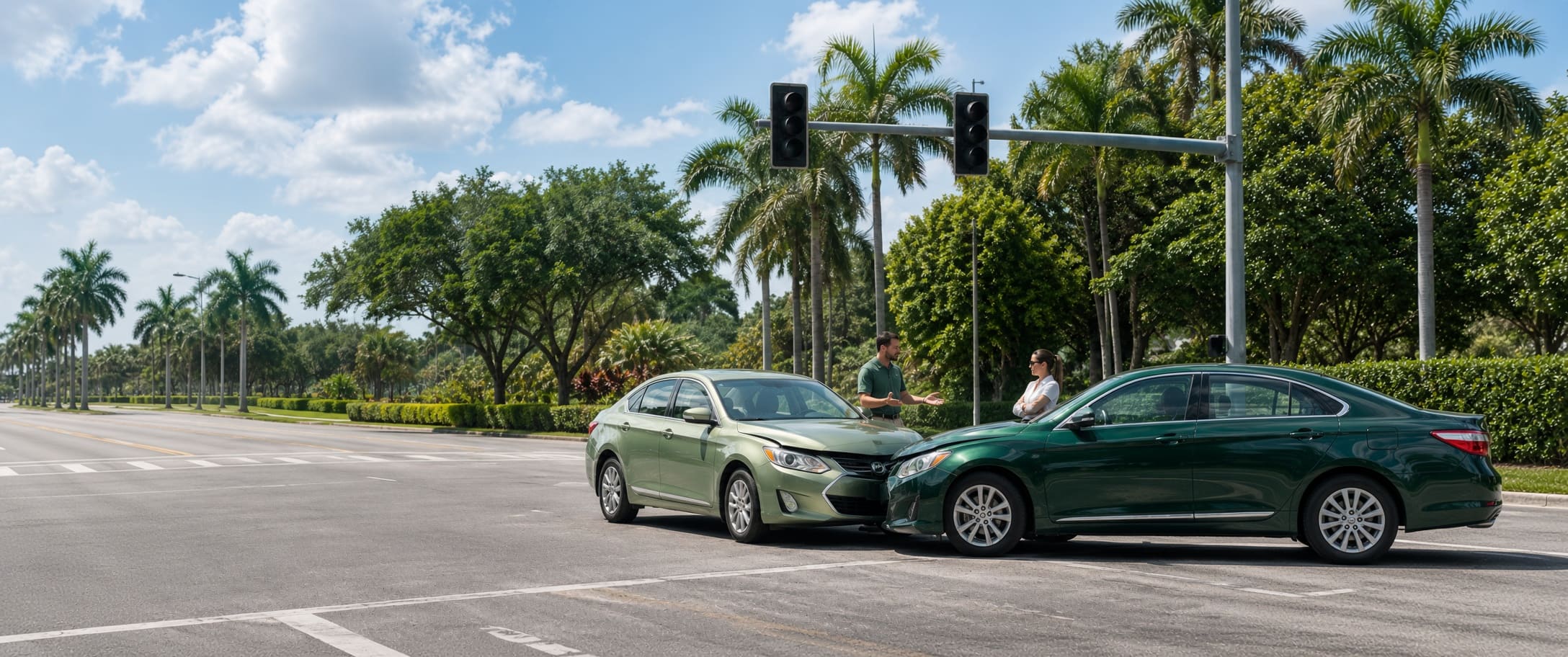
When all traffic lights are dark, drivers must stop and yield to vehicles already crossing or presenting an immediate hazard. A flashing red light requires a stop; a flashing yellow light requires caution, not an automatic stop. Fault depends on what each driver actually faced and did.
Florida law when traffic lights are not working
Under Florida Statute §316.1235, a driver approaching an inoperative traffic light must stop in the manner prescribed by §316.123(2).
The required stopping position is:
- At a clearly marked stop line.
- Before the near-side crosswalk if there is no stop line.
- At the nearest point with a view of approaching traffic before entering the intersection if neither is present.
The law also addresses partially inoperative intersections. If one signal head is dark while others remain operational, the driver facing the inoperative signal must stop. Drivers facing functioning signals must obey the indications applicable to them.
After stopping, a driver must yield to vehicles already within the intersection and vehicles approaching closely enough to present an immediate hazard.
Failure to stop at an inoperative traffic light is a noncriminal moving violation. It may also support a negligence claim if the violation contributed to a collision, although the violation alone does not establish every element of civil liability.
Completely dark traffic lights vs. flashing signals
The first question after a Florida broken traffic light accident is often whether the signal was completely dark, partially inoperative, or flashing.
| Signal condition | Required driver response |
|---|---|
| All traffic signals dark | Stop and follow applicable stop-intersection yielding rules |
| Only the driver’s signal inoperative | Stop under §316.1235, even if other signals function |
| Flashing red | Stop, then proceed subject to stop-sign right-of-way rules |
| Flashing yellow | Proceed with caution; a complete stop is not automatically required |
Florida Statute §316.076 governs illuminated flashing signals.
A flashing red light requires a stop. A flashing yellow light allows a driver to continue with caution, provided the driver responds safely to traffic and roadway conditions.
For example, an intersection may display flashing yellow along a major road and flashing red on a side street. The side-street driver must stop and yield as required, while the driver facing flashing yellow must exercise caution.
When a police officer or another authorized official is directing traffic, drivers must follow applicable lawful directions.
Who has the right of way at a dark intersection?
When every traffic signal controlling an intersection is inoperative, drivers approaching from the affected directions must stop under §316.1235.
The statute refers to §316.123(2), which establishes stopping and yielding requirements at stop intersections.
At an intersection legally controlled as a four-way stop, §316.123(2)(b) gives the first vehicle to stop priority to proceed. When vehicles arrive simultaneously, the driver on the left must yield to the driver on the right. That provision specifically addresses four-way stop intersections; §316.1235 does not expressly classify every dark-signal intersection as a four-way stop.
When every signal is dark, each approaching driver must stop under §316.1235. After stopping, the driver must yield to traffic already in the intersection or approaching closely enough to create an immediate hazard under §316.123(2)(a). Using four-way-stop arrival order as a practical guide does not grant an unconditional right to enter.
The distinction becomes especially important when only some signals are inoperative. A driver facing a dark signal cannot assume that drivers approaching under functioning green lights are also required to stop.
A safe approach is to:
- Stop at the required location.
- Check for pedestrians, cyclists, and vehicles already crossing.
- Identify whether other approaches have dark, flashing, or functioning signals.
- Follow the applicable yielding rules rather than assuming every direction has the same indication.
- Proceed only when entering the intersection will not create an immediate hazard.
Even a driver who has priority must exercise reasonable care. Visibility, turning movements, traffic speed, and the positions of other vehicles may affect the liability analysis.
Who is liable when one driver stops and another does not?
Suppose Driver A stops at a completely dark signal, checks the intersection, and begins crossing. Driver B approaches from another direction without stopping and strikes Driver A.
Driver B’s failure to stop may support a finding of negligence under §316.1235.
However, determining liability requires evidence that the violation contributed to the collision and resulting injuries.
Investigators may examine whether Driver A entered when another vehicle was already dangerously close, whether Driver B was speeding, and whether either driver had an opportunity to avoid the impact.
A driver who stopped correctly is in a stronger factual position, but stopping does not automatically eliminate comparative fault.
For broader discussion of intersection collisions, see our Florida Intersection Accident Lawyer guide.
Three broken traffic light accident scenarios
Two drivers approach a completely dark intersection
Driver A arrives and stops first. Driver B approaches several seconds later and stops.
Driver A would ordinarily expect to proceed first under four-way-stop arrival-order practice. But because the signals are inoperative, both drivers must stop and neither may enter if another vehicle is already crossing or presents an immediate hazard. The legal assessment turns on the actual stop, yielding, and collision evidence.
If Driver B enters and causes a collision, investigators should examine the arrival sequence, applicable yielding requirements, and whether either driver created an immediate hazard.
Dashcam footage showing the stop locations and timing can be more reliable than conflicting recollections.
A flashing yellow signal faces a flashing red signal
Driver A approaches flashing yellow and continues at a reasonable speed. Driver B faces flashing red, stops, but pulls into Driver A’s path.
Driver B may be primarily responsible for failing to yield after stopping.
The analysis could change if Driver A was traveling excessively fast, was distracted, or failed to exercise the caution required by §316.076.
One traffic light is dark while others still work
Driver A faces a dark signal and enters without stopping. Driver B approaches under a functioning green signal.
Driver A may have violated §316.1235. The investigation should still verify that Driver B’s signal was actually green and that the intersection operated as described.
The ordinary first-to-stop rule for a four-way stop should not be automatically applied to this partially functioning intersection.
Signal controller records, maintenance information, and independent video may be particularly important.
How Florida comparative fault affects compensation
Florida uses a modified comparative negligence system for negligence actions covered by §768.81.
When multiple parties contribute to an accident, responsibility may be divided according to their respective percentages of fault.
For example, assume an injured driver has $100,000 in recoverable damages and is assigned 20% responsibility. Under the applicable comparative-fault rules, that driver’s damages would generally be reduced to $80,000.
A party found more than 50% responsible for their own harm generally cannot recover damages in a negligence action governed by §768.81.
This makes accident reconstruction especially important when both drivers claim the other failed to yield.
The classification of the claim, applicable statutory exceptions, and circumstances of the accident must be evaluated before determining the effect of comparative fault.
Can a government agency be liable for a broken traffic light?
Potentially, but a malfunction does not automatically establish liability against a city, county, or state agency.
The investigation should identify who controlled and maintained the signal, when the malfunction began, whether the responsible entity received notice, and whether an actionable failure contributed to the crash.
Florida’s sovereign immunity statute, §768.28, permits certain negligence claims against government entities while imposing important procedural requirements and liability limitations.
There may also be distinctions between protected governmental planning decisions and negligent operational conduct. Whether a particular signal-maintenance failure supports liability depends on the circumstances and applicable law.
A private maintenance contractor may also warrant investigation if its work contributed to the dangerous condition.
Special notice requirements for claims against government entities
Under §768.28(6), an injured claimant generally must present a written claim to the appropriate government agency before filing suit.
For an ordinary claim covered by §768.28(6)(a), written presentment is generally required within three years after accrual. Notice must go to the appropriate agency and, except for claims against a municipality, county, or the Florida Space Authority, also to the Florida Department of Financial Services. These are presuit presentment rules, not necessarily the deadline for filing a lawsuit.
Wrongful death claims have separate requirements, including a two-year written-presentment provision applicable to the Department of Financial Services under §768.28(6)(a).
The statute also contains claim-denial and waiting-period provisions. Generally, failure to make a final disposition within six months after filing can constitute a final denial. For wrongful death and medical malpractice claims, the corresponding period is 90 days under §768.28(6)(d). The applicable presuit notice and lawsuit-filing deadlines must be assessed separately.
Government claims may also be subject to statutory recovery limits. Prompt investigation matters because traffic signal records and maintenance evidence may not remain available indefinitely.
Evidence that can establish what happened
Broken-signal collisions present an unusual evidentiary problem: the traffic light may be repaired before investigators or insurers document its earlier condition.
Useful evidence includes:
Dashcam and surveillance video
showing signal indications, arrival sequence, stops, and vehicle movements.
Witness statements
documenting which approaches had dark, flashing, or functioning signals.
Signal maintenance records
identifying reported defects, inspections, repairs, and controller faults.
Public malfunction complaints
helping establish when an outage was reported and what the responsible authority knew.
Scene photographs
recording signal heads, stop lines, lane markings, vehicle damage, and visibility obstructions.
Crash reconstruction evidence
examining impact positions, braking, speed, and whether the collision could reasonably have been avoided.
Weather reports, electrical outages, construction activity, and temporary traffic-control arrangements may provide additional context.
If a legal claim is being considered, an attorney may seek preservation of relevant recordings and maintenance records before they are routinely overwritten or discarded.
What to do after a crash at a broken traffic light
Get medical help and report the crash
First, obtain emergency medical assistance when necessary and report the collision as required by Florida law.
Document the full intersection
When it is safe, photograph the intersection from each relevant approach. A close-up photograph of a dark signal may not establish whether the entire intersection was disabled, so wider views can be important.
Preserve witnesses and recordings
Identify witnesses, preserve original dashcam files, and record the approximate time of the malfunction.
Describe only what you observed
When describing the crash, distinguish between what you personally observed and what another person told you. Avoid guessing about signal indications that were outside your field of vision.
If the collision caused injuries, significant losses, or disputed liability, a Florida car accident lawyer can assess the evidence and potential sources of responsibility.
For accidents involving an ordinary red-light violation rather than a malfunction, our Orlando Red Light Car Accident Lawyer page addresses that separate issue.
Frequently asked questions
Is a broken traffic light treated as a four-way stop in Florida?
Every driver facing an inoperative signal must stop under §316.1235 and yield under the applicable requirements of §316.123(2). Four-way-stop arrival order is a useful practical guide when all approaches are dark, not an unconditional statutory right of way for every malfunction. If only some signals are dark, drivers facing functioning signals follow their displayed indications.
Do I have to stop at a flashing yellow traffic light?
Not automatically. Florida Statute §316.076 requires drivers facing flashing yellow to proceed only with caution. Flashing red requires a full stop and compliance with stop-sign right-of-way rules.
Who is at fault if both drivers say they stopped?
Fault depends on the evidence. Investigators may compare arrival times, vehicle positions, right-of-way rules, visibility, and whether either driver entered when it was unsafe. Both drivers may share fault.
Can I recover compensation if I entered the intersection without stopping?
Possibly, depending on the other driver’s conduct and the applicable allocation of fault. In negligence actions covered by Florida’s modified comparative-fault rule, a party more than 50% responsible for their own harm generally cannot recover damages.
Can I sue the city for failing to repair a broken traffic light?
A claim may be possible in some circumstances, but it requires more than proof that the signal malfunctioned. Responsibility for maintenance, prior notice, causation, governmental immunity, and statutory notice requirements must all be considered.
Understanding your rights after a broken traffic light accident
A malfunctioning traffic light can make an intersection dangerous and leave drivers with conflicting accounts of who had priority.
Florida law provides specific stopping and yielding requirements, but establishing legal responsibility requires examining the signal condition and the conduct of everyone involved.
The Nunez Law Firm can evaluate the circumstances of a Florida car accident, identify potentially relevant evidence, and explain the legal options available under the facts of the case.
This article provides general legal information, not advice for a specific accident.
Free consultation
Discuss your Florida intersection accident
If a broken traffic light contributed to your crash, our team can assess the circumstances, available records, and potential claims.
(407) 203‑2769Official Florida legal sources
- Florida Statutes §316.1235Inoperative traffic control signals
- Florida Statutes §316.123Stop signs and right-of-way requirements
- Florida Statutes §316.076Flashing signal indications
- Florida Statutes §768.81Comparative fault
- Florida Statutes §768.28Claims against governmental entities