

Florida car accident income loss guide
Lost Wages After a Florida Car Accident: What Documents Prove Income Loss
Prove lost wages with pay records, employer verification, missed-work records, and medical restrictions linking your Florida car accident injuries to the income you lost.

Quick answer
To support lost wages after a Florida car accident, build a record that connects three things: your pre-crash income, the work time or income actually lost, and the crash-related medical restriction that caused the loss. Useful proof can include pay stubs, payroll records, an employer verification letter, timecards, tax returns, W-2 or 1099 forms, medical work notes, disability restrictions, invoices, bank records, and a calendar showing missed shifts or reduced hours. Florida PIP can pay 60% of qualifying loss of gross income and earning capacity when lost-wage coverage applies, but Florida law allows the named insured to elect a lost-wage exclusion, so the policy declarations and endorsements should be checked before assuming those benefits are available.
What documents can prove lost wages after a Florida car accident
No single document proves every wage-loss claim. Use records that establish pre-crash earnings, the work actually missed, and the medical restriction that explains the income loss.
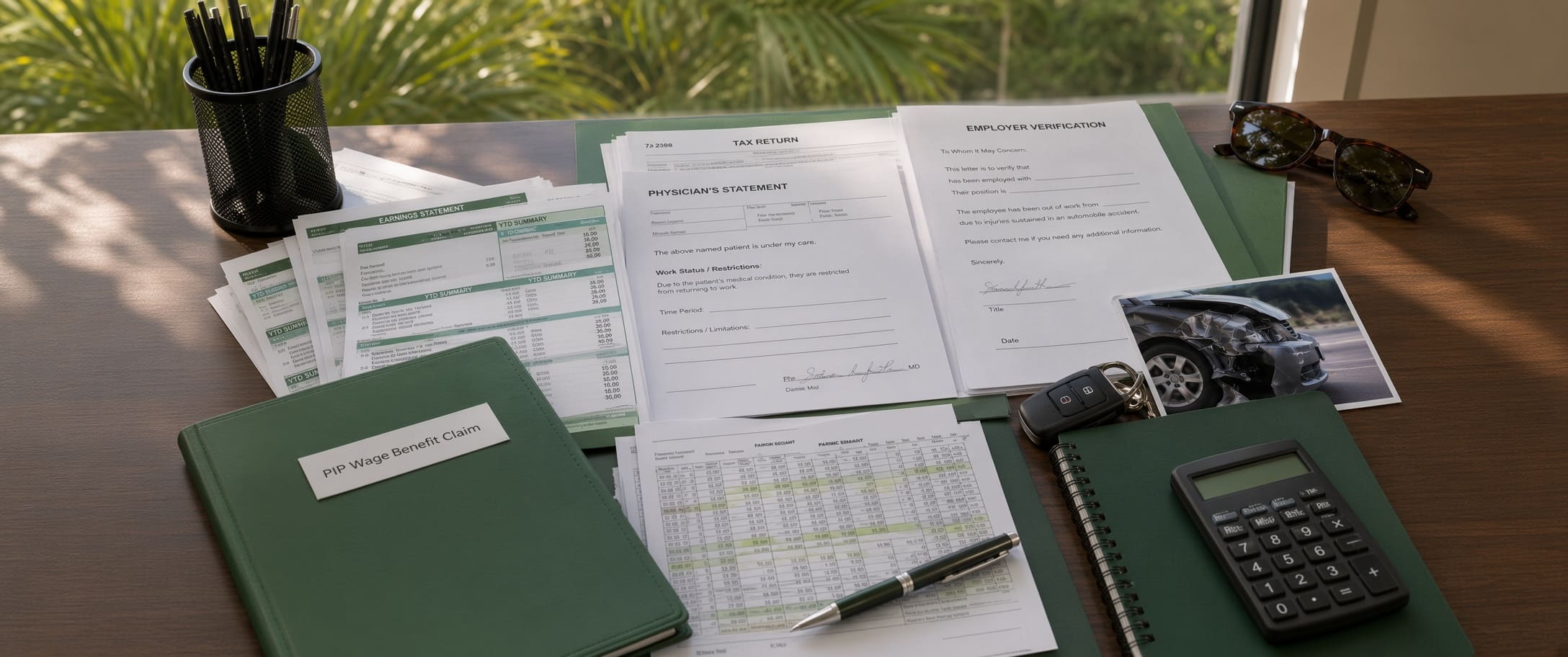
What makes the documents persuasive
Consistency matters. The dates in the medical records should line up with the dates of missed work, payroll records should support the wage rate being claimed, and any overtime, commission, or bonus component should be backed by a reliable pre-crash history rather than an estimate created after the accident.
How employees can document missed hours and reduced pay
For a W-2 employee, the best evidence often comes directly from the employer's payroll and attendance systems. A short employer letter is useful, but it is stronger when the numbers can be matched to pay stubs, time records, and the employee's normal schedule.
Establish the normal work pattern
Save several pay periods from before the crash. They can show hourly rate or salary, recurring overtime, commissions, regular weekly hours, and whether earnings fluctuated seasonally.
Identify the exact time lost
Use timecards, schedules, attendance records, payroll codes, leave records, or shift logs to identify full days, partial days, reduced hours, missed overtime, and any period of light duty.
Separate unpaid loss from paid leave
Record whether missed time was unpaid, covered by sick leave or PTO, replaced by short-term disability benefits, or handled another way. Do not simply label every day away from work as an unpaid wage loss.
Document the return to work
Keep the first return-to-work note, modified-duty instructions, reduced schedule, and later releases. These records can show whether the wage loss ended, continued at a lower level, or changed into a reduced earning-capacity issue.
What an employer verification letter should include
An employer verification should be factual and easy to compare with payroll records. It does not need to argue that the crash caused the injury. Its job is to verify the employment relationship, normal compensation, and work actually missed or reduced.
Employment details
Job title, employment status, start date, normal schedule, whether the employee is hourly or salaried, and the regular pay rate.
Time missed
Dates absent, number of hours or shifts missed, periods of reduced hours, and dates of any return to work or modified duty.
Compensation affected
Base wages lost and, when supported by records, missed overtime, commissions, shift differentials, bonuses, tips, or other regular compensation.
Source of the information
The name and title of the person verifying the records, employer contact information, and a statement that the figures come from payroll, attendance, or scheduling records.
PIP may require a sworn employer earnings statement
A normal employer verification letter can support the overall injury claim, but Florida PIP has a more specific proof mechanism. Under Florida Statutes section 627.736(6)(a), when the PIP insurer requests it, an employer must provide a sworn statement of the injured person's earnings since the injury and for a reasonable period before the injury, using a form approved by the Florida Office of Insurance Regulation. Keep that statement with the payroll and attendance records used to support it.
Medical work restrictions connect the injury to the income loss
Payroll records can show that income dropped, but they usually do not explain why. Medical documentation is the bridge between the crash-related injury and the inability to work, reduced hours, or modified duties.
Off-work notes
A provider's note can identify the period during which the patient should not work. The restrictions should reasonably correspond to and explain the claimed period of missed or reduced work.
Specific activity restrictions
Restrictions on lifting, standing, driving, bending, reaching, concentration, screen time, or other job functions can be more useful than a generic note when the employee tried to return but could not perform the normal job.
Follow-up records
If restrictions change, save each updated note. A timeline of continued restrictions helps explain why the wage loss lasted beyond the first medical visit.
Connection to the collision
The medical record should accurately document the crash history, symptoms, diagnosis, treatment, and functional limits. An unexplained gap between the injury and the work restriction can create a causation dispute.
Key distinction
A doctor's note does not prove the dollar amount of lost wages, and a pay stub does not prove medical causation. The claim is stronger when the medical and financial records support each other.
How self-employed workers can prove lost income
Self-employed income can be harder to document because revenue may vary, expenses continue while the owner is injured, and a lost contract is not always the same as lost personal earnings. The best approach is to use records created in the ordinary course of business and compare the same periods before and after the crash.
Income history
- Federal tax returns and Schedule C when applicable
- 1099-NEC or other tax reporting forms
- Invoices, contracts, purchase orders, and client statements
- Business bank deposits and payment-processor records
Loss after the crash
- Canceled or postponed jobs with dates and amounts
- Reduced billable hours or completed projects
- Calendar, CRM, dispatch, booking, or job-management records
- Continuing business expenses that affect the net-income calculation

Revenue is not automatically the same as lost earnings
A business may collect gross receipts while also paying materials, subcontractors, advertising, rent, software, vehicle expenses, and other costs. For a self-employed claim, the records should help distinguish gross business revenue from the income or earning capacity actually lost because the injured person could not work.
How Florida PIP wage benefits fit into the claim
Florida Personal Injury Protection can include disability benefits for qualifying work loss. Under section 627.736, disability benefits are 60% of loss of gross income and loss of earning capacity caused by an inability to work that is proximately caused by the crash injury. However, section 627.739 allows the named insured to elect a deductible and to exclude lost-wage benefits for the named insured alone or for the named insured and dependent resident relatives. Medical and disability benefits otherwise share the available PIP benefit limit under the statute and policy.
| Issue | Why it matters | Useful records |
|---|---|---|
| Is lost-wage PIP coverage included? | Florida allows the named insured to elect a lost-wage exclusion, and a deductible may also apply. Do not assume disability benefits are available from the policy alone. | Declarations page, endorsements, policy notices, insurer confirmation. |
| Amount of income lost | The insurer needs reasonable proof of the covered loss and the amount claimed. If requested, the employer may need to provide the sworn earnings statement described in section 627.736(6)(a). | Pay stubs, payroll reports, sworn employer earnings statement, tax records, timecards. |
| Inability to work | The disability benefit is tied to inability to work caused by the injury. | Off-work notes, restrictions, treatment records, modified-duty records. |
| 60% statutory benefit | PIP disability benefits are calculated at 60% of qualifying gross-income and earning-capacity loss, subject to available benefits. | Insurer calculation, PIP ledger, explanation of benefits, wage statement. |
| Available PIP limit | Medical and disability benefits draw from the same statutory PIP benefit limit, so medical payments can affect what remains available for wage loss. | Declarations page, PIP payment ledger, medical EOBs, insurer correspondence. |
| No double recovery | Florida law does not permit recovery in the tort claim for special damages already paid or payable as PIP benefits. | PIP payment history, liability claim calculation, settlement accounting. |
The 14-day medical rule is a separate issue
Florida's 14-day rule applies to PIP medical benefits, not as a universal filing deadline for every wage-loss claim. Timely medical records still help connect the crash injury to the work restriction. For the medical-benefit rule, see medical bills after a Florida car accident.
Temporary lost wages and reduced earning ability are not the same
A person can return to work and still have an income-loss issue. Florida civil jury instructions distinguish past earnings or working time lost from a future loss of ability to earn money. The proof is different because one focuses on income already missed and the other focuses on an impaired ability to earn going forward.
Temporary inability to work
This is usually the most direct wage-loss category: the person misses identifiable days or hours while recovering. Payroll records and matching medical restrictions are central.
Reduced hours or modified duty
A person may return to work but earn less because of fewer hours, no overtime, light duty, reduced commissions, or an inability to perform the same volume of work.
Past loss of earning capacity
In some cases, the injury limits the person's ability to earn even when the records do not show a simple day-by-day wage loss. The work history and functional limitations become more important.
Future loss of earning capacity
A long-term restriction may affect future hours, job duties, promotions, physical trades, self-employment output, or the type of work a person can perform. Serious claims may require a fuller vocational or economic analysis depending on the facts.
How to organize the wage-loss calculation
The calculation should be traceable back to source documents. Avoid presenting a lump-sum number without showing the pay rate, missed time, and supporting records used to reach it.
Hourly employees
Start with the regular hourly rate and verified hours missed. Add recurring overtime or shift differentials only when the pre-crash records support that they were reasonably part of normal earnings.
Salaried employees
Show whether the salary was actually reduced, whether unpaid leave was used, and whether bonuses, commissions, or other compensation changed because of the absence.
Commission or variable-pay workers
Use a meaningful pre-crash history rather than a single unusually high period. Commission statements, sales reports, bonus formulas, and seasonal patterns can help establish a reliable baseline.
Self-employed workers
Compare consistent periods and account for business expenses. Contracts, invoices, tax records, and ordinary business books are usually more persuasive than an unsupported estimate of what the business "would have made."
Practical file format
Create a one-page wage-loss summary with columns for date, hours or work lost, pay rate or income source, gross amount claimed, medical restriction covering that date, and the document that proves the figure. Keep the underlying records behind the summary.
Related Florida car accident resources
For a broader coverage review, see the Florida car accident insurance guide. If you are evaluating the overall strength of the injury claim, use the Florida car accident claim checker. For legal help with liability, insurance, medical evidence, and damages, visit the Florida car accident lawyer page.
Why insurers dispute lost wage claims
Wage-loss disputes often come from missing links in the evidence rather than from the fact that the person missed work. A claim can be challenged when the amount is not documented, the medical restriction does not cover the time claimed, or the income history is inconsistent with the number submitted to the insurer.
No medical restriction for the missed period
The adjuster may argue that the person chose not to work rather than being medically unable to work. Preserve the initial and updated restrictions, not just the final release.
The employer letter does not match payroll
If the employer states one pay rate or number of missed hours and the payroll records show another, the discrepancy should be corrected before the package is submitted.
Variable income is based on a best month
A short selective comparison can exaggerate a commission, overtime, or self-employed claim. A broader history is usually more credible when earnings naturally fluctuate.
The claim mixes PIP-paid loss with the liability demand
Keep a current PIP ledger and identify what was paid, what remains payable, and what is being pursued elsewhere. This helps avoid presenting the same wage loss twice.
Keep insurer correspondence
Save every request for documents, wage-loss form, partial-payment explanation, denial, and PIP ledger. If the insurer says the proof is incomplete, the response should address the specific missing item rather than resubmitting the same packet unchanged.
When a lost wage claim deserves closer legal review
A simple wage claim may be documented with payroll and medical records. Legal review becomes more useful when the injury has long-term work effects, income is variable, the worker is self-employed, PIP benefits are disputed or exhausted, the employer will not verify the loss, or the liability insurer disputes that the crash caused the inability to work.
Before accepting a settlement
Before settlement, make sure past wage loss is fully documented, ongoing work restrictions and any potential future loss of earning capacity have been evaluated, and PIP payments have been reconciled.
Lost wages after a Florida car accident FAQ
What documents do I need to prove lost wages after a car accident in Florida?
Common supporting records include pay stubs, payroll history, timecards, an employer verification letter, tax returns, W-2 or 1099 forms, medical work restrictions, and a calendar of missed shifts or reduced hours. Self-employed workers may also need Schedule C records, invoices, contracts, bank deposits, and business-expense records.
Does Florida PIP pay lost wages?
Florida Statutes section 627.736 provides disability benefits equal to 60% of qualifying loss of gross income and loss of earning capacity from an inability to work proximately caused by the injury. But section 627.739 allows the named insured to elect a lost-wage exclusion, so first confirm that disability benefits apply under the policy and whether a deductible affects the claim.
Can I claim lost wages if I used sick leave or PTO?
Do not assume paid leave and unpaid wage loss are identical. Keep payroll and leave records showing how the missed time was treated and identify any benefit that replaced earnings. The claim should accurately account for what was paid, what was consumed, and what economic loss is actually being asserted.
How do I prove lost income if I am self-employed?
Use tax returns, Schedule C, 1099 forms, invoices, contracts, bank records, and business-expense records to show normal net earnings and the financial effect of the work interruption.
What if I returned to work but cannot earn what I earned before?
The issue may extend beyond past lost wages into reduced earning ability. Keep records of reduced hours, modified duty, lost overtime or commissions, medical restrictions, and before-and-after earnings. Florida civil jury instructions recognize both past earnings or working time lost and loss of ability to earn money in the future.

Free consultation
Talk to an attorney about your wage-loss evidence
If a Florida car accident kept you from working, reduced your hours, or changed what you can earn, our team can review the medical restrictions, payroll or business records, PIP payments, and the remaining injury claim.
No attorney's fee unless there is a recovery. Responsibility for case costs is governed by the written fee agreement. Available 24/7 for new clients in Orlando, Fort Myers, and across Florida.
(407) 203-2769Official sources
-
Florida Statutes Section 627.736
Primary Florida source for PIP disability benefits, the 60% wage-loss benefit, reasonable proof requirements, the employer sworn earnings statement in subsection (6)(a), benefit payment rules, and the bar against duplicate recovery of PIP-paid or payable special damages. -
Florida Statutes Section 627.739
Primary Florida source for optional PIP deductibles and the election to exclude benefits for loss of gross income and loss of earning capacity. -
Florida Standard Jury Instructions in Civil Cases
Official Florida Bar source for current civil damages instructions, including past lost earnings or working time and future loss of ability to earn money in motor vehicle cases. -
IRS Instructions for Schedule C
Federal source explaining Schedule C reporting and the distinction between business income, expenses, and net profit for sole proprietors. -
IRS 1099 and Self-Employed Guidance
Federal source explaining independent-contractor income reporting and use of Form 1099-NEC and Schedule C.