

Florida roadway debris and truck accident evidence
Truck tire debris caused a crash in Florida: who may be responsible?
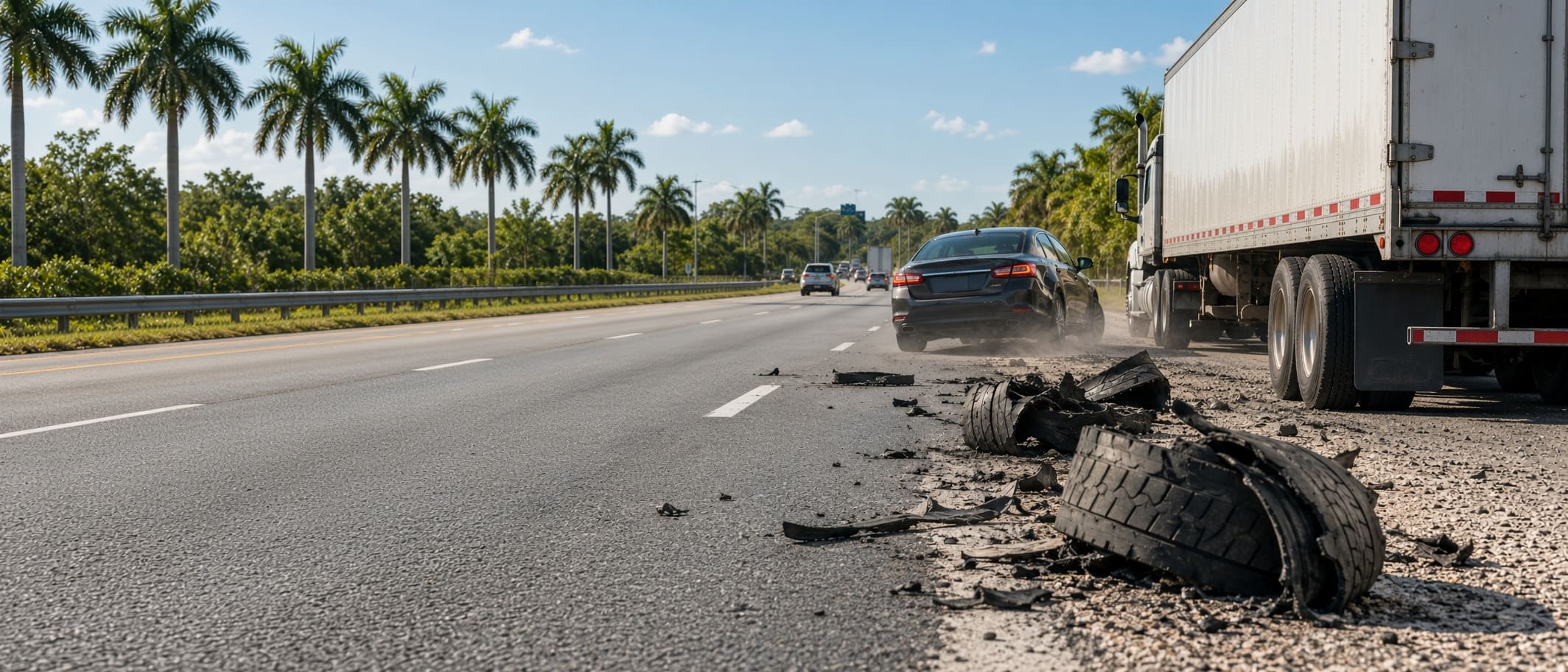
A strip of truck tire tread can strike a vehicle or leave a driver with seconds to react. Finding who is responsible depends on the tire's source, how it reached the roadway, and what evidence survives.
Quick answer
After a truck tire debris accident in Florida, a truck driver, motor carrier, tire service company, or manufacturer may be responsible, but only if the evidence connects that party's conduct or product to the crash. A piece of tire rubber on the highway does not, by itself, identify the truck or prove negligence. When the source is unknown, your own insurance coverage may also matter.
Who may be liable for truck tire debris on the road?
On I-4 or the Florida Turnpike, a strip of tire tread can strike a vehicle, cause damage, or prompt a driver to swerve. Although people often call these fragments tire gators, the nickname does not explain where they came from.
The central questions are practical: Did a truck shed the tread moments before impact? Had the rubber been lying on the road for an unknown period? Can the truck, trailer, or tire be identified? Those facts determine whether a third-party claim can be supported and which evidence is worth preserving.
Liability is not assigned automatically to the nearest truck. The claimant generally must establish a legally responsible person or company, a failure to meet an applicable duty or another viable basis of liability, and a causal link between that failure and the resulting harm.
The truck driver
A driver may face questions about known tire damage, a serious warning sign before departure, or continuing to drive after noticing a tire problem. The driver is not automatically negligent merely because a tire failed.
The trucking company or motor carrier
The carrier may be responsible for its own unsafe practices or, under applicable rules of responsibility, a driver's conduct. A claim may examine who controlled the truck, scheduled inspections, approved repairs, and decided whether it was safe to operate.
A tire installer, repair shop, or maintenance provider
If faulty installation or negligent service caused a tire to separate, the business performing that work may be relevant. A service receipt alone, however, does not prove the work caused the failure.
A tire manufacturer or other product defendant
A design or manufacturing defect may justify a product liability investigation when the actual tire and its condition can be examined. Tread separation is a clue to investigate, not automatic proof of a defect.
What about the road authority?
A highway agency is not automatically liable because debris was present. A claim involving roadway response would require a separate analysis of duty, notice, causation, governmental immunity, and special procedural requirements.
What if the truck cannot be identified?
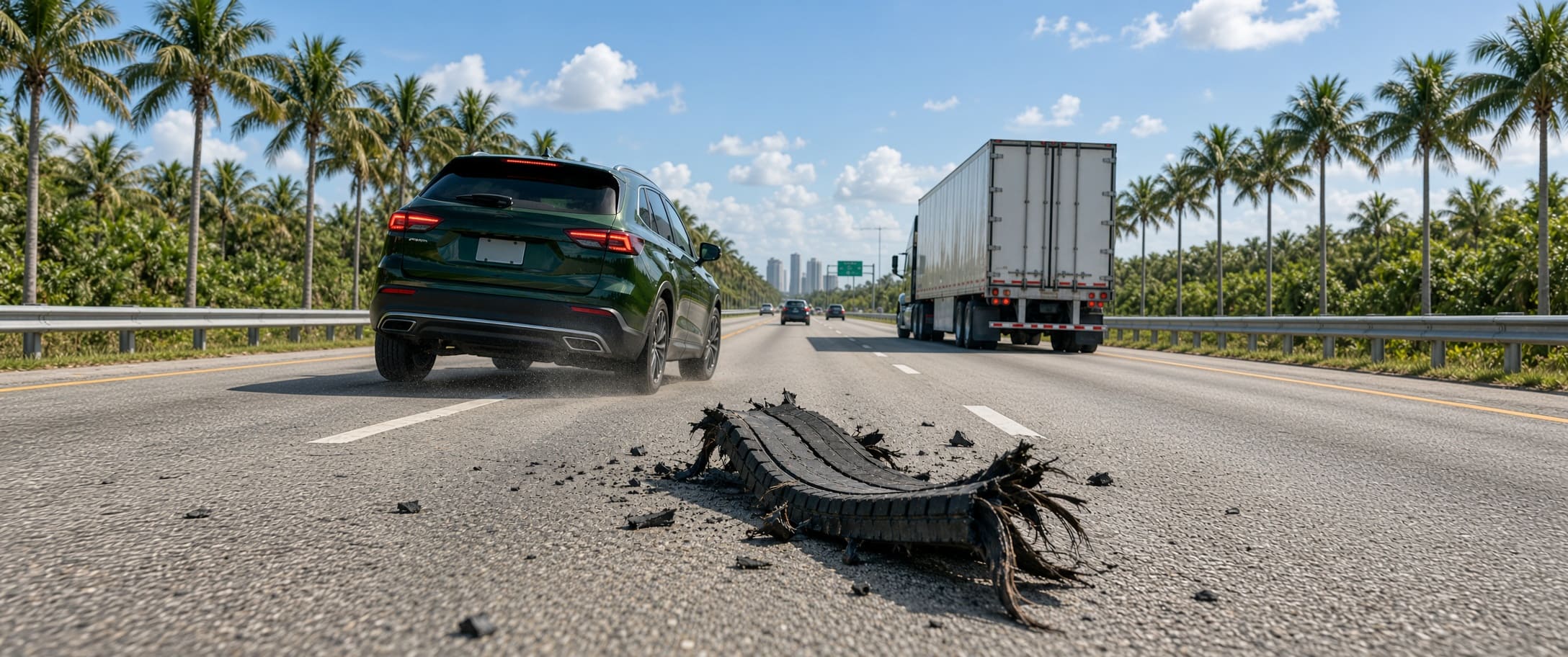
Many drivers never see a license plate. The tread may separate well ahead of their car, or the truck may leave before anyone recognizes what happened. Without an identifiable vehicle or another responsible party, establishing a third-party claim becomes more difficult, but the initial investigation should not stop at the missing plate.
Look beyond the license plate
Witnesses may remember a carrier logo, tractor color, trailer number, distinctive trailer marking, or part of a USDOT number. Even an approximate vehicle description can help narrow the search.
Reconstruct the time and location
Note the road, travel direction, nearest exit, mile marker, lane, and approximate time. These details can help identify nearby traffic, potential cameras, and responding officers.
Seek recordings promptly
Dashcams, nearby business cameras, and potentially available traffic video may provide leads. Not every camera records or retains footage, so preservation requests can be time-sensitive.
Keep the insurance issue separate
An unknown truck does not automatically qualify for uninsured motorist benefits. The policy and the evidence connecting an uninsured or unidentified motor vehicle to the crash must be reviewed.
Describe only what you observed
Tell the responding officer what you actually observed: whether you saw rubber detach, saw a particular truck moments earlier, or encountered debris already lying in the lane. Do not describe an unidentified fragment as coming from a specific truck unless there is evidence for that conclusion.
Tire failure versus debris already on the road
Two crashes may look similar from the damaged driver's perspective but have very different proof of responsibility. A tire blowout is also different from a truck losing tread while continuing to travel normally.
Tread separates in view
A driver or camera sees rubber leave a particular truck immediately before the collision. The source may be easier to trace, though unsafe operation or a product defect still must be established.
Rubber was already in the lane
The debris is stationary and its age or source is unknown. Identifying the originating vehicle and showing why anyone should be held responsible can be substantially harder.
A driver swerves to avoid it
The vehicle may never touch the rubber. The reason for the maneuver, available reaction time, nearby traffic, and proof of where the debris came from become particularly important.
How blowout cases differ
A truck that suffers a blowout and loses control raises additional questions about the truck's movement and direct contact with other vehicles. For that separate situation, see the firm's Orlando guide to truck tire blowout accidents.
Evidence that can help identify the source
The most useful evidence establishes both where the tread came from and how it caused the collision. A good photograph of a tire fragment may document the object but still leave the truck unidentified.
Dashcam or witness video
Footage showing the truck, tread separating, debris landing, and the following collision may establish the sequence more clearly than a driver's recollection.
Precise scene details
Record the mile marker, lane, road direction, nearby exits, time, roadway conditions, and the location where your vehicle came to rest.
Truck identifiers
Trailer number, motor carrier name, markings, plate information, or a partially visible USDOT number may help identify a truck or carrier.
Physical damage and fragments
Photographs of impact marks, glass, undercarriage damage, or recovered tire pieces may help reconstruct contact. Save items only when they can be collected safely.
Crash report and witnesses
The investigating agency's report, independent witness contact information, and any recorded comments can point investigators toward a source or competing explanation.
Vehicle and commercial records
When a truck is identified, available inspection, repair, dispatch, and other relevant records may help evaluate its tire condition or connect the truck to the location.
Preserve physical evidence safely
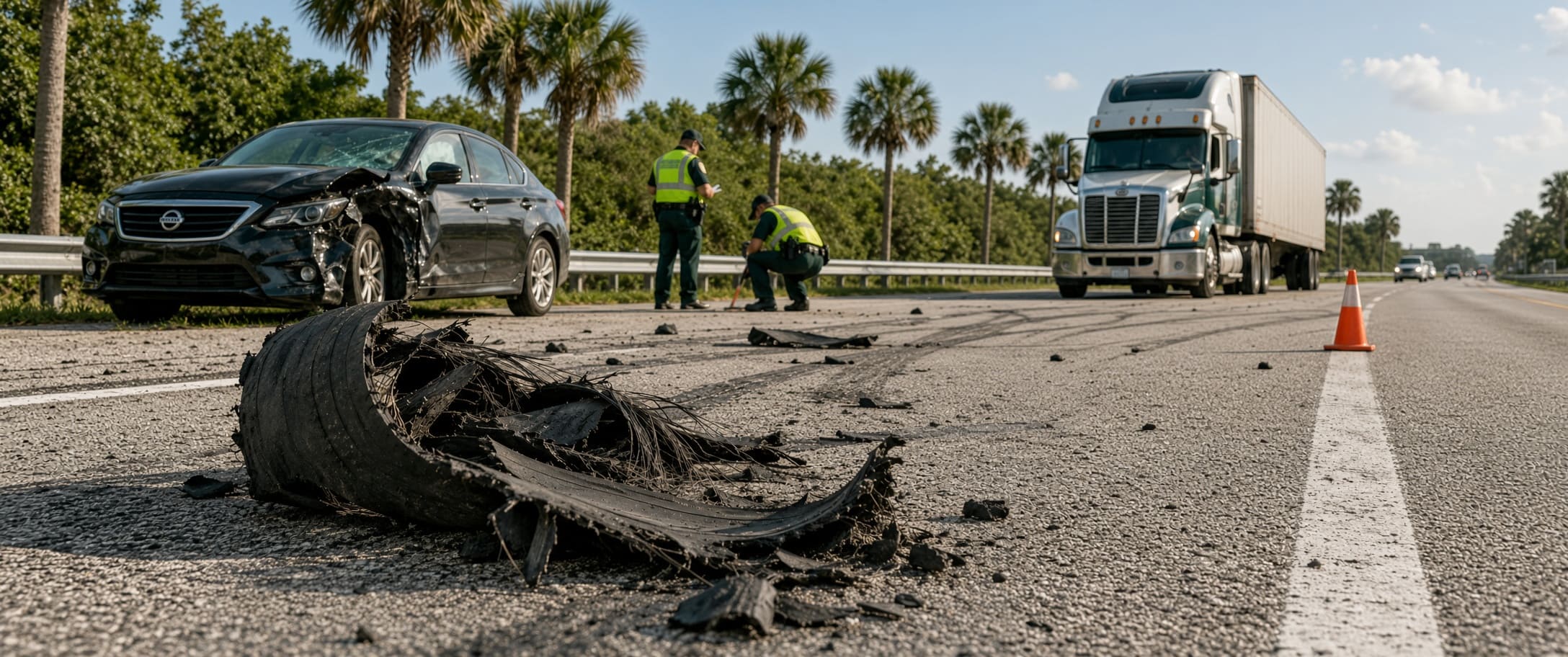
If a physical fragment is recovered, do not clean, cut, or discard it. Keep it documented and stored safely. A qualified examiner may be able to evaluate its construction, damage pattern, or possible source, but a generic tire fragment seldom identifies a particular truck without additional evidence.
Can maintenance or manufacturing defects matter?
Yes. Federal tire safety rules prohibit operating covered commercial vehicles with certain tire conditions, including tread or sidewall separation and exposed belt material. 49 CFR § 393.75 also sets minimum tread-depth requirements for specified tire positions. Separately, 49 CFR § 396.3 generally requires covered motor carriers to inspect, repair, and maintain vehicles under their control.
Those rules can become relevant when investigators identify the truck and determine how the tire failed. For example, an expert may consider evidence of preexisting separation, underinflation, overloading, road-impact damage, poor installation, or a possible manufacturing defect. The evidence must distinguish a preventable condition from damage that occurred during the failure itself.
A retreaded tire is not automatically defective or unlawful. Applicable restrictions depend on the vehicle and tire position. Likewise, the sight of detached tread does not prove a manufacturer caused the failure. The original tire, remaining casing, service history, and physical examination may be needed before reaching a conclusion.
First identify the source
The immediate focus of a debris crash investigation is identifying the source and proving the collision sequence. Maintenance records become important after investigators have a plausible truck, motor carrier, or tire to examine; they do not replace proof that the debris came from that source.
Insurance and injury claims after a tire debris crash
Coverage depends on whether a liable party can be identified, how the tire debris struck the vehicle, and the policies involved. Hitting rubber already on the pavement may be treated differently from being struck by an airborne fragment. Property damage and bodily injury can also involve different coverage.
| Coverage or claim | What may apply |
|---|---|
| Third-party liability | If evidence identifies a responsible driver, carrier, maintenance provider, or other defendant, a claim may seek compensation for supported losses subject to liability, causation, coverage, and applicable law. |
| Collision coverage | If your vehicle strikes tire rubber already lying in a traffic lane, optional collision coverage may pay for covered damage, subject to the policy terms and deductible. It does not establish who left the debris. |
| Comprehensive coverage | If an airborne tire fragment strikes your vehicle, optional comprehensive (other-than-collision) coverage may apply as damage from a falling object. The impact circumstances and policy wording determine how the insurer classifies the loss. See the Florida Department of Financial Services' auto insurance overview. |
| Personal injury protection (PIP) | Eligible Florida motorists may have PIP benefits for certain accident-related medical expenses and lost income regardless of fault. Under Fla. Stat. § 627.736, eligible initial medical care must generally be received within 14 days for covered medical benefits. |
| Uninsured motorist (UM) coverage | UM coverage may be worth reviewing when an unidentified or uninsured motor vehicle caused bodily injury, but a fragment of unknown origin does not automatically satisfy the requirements. Florida's UM framework is in Fla. Stat. § 627.727; policy language and facts matter. |
What losses may be part of an injury claim?
Depending on the cause of action and the available evidence, recoverable damages may include medical expenses, lost income, future care needs, and other accident-related losses. Non-economic damages may be available when Florida's legal requirements are met. Property damage, towing, and related expenses should be documented separately rather than assumed to be covered by every policy.
Fault rules and filing deadlines matter
Under Fla. Stat. § 768.81, a claimant's share of fault can reduce recovery; in negligence actions governed by the statute, fault greater than 50% generally prevents recovery. Fla. Stat. § 95.11 generally provides a two-year period for negligence lawsuits. Some personal-injury claims based on the design, manufacture, distribution, or sale of a defective product fall within a four-year category under § 95.11(3)(d); certain claims for injury to personal property are addressed separately in § 95.11(3)(g). The correct period depends on the legal theory and facts, and special notice, accrual, and product-repose rules may apply. Evidence can disappear much sooner than any filing deadline.
What to do after hitting truck tire debris
The first priority is safety, not collecting proof from an active roadway.
Get out of immediate danger.
Move to a safe location if possible and call 911 for injuries or an ongoing road hazard. Do not enter traffic lanes to retrieve tire rubber.
Report what happened accurately.
Tell the investigating officer whether you saw a tire come off a truck, struck an object already in the lane, or swerved to avoid it.
Document your vehicle and the surroundings.
Save safe scene photos, vehicle damage images, witness details, exact location, and original dashcam footage.
Address injuries and policy notice promptly.
Seek appropriate medical attention, keep records, and notify your insurer within applicable policy requirements.
Preserve evidence before it is lost.
Do not discard relevant damaged parts or recordings, and consider prompt legal review if a truck needs to be identified or footage may soon be overwritten.
Frequently asked questions about truck tire debris accidents
Can I sue a trucking company if tire tread caused my crash?
Possibly. A claim needs evidence connecting the tread to an identifiable truck or another responsible party and showing an actionable basis for liability. Simply finding truck tire rubber on a Florida highway does not prove a particular company caused the hazard.
What if I never saw which truck dropped the tire debris?
Useful leads may still exist in dashcam footage, eyewitness accounts, carrier markings, precise location records, or available nearby video. If no responsible vehicle can be identified, a third-party claim may be difficult and your own available coverage should be evaluated.
What if I swerved to miss the rubber and hit another car?
The absence of direct contact with the debris does not by itself resolve negligence or insurance coverage. Investigators may consider how suddenly the hazard appeared, the drivers' reactions, traffic conditions, independent evidence, and any policy requirements.
Does hitting a tire fragment prove that the truck driver was negligent?
No. The fragment may not identify a truck, and a tire can fail for different reasons. Evidence of the tire's condition, the driver's knowledge, maintenance, and the collision sequence may be needed to support liability.
Are retreaded truck tires illegal in Florida?
No. There is no blanket federal ban on retreaded truck tires. Under 49 CFR § 393.75(d), buses may not use retreaded, recapped, or regrooved tires on their front wheels. A separate rule, § 393.75(e), prohibits regrooved tires rated to carry 4,920 pounds or more on the front wheels of trucks or truck tractors. These are different restrictions; retreading alone does not prove negligence or a tire defect.
Will my car insurance pay if the truck is never found?
Potentially, depending on the policy and how the crash occurred. Collision coverage may apply when your car strikes debris on the road; comprehensive coverage may apply when a fragment strikes the vehicle while airborne. PIP may apply to eligible injuries. UM bodily injury coverage is not automatically triggered by unidentified roadway debris.
Should I keep the piece of tire rubber?
If it has already been recovered safely, document and preserve it without altering it. Never walk into an active traffic lane to collect debris. Photographs, original recordings, and the vehicle's damaged parts can also be useful.
How long do I have to bring a Florida injury lawsuit?
Florida generally allows two years for negligence lawsuits under Fla. Stat. § 95.11. Certain defective-product personal injury claims and certain property-damage claims can fall within four-year categories, but exceptions and other deadlines may apply. Seek guidance early because recordings, physical evidence, and witness memories can disappear.

Florida truck accident guidance
Questions about a truck tire debris crash?
If you were injured and the source of the debris or the insurer's response is disputed, The Nunez Law Firm can review the circumstances and explain potential next steps.
(407) 203-2769Laws and safety rules referenced
Legal and official consumer-insurance sources for the safety, fault, coverage, and deadline issues discussed above.
- Florida Statutes § 316.610Safety and operation of vehicles in unsafe condition
- 49 CFR § 393.75Federal commercial vehicle tire requirements
- 49 CFR § 396.3Inspection, repair, and maintenance duties
- Florida Statutes § 768.81Comparative fault in covered negligence claims
- Florida Statutes § 627.736Personal injury protection benefits
- Florida Statutes § 627.727Uninsured and underinsured motorist coverage
- Florida Statutes § 95.11Different filing deadlines for negligence, product-related injury, and property damage
- Florida Department of Financial ServicesOfficial explanation of collision, comprehensive, PIP, and uninsured motorist coverage
Article information
Published by The Nunez Law Firm · Updated October 15, 2026
This article provides general information about Florida truck tire debris accidents. It is not legal advice, and it does not establish an attorney-client relationship. The outcome and available coverage depend on the individual facts and applicable law.