

Safety comes first
Move out of danger only if it is safe. Emergency help and medical care come before photos or paperwork.
Florida Accident Guide
Protect your safety, document the crash, seek medical care, notify your insurer, and preserve evidence. These first-day steps can affect PIP benefits, fault disputes, and your injury claim.

After a Florida car accident, focus on five steps first:
Move out of danger only if it is safe. Emergency help and medical care come before photos or paperwork.
Immediate notice under Section 316.065 is not the same thing as the long-form written crash report process under Section 316.066.
Florida PIP medical benefits depend in part on timely initial services and care after the crash.
Early statements, releases, and broad authorizations may be compared with medical records, photos, and witness accounts.
Use this short checklist first. The full checklist appears later in the document, but these items should be handled early when safety allows.
If there is pain, visible injury, suspected impairment, a hit-and-run, a disabled vehicle, or uncertain damage, contact emergency services or law enforcement.
Get names, phone numbers, license plates, driver's license details, insurance information, and witness contact information.
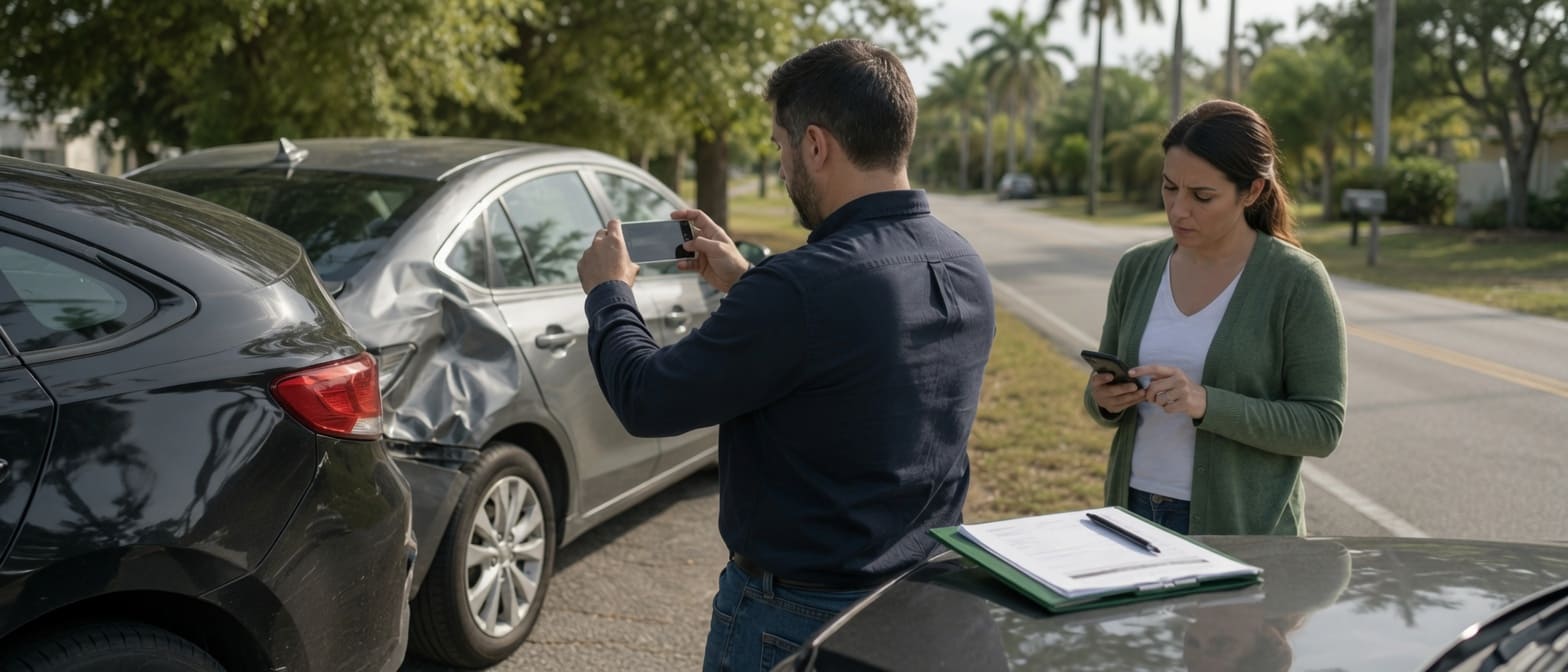
Capture wide shots, close-ups, road signs, traffic lights, lane markings, vehicle positions, damage, debris, and visible injuries if safe.
Tell the provider the symptoms began after a motor vehicle accident, even if pain appeared later.
Report the crash to your own insurer, but do not guess about fault, speed, injury severity, or future care.
The first day does not need to answer every legal question. It should protect safety, document what happened, start appropriate medical care, and avoid statements or signatures that may create problems later.
Florida accident questions often sound similar, but they are governed by different rules. Police notice, written crash reports, PIP medical benefits, lawsuit deadlines, and comparative fault should not be treated as one deadline or one form.
Florida Statutes Section 316.065 requires the driver of a vehicle involved in a crash to give immediate notice by the quickest means of communication when the crash results in injury, death, or apparent vehicle or property damage of at least $500. If the crash occurs inside a municipality, notice goes to the local police department. Otherwise, notice goes to the county sheriff or the nearest Florida Highway Patrol office or station.
Why this matters: if someone has pain, the damage may exceed $500, the other driver leaves, impairment is suspected, or the scene feels unsafe, calling law enforcement is safer than trying to make a legal judgment under stress.
Florida Statutes Section 316.066 deals with written reports after a crash is investigated by law enforcement. A Florida Traffic Crash Report, Long Form is required in situations listed by the statute, including death, personal injury, any indication of complaints of pain or discomfort, leaving-the-scene or DUI-related issues, a vehicle requiring a wrecker, or involvement of a commercial motor vehicle.
Important distinction: complaints of pain are specifically tied to long-form crash report rules under Section 316.066. They should not be confused with the separate immediate-notice threshold in Section 316.065, although pain is also a practical reason to call for help.
Florida Personal Injury Protection, often called PIP, has its own medical-benefit timing rule. For certain PIP medical benefits, initial services and care must be received within 14 days after the motor vehicle accident. PIP is an insurance-benefit issue, not the same thing as the police-reporting rule or the deadline to file a lawsuit.
Do not confuse this with: the first 24 hours are not the PIP deadline. Still, early care helps document symptoms, treatment instructions, referrals, and whether the crash caused or aggravated the condition.
Florida Statutes Section 95.11 places negligence actions and wrongful death actions in a two-year limitations category. The correct deadline can still depend on the claim type, the parties involved, the facts, and any specific exception that may apply.
Keep in mind: insurance calls, repair discussions, or settlement negotiations do not automatically protect every legal filing deadline. A claim can feel active while a legal deadline is still moving.
Florida Statutes Section 768.81 addresses comparative fault in covered negligence actions. In a negligence action to which the statute applies, a party found greater than 50 percent at fault for his or her own harm may not recover damages, except as stated in the statute for medical negligence actions.
For your claim: photos, vehicle positions, witness names, road conditions, and careful statements can become important when an insurer later argues that you were partly or mostly at fault.
A police report does not decide the value of a claim. A PIP claim does not prove fault. A medical visit does not automatically establish liability. A lawsuit deadline is not the same as an insurance deadline. Each rule answers a narrower question, so the safest approach is to preserve facts early and review the case before making final decisions.
Important: do not rely on one document, one phone call, or one deadline to protect every part of a Florida car accident claim.
The order below is designed for real accident conditions. If someone is injured, safety and medical care come first. If it is safe to document the scene, collect facts before vehicles are moved, witnesses leave, or video is overwritten.
Check yourself, your passengers, and anyone else involved. Move out of traffic only if it is safe. Turn on hazard lights and avoid standing between vehicles. Call 911 or law enforcement if anyone may be hurt, a driver leaves, impairment is suspected, a vehicle cannot be driven, a commercial vehicle is involved, or the damage threshold is unclear.
Do not argue about fault at the scene. Focus on injuries, location, vehicles involved, emergency needs, and the facts a responding officer or dispatcher may need.
Get the other driver's name, phone number, address, license plate, driver's license information, insurance company, policy details, and vehicle description. If there are passengers or witnesses, ask for names, phone numbers, and a short note about what each person saw.
If the other driver refuses to share information, gives inconsistent details, or appears impaired, tell the responding officer or dispatcher and preserve what you can safely document, including the license plate, vehicle description, and photos.
Take wide photos, close-up photos, and context photos if it is safe. Capture vehicle positions, all sides of each vehicle, license plates, damage, airbags, broken glass, debris, skid marks, traffic signs, traffic lights, lane markings, construction areas, weather, lighting, visible injuries, and the surrounding roadway or intersection.
Look for possible video sources: dashcams, nearby businesses, homes, rideshare vehicles, parking-lot cameras, traffic cameras, or security cameras. Write down the location before leaving, because video can be deleted or overwritten quickly.
Pain after a crash may be delayed. Neck pain, back pain, headaches, shoulder pain, dizziness, numbness, tingling, nausea, stiffness, anxiety while driving, sleep problems, and worsening soreness should be reported to a medical provider, even if the symptoms seem mild at first.
Tell the provider that the symptoms began after a motor vehicle accident. Explain where you were seated, how your body moved, where the impact occurred, whether airbags deployed, whether you hit any part of the vehicle, and when each symptom appeared.
Most auto policies require prompt notice. When reporting the claim to your own insurer, provide basic facts: date, time, location, vehicles involved, whether anyone was injured, whether law enforcement responded, where your vehicle is located, and any claim or report number you have.
Keep the report factual. Do not guess about speed, distance, fault, injury severity, future treatment, or claim value. If you do not know an answer, say that you do not know.
Create one folder for the crash report number, photos, videos, discharge papers, prescriptions, referrals, work restrictions, insurance cards, repair estimates, towing receipts, rental car information, missed-work notes, and messages from insurance companies.
Keep a simple symptom and expense log. Note pain levels, medical visits, medication, transportation costs, missed work, and daily limitations. A same-day record is usually easier to rely on than memory weeks later.

Real crashes do not always follow a clean checklist. These scenarios explain what to do when the scene was confusing, symptoms appeared later, or the other driver is already disputing what happened.
Delayed pain is common after a collision. If symptoms appear the next morning, get medical care as soon as possible and explain that the pain began after the crash. Do not describe yourself as "fine" to an insurer if you have not yet been evaluated and symptoms are still developing.
Why this matters: the key is not pretending every symptom was immediate. The key is accurately documenting when each symptom started and how it changed.
If you left before collecting everything, write down what you remember while it is fresh: location, time, lanes, weather, vehicle descriptions, damage, statements, witnesses, and nearby businesses. Save photos of your vehicle, repair estimates, medical paperwork, texts, and any insurer messages.
Keep in mind: you may not be able to recreate the scene perfectly, but a clear same-day note can preserve important details before memory fades.
Sometimes a minor crash is handled with driver exchange information, or law enforcement may not come to the scene. If that happens, preserve the other driver's information, photos, witness names, insurer details, and any dispatch or incident number. If pain develops or the facts become disputed, the lack of a full report can make your own documentation more important.
Important: no officer at the scene does not automatically mean there is no claim. It means the available proof may come from photos, witnesses, medical records, repair evidence, and insurance documentation.
Do not debate fault at the scene or during an early insurance call. Save evidence that may help clarify what happened: vehicle positions, traffic controls, lane markings, turn signals, dashcam video, witness information, and the exact location of impact.
For your claim: disputed fault is one reason early photos and witness details matter, especially under Florida's comparative fault rules.
Call law enforcement, write down the license plate or partial plate if known, save a vehicle description, photograph damage and the scene, and identify cameras or witnesses nearby. Also notify your own insurer because uninsured motorist coverage, collision coverage, or other policy provisions may become important.
Early settlement offers may arrive before diagnosis, imaging, follow-up care, wage loss, future treatment, or all available insurance is clear. A release can end claims against certain parties or for certain damages, so it should be reviewed carefully before signing.
Florida PIP is one reason early medical care matters after a crash. The first 24 hours are not the PIP deadline, but they are often the best time to document symptoms, receive treatment instructions, and avoid gaps in the record.
Florida PIP medical benefits require initial services and care within 14 days after the motor vehicle accident for certain medical benefits. Waiting can create both health and insurance problems, especially when pain, headaches, numbness, or stiffness becomes more serious after the scene has cleared.
Florida PIP can reimburse 80% of reasonable expenses for medically necessary covered care, subject to the statute and policy terms. Reimbursement may reach up to $10,000 when a qualified provider determines that the injured person had an emergency medical condition. If a provider determines there was no emergency medical condition, medical benefits may be limited to $2,500.
In simple terms, an emergency medical condition is a serious medical condition with acute symptoms, which may include severe pain, where lack of immediate medical attention could reasonably be expected to put health in serious jeopardy, seriously impair bodily functions, or cause serious dysfunction of a body organ or part.
The PIP statute identifies categories of providers and services that may qualify for medical reimbursement. Emergency care, hospital care, physicians, dentists, physician assistants, advanced practice registered nurses, chiropractic physicians, and other listed providers may be relevant depending on the treatment path.
Explain that you were in a motor vehicle accident, describe your position in the vehicle, where the impact occurred, whether airbags deployed, and when each symptom started. Do not minimize pain to be polite. Accurate details help the provider decide whether imaging, referrals, medication, work restrictions, or follow-up care are needed.
PIP timing does not decide who caused the crash, the full value of the claim, or whether another insurer may be responsible. It is one part of a larger insurance and injury analysis.
Evidence and insurance communication are connected. What you save early can answer questions later; what you say too broadly can create avoidable disputes before the medical and repair facts are clear.
Save photos of the vehicles, roadway, traffic controls, lane markings, debris, broken glass, skid marks, airbags, injuries, repair estimates, towing receipts, and video locations. Also keep witness names and short notes about what each person saw.
Report the crash to your own insurer with basic facts and ask for the claim number. With the other driver's insurer, be more cautious. You can confirm contact information, but avoid recorded statements, broad medical authorizations, injury minimization, or quick releases before the facts are clear.
Your own policy may require prompt notice and cooperation. The other driver's insurer is evaluating liability, coverage, and settlement exposure for its insured. That difference matters when deciding how much to say, what to sign, and whether a request is routine or too broad.
Use this checklist to organize the first day after a crash. It is not a substitute for emergency care. If you are hurt, medical care and safety come before documentation.
Turn on hazard lights, avoid traffic, and call emergency services if anyone may be hurt.
Call for injury, death, apparent damage of at least $500, suspected impairment, hit-and-run, a disabled vehicle, commercial vehicle involvement, or uncertainty about safety or damage.
Complaints of pain are listed in Florida's long-form crash report rule when law enforcement investigates the crash. Pain is also a practical reason to seek help, but it should not be confused with every separate legal threshold.
Save names, phone numbers, license plates, driver's license details, insurance companies, policy numbers, and vehicle descriptions.
Include close-ups, wide shots, road signs, traffic signals, debris, lane markings, injuries, and vehicle positions.
Ask witnesses for names, phone numbers, and a short note about what they saw.
Tell the provider you were in a motor vehicle accident and describe every symptom, including symptoms that appeared later.
Report the basic facts without guessing about fault, injury severity, future treatment, or claim value.
Avoid recorded statements, broad medical authorizations, and quick releases until you understand the request.
Keep discharge papers, prescriptions, referrals, repair estimates, towing receipts, rental records, claim numbers, emails, and text messages.
Ask for help if injuries are significant, fault is disputed, the police report is wrong or incomplete, the crash involved a commercial vehicle or hit-and-run, or a release is presented early.
Some crashes should not be treated like a routine insurance claim. A checklist helps with organization, but complex cases may require faster evidence preservation, a careful insurance review, and a closer look at who may be responsible.
Complex crashes may involve multiple insurers, employer records, vehicle maintenance records, driver logs, dashcam or surveillance footage, electronic vehicle data, special notice requirements, medical liens, future treatment, lost earning capacity, and disputes about comparative fault. In these situations, preserving evidence and avoiding broad statements or releases may be more important than trying to resolve the claim quickly.
Use the Florida Car Accident Claim Checker to identify common warning signs after a crash: https://thenunezlawfirm.com/blog/auto-accident/florida-car-accident-claim-checker/
Not every minor crash becomes a legal dispute. Legal help becomes more important when the crash involves serious injuries, disputed fault, missing evidence, unclear insurance, or settlement documents that would end the claim.
Video may be overwritten, vehicles may be repaired, commercial records may change hands, and witnesses may become harder to reach. A legal review can identify what should be requested or preserved early.
Crash reports can be incomplete, contain errors, or leave out information that later matters. A lawyer can review whether the report matches photos, witness accounts, vehicle damage, medical records, and the client's recollection.
A Florida crash may involve PIP, bodily injury liability coverage, uninsured or underinsured motorist coverage, property damage coverage, commercial coverage, employer coverage, or more than one policy.
A release can end important rights. Before signing, an injured person should understand which claims are being released, which parties are protected, what bills remain unpaid, and whether future treatment is still expected.
The Nunez Law Firm helps injured drivers, passengers, and families understand the next steps after a Florida crash. If you are dealing with pain, disputed fault, insurance calls, medical bills, or a settlement offer that feels too fast, the firm can review what happened and explain your options. Contact: https://thenunezlawfirm.com/contact-us/
First, get to safety and check for injuries. Call 911 or law enforcement if anyone is hurt, if there is apparent damage of at least $500, if a vehicle cannot be driven, if the other driver leaves, if alcohol or drugs may be involved, or if you are unsure whether the crash must be reported. Then exchange information, take photos if safe, get witness details, and seek medical care.
Not every minor crash is handled the same way, but Florida law requires immediate notice to law enforcement when a crash results in injury, death, or apparent vehicle or property damage of at least $500. Written crash report rules are separate and can apply in injury, pain, tow-away, commercial vehicle, DUI-related, or leaving-the-scene situations.
No. Complaints of pain are specifically listed in Florida's long-form written crash report rule when law enforcement investigates the crash. The immediate notice rule under Section 316.065 focuses on injury, death, or apparent damage of at least $500. In practice, pain is still a strong reason to call for help and seek medical care.
Get medical care as soon as symptoms appear and explain that the pain began after the accident. Do not ignore headaches, dizziness, neck pain, back pain, numbness, tingling, worsening stiffness, or symptoms that affect work, sleep, driving, or daily movement.
Preserve what you can: driver information, insurance details, photos, witness names, vehicle damage, repair estimates, medical records, and any dispatch or incident number. If pain develops or the facts become disputed, your own documentation may become especially important.
Florida PIP medical benefits require initial services and care within 14 days after the motor vehicle accident for certain medical benefits. The first 24 hours are not the PIP deadline, but early care helps document symptoms, treatment instructions, referrals, and whether the crash caused or aggravated the condition.
Be cautious. You can identify the claim and provide basic contact information, but avoid guessing, admitting fault, minimizing injuries, giving a recorded statement, signing broad medical authorizations, or accepting a release before the injuries, coverage, and next steps are understood.
Consider contacting a lawyer if you were injured, fault is disputed, the crash report is wrong or incomplete, the insurer asks for a recorded statement or release, the other driver has no insurance, the crash involved a commercial vehicle, or you receive a settlement offer before treatment and damages are clear.
Free Consultation
If an insurance company is pressuring you or you are unsure what to do after an accident, contact our team for a free case assessment. We review your situation and explain your options at no cost.
No fee unless we win. Available 24/7 for new clients in Orlando, Fort Myers, and across Florida.
(407) 203-2769