

Who is liable for a bicycle dooring accident in Florida?
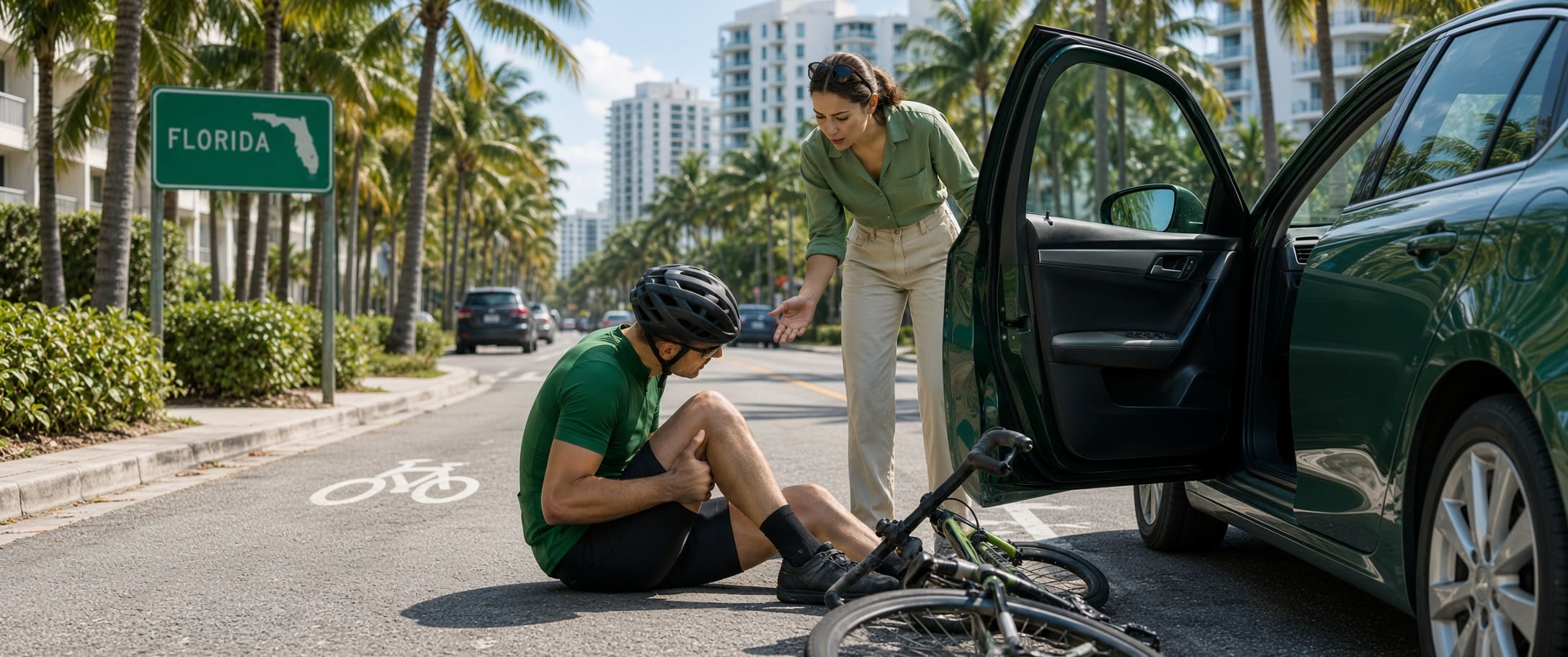
A driver or passenger who opens a car door into a bicyclist’s path may be liable for a Florida bicycle dooring accident. This can happen alongside a parked car or during a curbside drop-off. Florida’s vehicle-door law (section 316.2005) prohibits unsafe door opening. A cyclist who falls or swerves into traffic to avoid the door may also have a negligence claim, even without touching the car. The rider’s own conduct and eligibility for insurance benefits are separate questions.
Florida’s law on opening vehicle doors
Section 316.2005 applies to both drivers and passengers. They must wait to open a door until it is reasonably safe and will not interfere with moving traffic. On the traffic side of the vehicle, the door must not remain open longer than needed to load or unload passengers. Violations are classified as nonmoving traffic infractions.
A violation can help establish negligence, but the injured rider must still connect the unsafe opening or obstruction to the injury and resulting loss.
Who can be responsible for a dooring collision?
| Person or entity | Possible basis for responsibility |
|---|---|
| Driver opening a door | Failing to look for an approaching cyclist or opening a door before there is adequate clearance. |
| Passenger opening a door | Opening a passenger door into moving traffic without checking the path. |
| Driver who is not the door opener | Independent negligent conduct, such as an unsafe stopping position or instructions to exit into an obvious hazard, if causally connected to the injury. |
| Another motorist | Unsafe passing or another negligent maneuver that contributes to a secondary collision. |
When a rideshare or taxi passenger opens the door
Identify who opened the door and where the driver stopped. The driver is not necessarily responsible for a passenger’s actions, but choosing an unsafe drop-off location can be a separate basis for liability.
Save the trip confirmation, receipt, app messages and location details. The trip status, the identities of the driver and passenger, and the applicable insurance policies help determine coverage; the receipt alone does not establish it.
Can a bicyclist share fault for riding near parked cars?
Yes, although riding beside parked cars is not automatically negligent. The relevant facts include the cyclist’s speed and position, visibility, available clearance and whether moving traffic or another obstacle prevented the rider from moving away.
Under section 316.2065(5)(a), a cyclist traveling slower than normal traffic must generally use an available bike lane or keep as far right as practicable if none exists. Subparagraph (5)(a)3 expressly allows departure when reasonably necessary to avoid a hazard or potential conflict, including parked cars. The provision does not set a universal clearance distance from parked vehicles. Look at the lane width, door position and available space rather than assuming the rider should have stayed against the curb.
In one hypothetical example, a cyclist riding at a reasonable speed has almost no time to react when a door opens just ahead. In another, a rider sees an already open door with enough time and space to avoid it. The second rider may share fault, although the person who left the door open may still be responsible for creating the hazard.
Under section 768.81(2) and (6), a claimant’s share of fault generally reduces recoverable damages. More than 50% fault bars recovery in a covered negligence action; exactly 50% does not. The reform took effect March 24, 2023. Chapter 2023‑15, sections 30–31, sets out the transition rules. An older accident or lawsuit may require a review of which version of the law applies.
What evidence is especially useful in a dooring claim?
With a direct impact, marks on the door and bicycle may help establish contact. A fall without contact is harder to reconstruct from damage alone: footage or witnesses may show the door moving, the rider swerving and, in a secondary collision, the position of another vehicle.
Document the door, bicycle and roadway together
- Photograph the relevant door, its position, damage and any marks on the bicycle.
- Capture the width and markings of the bike lane, parking space, travel lane and curbside restrictions.
- Record obstructions that limited visibility or the cyclist’s ability to move away from parked vehicles.
- Identify the precise vehicle and the person who opened the door; do not assume it was the registered owner.
- Keep the damaged bicycle, helmet and relevant equipment until their condition has been documented and any necessary inspection arranged.
Preserve video and witness information
Storefront cameras, dashcams, bicycle cameras and recordings from nearby vehicles may show when the door moved. Ask businesses or property managers to preserve the relevant footage promptly. Where possible, obtain the complete recording, not only the moment of impact.
Ask witnesses what they saw before the fall: where the cyclist was riding, when the door moved and whether the rider braked or swerved. A crash report can help identify the people and vehicles, but compare its account with the original footage and witness observations.
Which insurance can cover a Florida bicycle dooring accident?
The person who caused the crash and the insurer responsible for initial medical bills may be different. Depending on the incident, personal injury protection (PIP), liability insurance, health insurance or other coverage may apply.
| Potential coverage | What needs to be established |
|---|---|
| Personal injury protection | Whether the cyclist qualifies as an insured or eligible nonoccupant, and whether the injury satisfies the statute’s motor vehicle involvement and contact requirements. |
| Auto bodily injury liability | Whether the responsible person is covered and the injuries arise from a covered use of the vehicle. |
| Other liability coverage | Whether another policy applies to the passenger or other responsible party; motor vehicle exclusions may be relevant. |
| Uninsured or underinsured motorist coverage | Whether the claimant is insured under the applicable policy and whether the circumstances qualify for uninsured or underinsured motorist benefits. |
| Property damage coverage or liability claim | The cause, value and extent of damage to the bicycle and related property. |
Which PIP policy should a cyclist check first?
For a cyclist on a conventional bicycle injured in Florida, section 627.736(4)(e) sets out the following coverage categories. Each of the nonoccupant categories below requires the injury to result from physical contact with a motor vehicle. Check the policies and exclusions before assuming that a particular insurer owes benefits.
- Your own auto insurance: If you own a motor vehicle subject to Florida’s required insurance laws, start with your own applicable policy. Subparagraph (4)(e)1 addresses an insured vehicle owner’s injuries as a nonoccupant in Florida.
- A resident relative’s auto insurance: If you do not own a motor vehicle for which Florida requires security, check the policy of a relative who owns one and with whom you were domiciled at the time of the accident. Subparagraph (4)(e)3 may apply, subject to coverage and exclusions.
- The involved vehicle’s insurer: If you are a Florida resident, do not own a vehicle for which security is required and are not entitled to PIP from another such owner’s insurer, subparagraph (4)(e)4 may provide coverage through the insurer of the vehicle with which the injury-causing contact occurred. A nonresident cyclist cannot assume eligibility under this fallback provision.
Do not postpone medical care while you identify the right insurer. Section 627.736(1)(a) requires qualifying initial care within 14 days of the motor vehicle accident for PIP medical benefits. Medical and disability benefits share a $10,000 statutory limit.
Medical reimbursement above $2,500 requires an affirmative emergency medical condition (EMC) determination by a provider authorized under section 627.736(1)(a)3. If no such determination has been made, or a qualifying provider finds no EMC, medical reimbursement is limited to $2,500. See Medical Center of the Palm Beaches v. USAA Casualty Insurance Co. (2016).
What if the bicycle never touched the vehicle?
If there is no contact with any motor vehicle, the physical-contact requirement in the PIP provisions above is not met. A door striking only the bicycle, or a collision with a second vehicle during the fall, needs closer review. Document the contact points and identify the insurers of any vehicles involved. Bicycle-only contact should not be treated as automatically qualifying or disqualifying for PIP.
Even without PIP eligibility, a cyclist may have a claim against the person whose unsafe door opening caused the fall. Whether liability insurance covers that claim is a separate matter.
What losses may be recoverable?
Possible losses include medical bills, medically supported future care, lost income, proven loss of earning capacity and damage to the bicycle or equipment. Treatment records, employment records and repair estimates help document these losses.
For an injury claim subject to Florida’s motor vehicle tort exemption, section 627.737(1)–(2) restricts certain losses payable by PIP and certain noneconomic damages. The injury threshold includes permanent injury within a reasonable degree of medical probability (other than scarring or disfigurement), significant permanent loss of an important bodily function, significant permanent scarring or disfigurement, or death. Whether the exemption applies depends on the person responsible, the required security on the vehicle and the connection between the injury and vehicle use.
Frequently asked questions
Does a dooring accident count if the car was legally parked?
Yes. Lawful parking does not give an occupant permission to open a door unsafely into moving traffic. The parking position and the door opener’s conduct are separate issues.
What if the door opener leaves before I learn their name?
Keep the vehicle description, plate number if available, witness contacts and the exact location. Ask nearby businesses to preserve footage that may identify the person getting out, not only the car.
Can a cyclist be blamed for not wearing a helmet?
Section 316.2065(18) specifically provides that failure to wear a bicycle helmet is not evidence of negligence or contributory negligence. Other facts concerning how the collision occurred may still be relevant.
Does a bike lane guarantee that the driver is fully at fault?
No. The bike lane is important evidence about where the cyclist was traveling, but responsibility depends on the movements, visibility and conduct of the parties.
Should I repair my bicycle immediately after a dooring crash?
Address any safety and transportation needs, but first document the damage thoroughly and preserve damaged parts if possible. Repairs or disposal may remove evidence that helps reconstruct the impact.
What to do if the door opener disputes responsibility
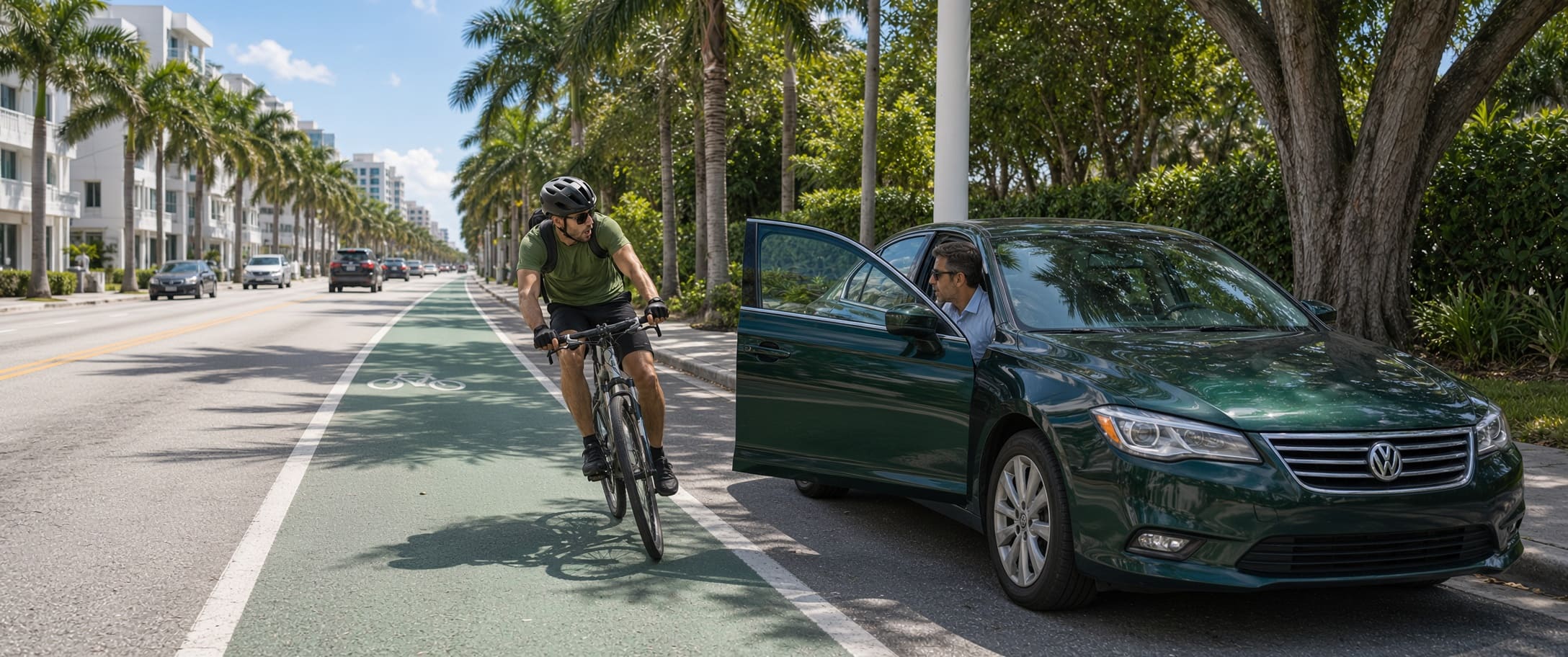
Write down the sequence of events while it is fresh, preserve any video and identify the person who opened the door. If an injury claim involves a passenger, multiple insurers or a disputed evasive maneuver, a Florida bicycle accident lawyer can help assess the relevant evidence and coverage. For an incident in the Orlando area, see the firm’s Orlando bicycle accident legal services.
Official sources
- Florida Statutes, section 316.2005: opening and closing vehicle doors
- Florida Statutes, section 316.2065: bicycle regulations
- Florida Statutes, section 768.81: comparative fault
- Chapter 2023‑15, Laws of Florida: civil remedies and effective date
- Florida Statutes, section 627.736: PIP requirements
- Medical Center of the Palm Beaches v. USAA Casualty Insurance Co., No. 4D14‑3580 (Fla. 4th DCA, August 31, 2016): PIP medical benefit limits
- Florida Statutes, section 627.737: motor vehicle tort exemption and injury threshold
- Florida Statutes, section 627.727: uninsured and underinsured motorist coverage