Florida bicycle accident: which auto insurance pays?

Florida bicycle accident insurance guide

Which auto insurance pays when a bicyclist is hit by a car in Florida?

The driver’s insurance is not always the first source of medical benefits. Florida’s PIP rules look at the injured bicyclist’s own coverage, qualifying household coverage, and the vehicle that made contact.

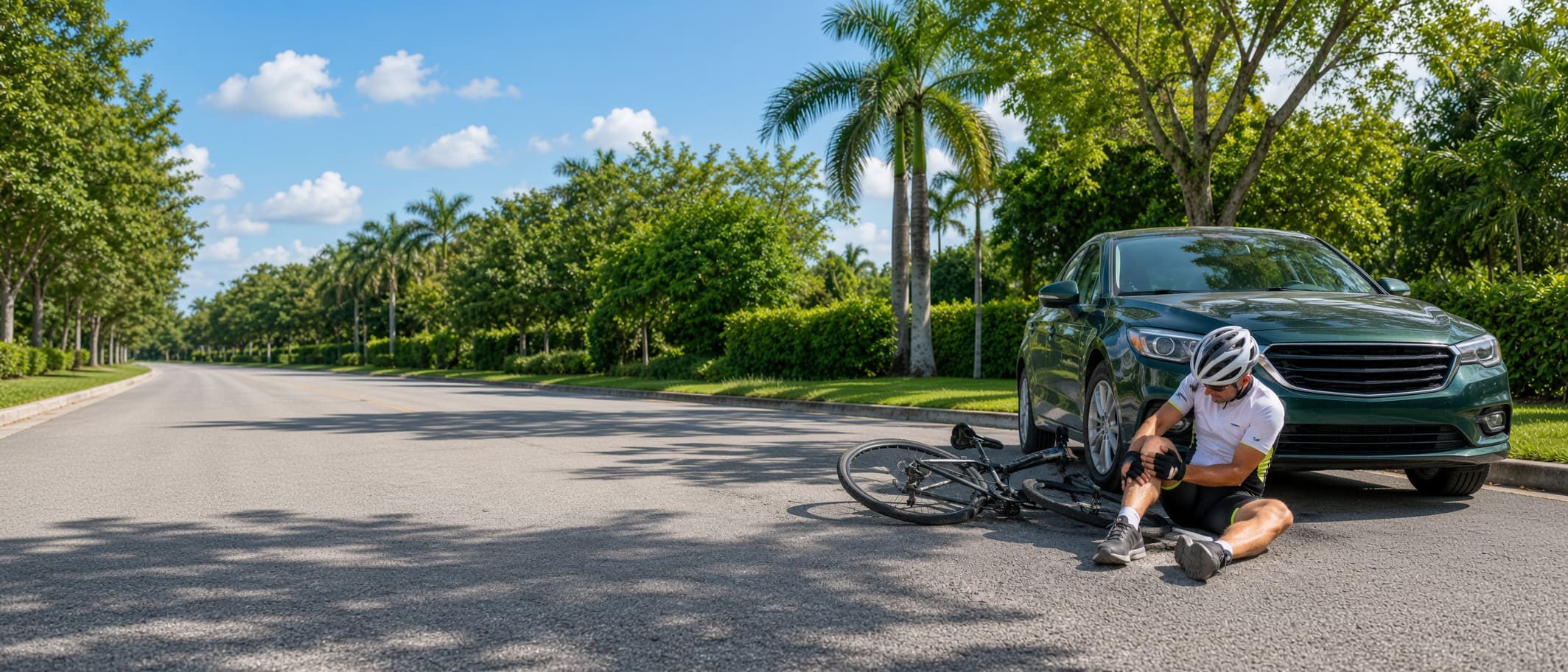
Bicyclist and passenger car involved in a Florida road collision

Quick answer

After a Florida driver hits a bicyclist, check the bicyclist’s own applicable auto PIP policy first. If there is none, check whether a qualifying resident-relative policy covers the bicyclist. If neither applies, the insurer of the car that physically struck the bicyclist may owe PIP benefits, provided the statutory conditions are met. Florida Statutes §627.736(1), (4)(e) controls the analysis—not simply who caused the crash.

How to identify the responsible PIP insurer

These are the three main coverage inquiries. The result depends on who owns a motor vehicle, how the policies define the insureds, where the bicyclist lives, and whether the car struck the rider.

1

Check your own auto policy

If you own a motor vehicle required to carry Florida PIP and have an applicable policy, its insurer is generally the starting point even though you were riding a bicycle. Ownership is relevant even if the required insurance was not maintained.

2

Check eligible household coverage

A resident relative who does not own a motor vehicle requiring PIP may be covered under the motor vehicle owner’s policy.

3

Check the striking vehicle

If you have no applicable owner or household PIP entitlement, the insurer of the vehicle that physically struck you may be responsible.

If you own an uninsured car

Owning a motor vehicle that was required to carry Florida PIP can prevent you from claiming nonoccupant PIP under the striking vehicle’s policy—even if your own car was uninsured. Section 627.736(4)(e)4.a expressly excludes this category of owner. Check whether security was legally required for the vehicle on the accident date.

This sequence identifies possible insurers; it does not guarantee payment. If more than one insurer is liable, §627.736(4)(f) provides for a proportional adjustment between insurers without increasing the injured person’s benefit limit.

Why bicyclists can qualify for Florida PIP

Florida PIP is not limited to people sitting inside cars. Section 627.736 expressly addresses an insured person injured while not occupying a self-propelled vehicle and other qualifying people struck by an insured motor vehicle. A conventional bicycle rider can therefore fall within the statute.

For an owner or covered resident relative injured while cycling in Florida, §627.736(4)(e) refers to physical contact with a motor vehicle. The striking-vehicle provision likewise requires physical contact and, for the relevant nonoccupant category, Florida residency. An evasive fall without contact requires a separate coverage analysis; the striking car’s PIP should not be assumed to apply.

Situation 1: the bicyclist owns an insured car

Suppose you have an active Florida auto policy with PIP on a car you own. That insurer generally provides your PIP benefits for a covered collision with a motor vehicle, although you were cycling and your own car was parked at home. The striking driver’s fault does not shift the first PIP claim automatically to that driver’s carrier.

Situation 2: the bicyclist lives with an insured relative

Suppose you do not own a motor vehicle requiring Florida PIP and live with a parent or other qualifying relative who owns an insured car. Under §627.736(4)(e)3, the relative’s insurer can be responsible when the residency, relationship, ownership, and other coverage requirements are met. Sharing an address alone does not make an unrelated roommate’s policy your PIP coverage.

Situation 3: no personal or eligible household PIP

If you are a Florida resident, do not own a motor vehicle requiring PIP, and are not entitled to qualifying owner or resident-relative benefits, look to the insurer of the motor vehicle that physically struck you. Section 627.736(4)(e)4 provides this route subject to its stated exclusions. Get the driver’s and vehicle owner’s details; the driver and the owner may be different people.

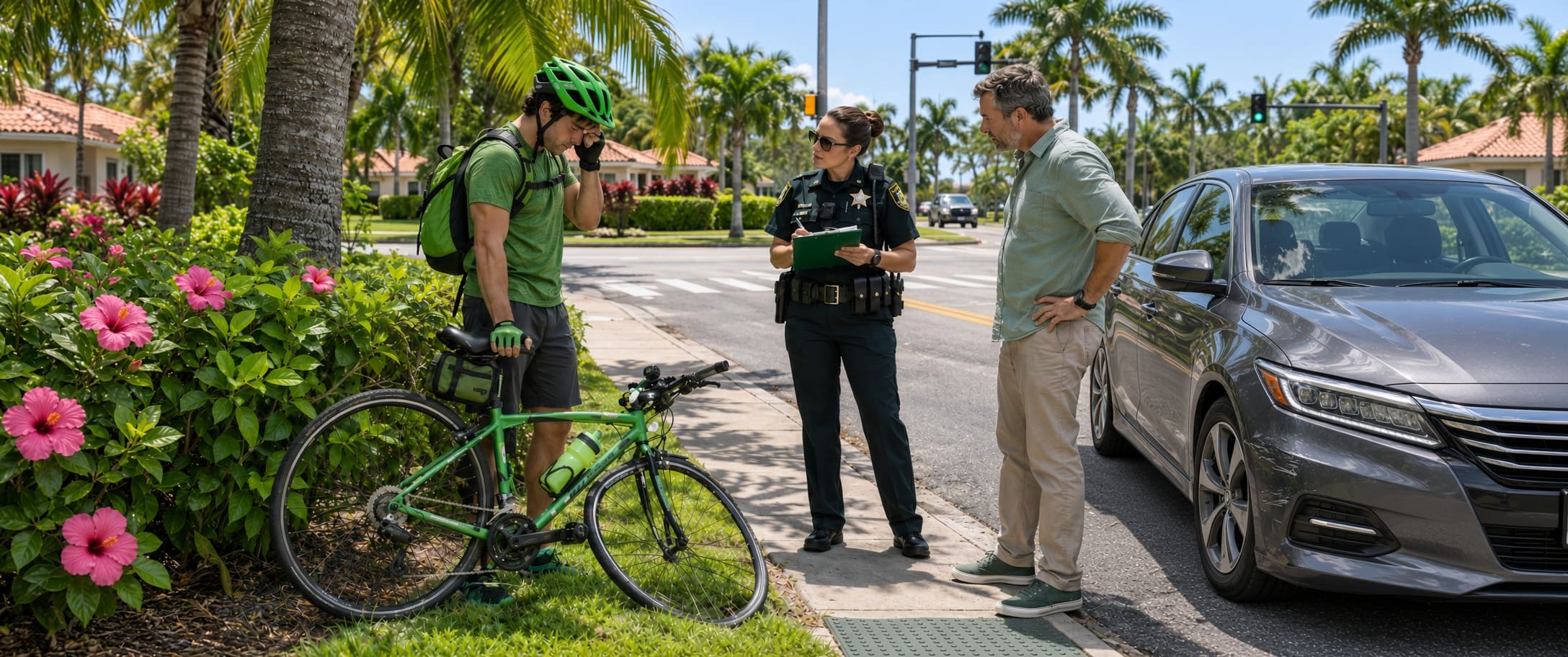
Florida bicyclist reviewing automotive insurance paperwork after a collision

What determines coverage priority under §627.736(4)(e)?

Fact to verifyWhy it matters
Vehicle ownershipOwning a motor vehicle for which Florida PIP security is required may put its insurer ahead of the striking vehicle’s insurer.
Named-insured statusThe policy and statutory insured status establish whether the cyclist has a direct PIP entitlement.
Family relationship and domicileA covered relative must meet the statute’s household and ownership conditions; a visiting relative is not automatically eligible.
Florida residencyThe striking-vehicle nonoccupant provision specifically addresses a Florida resident.
Physical contactContact with a motor vehicle is a specific statutory requirement for the cycling scenarios described in §627.736(4)(e).

A household policy should not be treated as an automatic fallback whenever someone at the address has insurance. Confirm the relative’s status and the actual insured vehicle before filing.

Four examples of which auto insurance may pay

1. Own PIP policy; bicycle struck by an SUV

Facts: A Florida driver owns a car with active PIP, but was riding a bicycle when an SUV hit them.

Coverage analysis: Start with the cyclist’s own PIP insurer under §627.736(4)(e)1. The SUV driver’s fault does not automatically change who pays first.

2. No car; lives with an insured parent

Facts: The injured rider owns no motor vehicle requiring PIP and is domiciled in a parent’s home. The parent owns a PIP-insured vehicle.

Coverage analysis: Review the parent’s policy and resident-relative eligibility under §627.736(4)(e)3. Being a visitor rather than domiciled there may change the result.

3. No own or household PIP; physical impact

Facts: The rider is a Florida resident, owns no motor vehicle requiring PIP, has no qualifying resident-relative coverage, and is hit by an insured car.

Coverage analysis: The striking vehicle owner’s PIP insurer is the potential payer under §627.736(4)(e)4, subject to statutory exclusions.

4. Near miss; the vehicles never touch

Facts: A driver cuts across a bicyclist’s path, causing a fall, but neither the car nor another motor vehicle touches the rider.

Coverage analysis: Do not assume the striking-vehicle PIP provision applies: it requires physical contact. Investigate other available coverages and liability separately.

What information should you collect for the PIP claim?

Submit the claim to the insurer identified by the coverage review and explain that you were a bicyclist injured in contact with a motor vehicle. Gather:

All relevant policy declarations, insurance ID cards, effective dates, and policyholder names.
Your residential address on the crash date, plus household relationship and domicile information where applicable.
Vehicle ownership and registration information for you and household members.
The Florida crash report, crash date, impact description, and photographs showing the vehicles and contact.
The striking vehicle’s driver, registered owner, insurer, and claim number, if available.
Medical visit dates, bills, diagnoses, referrals, and wage-loss records if claiming disability benefits.

Act promptly on treatment. Under §627.736(1)(a), qualifying initial medical services must begin within 14 days of the accident. PIP generally pays 80% of eligible medical expenses and 60% of qualifying disability loss, subject to limits and conditions; the medical reimbursement limit is $10,000 when an authorized practitioner makes a qualifying emergency medical condition (EMC) determination, while §627.736(1)(a)4 specifies a $2,500 limit when an authorized provider determines that no EMC exists. Where no EMC determination is documented, entitlement to the higher limit may be disputed; the statute and relevant medical records must be examined rather than assuming that every missing EMC form establishes the same result. See the statute.

What if an insurer denies PIP or points to another policy?

A denial from one company does not prove that another company must pay. First identify the precise reason for the decision, then check it against the applicable ownership, household, residency, and contact rules.

Request a written, itemized decision

Ask whether the insurer disputes your insured status, vehicle ownership, household domicile, Florida residency, physical contact, or the medical claim itself. For a reduced or rejected claim, §627.736(4)(b) requires an explanation of the disputed items and identifying claim information.

Submit the records that resolve that issue

Provide the relevant declarations page, registration, proof of domicile, crash report, photographs, and treatment records. A second insurer should receive the facts needed to evaluate its own obligations—not just a copy of the first insurer’s denial.

Check the payment clock and correction option

Under §627.736(4)(b), supported PIP benefits generally become overdue 30 days after written notice of the covered loss and its amount. Payment is not overdue when the insurer has reasonable proof that it is not responsible. If an item was rejected for an alleged claim error, the claimant may submit a corrected claim within 15 days after receiving the explanation, without waiving other remedies.

Do not assume that a coverage dispute pauses the separate 14‑day initial-treatment requirement or provider billing deadlines.

What if your medical provider has the wrong PIP insurer?

Give the provider the corrected insurer name and address as soon as you identify the responsible policy. Keep the original insurance details supplied, both insurers’ responses, and proof of when the correction was received.

Ordinary provider billing deadlines

For many covered services, §627.736(5)(c) requires the provider to submit charges within 35 days of the service date. If the provider sent a qualifying notice of initiation of treatment within 21 days of the first visit, eligible charges may reach back up to 75 days. Hospital emergency-department, qualifying inpatient, and ambulance services have separate rules. These are provider billing periods, not a general deadline for the bicyclist to open a claim.

Exception for incorrect insurance information

Under §627.736(5)(c)1, if the insured gave the provider the wrong PIP insurer name or address, the provider has 35 days after learning the correct details to send the charges. The submission must contain evidence of reasonable reliance on the incorrect information and either a denial from the wrong insurer or proof that the bill was timely sent to the wrong insurer or address.

Who pays when the provider misses the deadline?

Under §627.736(5)(c), the injured person is not liable for charges unpaid because the provider failed to comply with that paragraph’s billing requirements, and the provider may not bill the patient for those particular charges. This does not cancel legitimate deductibles, coinsurance, uncovered services, or other charges owed on a different legal basis.

If you receive a bill after a PIP denial

Ask for the original submission date, the insurer’s written explanation, and any corrected billing record. Preserve these documents before accepting responsibility for a bill that may have been rejected because of provider filing rules.

Attorney and injured bicyclist reviewing accident insurance paperwork and a bicycle helmet

When do bodily injury liability and UM/UIM apply?

PIP addresses specified first-party benefits without requiring proof that the driver was negligent. A separate claim against the at-fault driver’s bodily injury liability coverage can address recoverable losses beyond PIP, subject to fault, available insurance, and applicable Florida tort rules. Section 627.737 addresses limitations on tort damages in covered circumstances.

If the responsible driver has no applicable liability insurance or insufficient coverage, an available uninsured/underinsured motorist policy may need review under §627.727. UM/UIM eligibility for an injured cyclist is policy- and fact-specific; it is not an automatic extension of the striking driver’s PIP.

For broader distinctions, see the Florida car accident insurance guide and the Florida UM/UIM coverage guide.

Frequently asked questions

Does the driver who hit me always pay my bicycle accident PIP claim?

No. Your own applicable motor-vehicle PIP coverage, or qualifying coverage through a resident relative, may be responsible before the insurer of the car that struck you.

Can I receive PIP if I do not own a car?

Potentially. You may qualify through a resident-relative policy or, if the statutory conditions are satisfied, through the insurer of the motor vehicle that physically struck you.

Does my spouse’s or parent’s PIP automatically cover me?

No. The relationship, shared household domicile, motor-vehicle ownership, exclusions, and applicable insured status must be verified.

What if a car caused me to fall but did not hit me?

Physical contact is important to the PIP provisions discussed here. A no-contact event needs a separate review of potentially applicable insurance and liability claims.

Can I pursue an injury claim after PIP pays medical bills?

Yes, where the facts and Florida law support it. PIP does not necessarily resolve liability for additional losses; bodily injury liability and applicable UM/UIM coverage may need review.

The Nunez Law Firm legal team

Florida bicycle injury claims

Need help identifying the right insurer?

The Nunez Law Firm can review the accident, available insurance policies, and disputed coverage questions after a bicycle collision in Florida.

Florida statutory sources

This article provides general legal information, not a determination of coverage in any particular claim. Policy terms and accident facts matter.